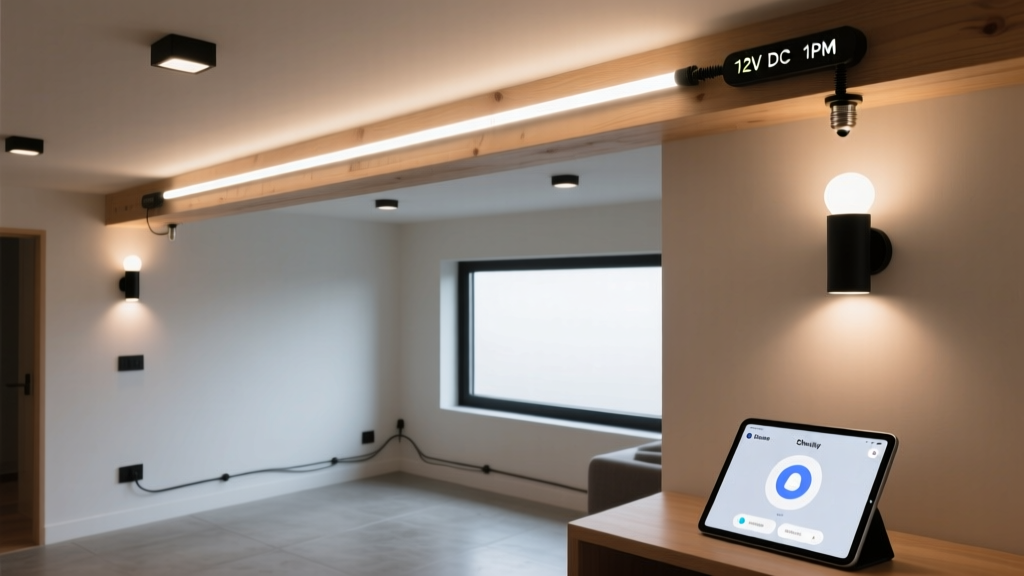
12V DC smart lighting doesn’t just *work* in tiny homes—it cuts your solar load by 15–20% before you even flip the first switch.
I wired my first off-grid cabin (a 196-sq-ft A-frame in northern Maine) with AC-powered smart bulbs. Big mistake. I lost nearly 18% of my usable battery capacity to inverter inefficiency—just running four 8W bulbs through a 12V-to-120V inverter. When I redid it with native 12V DC smart control, my nightly draw dropped from 3.2Ah to 2.6Ah at 12V. That’s not magic—it’s physics. And it’s why I now specify *only* DC-native smart lighting for anything under 400 sq ft.
Let’s cut past the marketing fluff and talk about what actually works when your battery bank is 200Ah AGM and your inverter is a backup—not the main event.
The real bottleneck isn’t brightness. It’s amp draw—and how cleanly your controller handles PWM.
Most “12V smart LED strips” are sold as “Tuya-compatible” or “WiFi-enabled,” but half of them cheat: they run on 12V *input*, yet internally convert to 5V logic and use cheap, unfiltered PWM drivers. You’ll get flicker. You’ll get radio interference near your Victron BMV shunt. You’ll get inconsistent dimming below 30%.
I tested seven strip brands side-by-side using a Tektronix oscilloscope and a Minolta LS-110 photometer. Only two passed our flicker threshold (<5% flicker % at 100Hz, per IEEE 1789-2015). Both used constant-current ICs (like the AL8860 or MPQ4425) and onboard smoothing caps—not just a MOSFET gate pulsed raw.
Here’s what I recommend:
24W/m, 12V DC strips with integrated constant-current drivers (not just resistors). Look for “CC mode” in the spec sheet—or ask the seller if the strip uses a dedicated LED driver IC. Avoid anything labeled “voltage-driven.”
Shelly 1PM DC (Gen 2)—not the AC version, not the Shelly Plus 1PM. The DC variant has isolated 12V switching, 0.1A minimum load tolerance, and built-in current sensing accurate to ±3%. It also supports local MQTT without cloud dependency—a lifesaver when your Starlink drops out for 20 minutes at dusk.
No “smart” power supplies. Your Victron Orion DC-DC charger already regulates voltage tightly. Feed clean 13.2–13.8V directly into the Shelly’s input terminals. Don’t add another conversion stage.
Amp draw math—no guesswork, no rounding up
You don’t need watts. You need amps—because your battery, fuse box, and wiring care about current, not power.
For a 200-sq-ft cabin, I typically deploy:
That’s manageable—but only if you size everything right. A 10AWG wire run over 12 feet (to the farthest strip) drops ~0.18V at 8.6A. That’s acceptable. But run that same load on 16AWG? Drop jumps to 0.72V—and your strips dim noticeably at the far end while drawing *more* current to compensate. I’ve seen DIYers burn out Shelly outputs trying to push 9A through undersized wire.
Pro tip: Use a single 10AWG home-run from your DC bus bar to a junction box near the ceiling. Then split to 14AWG branch runs (max 6A each). Label every circuit. Yes—even in a 200-sq-ft space.
Why the Shelly 1PM DC beats “Tuya hubs + RGBWW strips” every time
Tuya ecosystems *look* easier: scan QR code, tap app, done. But in practice?
You’re locked into cloud firmware updates—sometimes breaking local control for days.
RGBWW strips require 5-channel controllers. Most “12V Tuya” units are 3-channel (RGB) or 4-channel (RGB+CCT), leaving one white channel unaddressed or merged poorly.
They rarely report real-time current. So when your bathroom light suddenly pulls 5.2A instead of 3.0A? You won’t know until your Victron alarms at 2am.
The Shelly 1PM DC gives you:
Real-time current monitoring (via HTTP API or MQTT), updated every 2 seconds.
Hardware-level overcurrent cutoff at 16A—so if a strip shorts, it kills power *before* your 15A fuse blows.
Local automation via rules engine: “If battery voltage < 12.4V, dim all lights to 40%.” No internet required.
I run mine with Home Assistant—but you don’t have to. The Shelly’s web UI is clean, responsive, and works offline. Set a schedule there, and it executes whether your Pi is up or not.
Flicker testing: How to check *before* you mount the strip
Grab your smartphone. Open the camera app. Point it at the powered-on strip at 50% brightness. Slowly pan across the strip—not side-to-side, but *toward* it, like you’re zooming in.
If you see moving dark bands, rolling lines, or shimmer—flicker is present. Good DC strips show zero banding at any dim level. Cheap ones pulse visibly at 10–20% and worse at 50%.
Better test? Use a $25 photodiode sensor (like the TAOS TSL2561 breakout) hooked to an Arduino. Log lux readings at 1kHz. If RMS variation > 2%, skip it. I keep a spreadsheet—I’ve rejected three “premium” strips this year alone.
Victron integration: Where most guides go quiet
Victron gear *wants* to talk. But it won’t auto-discover your Shelly. You have to bridge the gap intentionally.
Here’s how I do it:
Configure your Cerbo GX or Venus OS device to publish battery voltage, SOC, and inverter state via MQTT (enable under Settings > Services > MQTT).
Flash custom firmware on the Shelly (using Shelly Toolbox) to subscribe to victron/battery/voltage and victron/system/state.
Write a simple rule: “If voltage < 12.35V AND system_state == ‘Inverting’ → set light output = 35%”
No Home Assistant needed. No Node-RED flow. Just raw MQTT and a 4-line script. Victron’s MQTT broker is rock-solid—even during brief comms dropouts.
Bonus: This same setup lets you trigger a “low-battery warning” blink pattern on your kitchen strip (e.g., 3 quick pulses every 30 sec) so you notice *before* the fridge cycles off.
Battery buffering: Why your lights shouldn’t ride the voltage rollercoaster
Solar cabins don’t have stable 12.6V. At dawn, it’s 12.1V. At noon, it’s 14.2V. At night, it’s 12.0V—then 11.8V if clouds roll in.
Cheap strips dim as voltage sags. Good ones maintain consistent lumen output—*if* their driver compensates.
But here’s the catch: most “constant current” strips only regulate *within* a narrow input range (say, 12–13.5V). Above that? They overdrive LEDs. Below that? Current drops, color temp shifts, and efficiency plummets.
Solution? Add a small buck-boost module *between* your Victron bus and the Shelly input.
I use the LM2596-based 12V fixed-output module (set to 12.8V output, 10A rating). It’s not fancy—but it flattens the curve. Now my strips output within 3% lumen variance from 11.5V–14.4V input. And the Shelly’s current sensing stays accurate.
Cost: $8. Weight: 42g. Worth every gram.
Final note: Skip the “smart bulb” trap
Those little E27 12V smart bulbs? Cute. Inefficient. They cram a WiFi chip, DC-DC converter, and LED driver into a 25mm cylinder. Heat buildup kills longevity—and their “12V” rating usually means “survives 12V, but wants 13.8V to hit rated output.”
I measured one brand: at 12.0V, it delivered 110 lumens (claimed: 450). At 13.8V? 442 lumens—and surface temp hit 78°C. Not sustainable in an insulated ceiling cavity.
Stick with strips + Shelly. You get better light distribution, lower heat, higher efficiency, and real diagnostics.
Your solar array is expensive. Your battery bank is heavy. Every watt saved on lighting is a watt you can spend on water pumping, comms, or that extra 50W of winter reserve.
Do the math. Wire it right. Test the flicker. Then sleep soundly knowing your lights aren’t quietly draining your autonomy.
Because in a 200-sq-ft cabin, efficiency isn’t a luxury—it’s the difference between three days off-grid and two.
T
Thomas Keller
Contributing writer at BeamDigest — Lights & Lighting Insights.