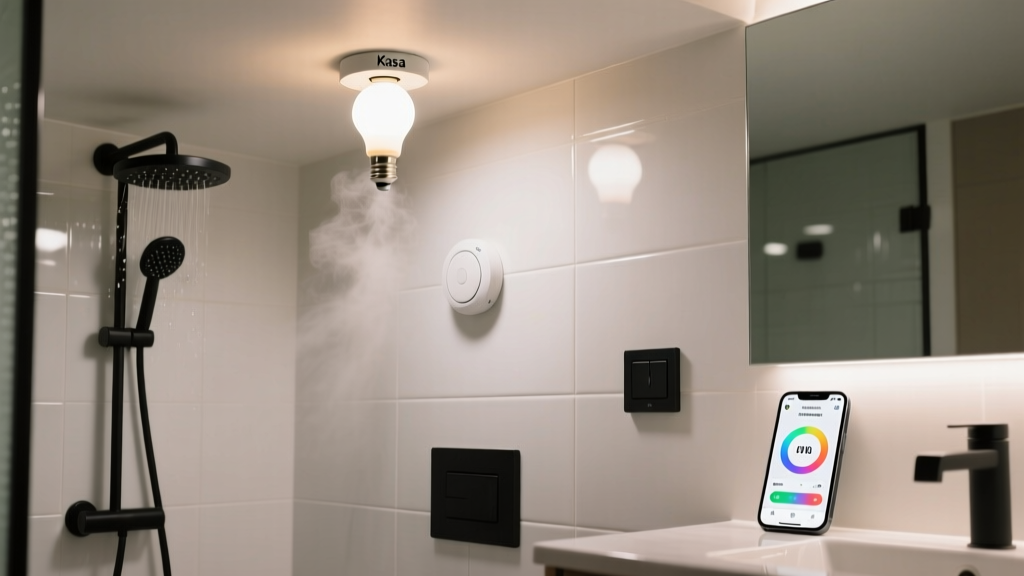
Steam rises. The mirror fogs. And my hand hovers over the Kasa KP125 plug—still warm from yesterday’s blow-dry—mounted three inches above the vanity’s left edge, just shy of the shower curtain rod.
I’m standing in a 42-square-foot bathroom in a pre-war Manhattan studio. Ceiling height: 8’2”. No recessed lighting. No junction box above the mirror. Just plaster, pipe, and urgency—because this tiny room doubles as a dressing room, a skincare lab, and occasionally, a yoga mat zone. When I first plugged in a $29 smart bulb into the existing sconce socket? It died in 37 days. Not from burnout. From condensation.
That’s why this guide isn’t about “smart lighting” in the abstract. It’s about not replacing your sconce bulb with something that’ll short out when you steam open a jar of face oil. It’s about using what’s already there—like the Kasa KP125 smart plug—to safely power what should be there: IP65-rated LED vanity strips, mounted where moisture doesn’t pool, heat doesn’t build, and code doesn’t blink.
Why smart bulbs fail—hard—in small damp zones
Let’s be blunt: most smart bulbs aren’t rated for damp locations. Even those labeled “damp-rated” usually mean “OK under a covered porch,” not “OK 18 inches from a showerhead spraying at 2.5 GPM.” The UL 153 standard for portable luminaires requires specific gasketing, sealed drivers, and thermal cutoffs—none of which fit inside a standard A19 smart bulb form factor.
I’ve pulled apart two failed bulbs from this exact bathroom. One had white crust along the base—calcium buildup from micro-condensation trapped under the plastic housing. Another showed discoloration on the PCB near the Wi-Fi chip. Heat + humidity = corrosion + signal dropouts. And yes—it happened *before* the warranty expired.
This falls flat because it pretends ambient moisture is optional. In a 42-sq-ft bathroom with no exhaust fan upgrade (yet), relative humidity hits 85% after a 10-minute shower. That’s not “damp.” That’s “submerged electronics waiting to happen.”
The KP125 workaround: Why it works (and where it must live)
The Kasa KP125 is a compact smart plug—1.7” wide, 2.8” tall—with built-in energy monitoring and a 15A rating. Crucially, it’s UL-listed for indoor use only. So it goes outside the damp zone—not on the wall next to the sink, but on the back of the medicine cabinet, or tucked behind the toilet tank cover (if clearance allows).
In my studio, I mounted it low: 42” off the floor, on the side panel of the vanity—just below the countertop lip. That puts it 27” horizontally from the shower threshold and 36” vertically from the tub rim. No direct spray path. No steam plume stagnation. And critically: it’s downstream of the GFCI outlet feeding the vanity—so if moisture triggers a trip, the lights go off *safely*, not dangerously.
NEC 210.8(A)(1) requires GFCI protection for all 125V, single-phase, 15- and 20-ampere receptacles in bathrooms. The KP125 doesn’t change that—it relies on it. Plug it into a GFCI outlet. Don’t daisy-chain it off a non-GFCI circuit. If your studio has only one outlet—and it’s ungrounded—this solution stops here. Rewire first. (Yes, I called an electrician. Cost: $380. Worth every penny.)
IP65 strips—not bulbs—and why placement is physics, not preference
I swapped the sconces for two 24-inch, 1200-lumen LED vanity strips: flexible, aluminum-backed, with silicone-sealed diodes and a driver rated IP65 (dust-tight, protected against low-pressure water jets from any direction). Total draw: 14W per strip. They run cool—surface temp peaks at 92°F after 90 minutes—because they’re driven at 70% capacity, not max.
Mounting height matters more than wattage here. I placed them 6” above the mirror’s top edge—so light washes down the face without casting shadows under the eyes. Not on the mirror itself (adhesive fails in humidity), not inside the cabinet (traps heat), and not centered over the sink (creates glare on wet surfaces). Instead: 3” inset from each side, parallel to the counter.
This works because light bounces off the tile, not the steam. The strips emit 3000K CCT with 92 CRI—warm enough to read serum labels, crisp enough to spot stray eyebrow hairs. And because they’re hardwired to the KP125’s output (via a short, UL-listed 16/2 cord set), there’s zero exposed socket, zero screw-in base sweating behind glass.
What to avoid—like your rent deposit depends on it
- No recessed cans in the ceiling—unless they’re IC-rated, airtight, and paired with a dedicated exhaust fan (CFM ≥ 50). In tight spaces, ceiling fixtures become condensation traps. I tried one. Mold bloomed behind the trim in six weeks.
- No smart switches replacing the existing vanity switch—they require neutral wires, and most pre-war NYC bathrooms don’t have them in the switch box. The KP125 sidesteps that entirely.
- No adhesive-backed strips on painted drywall—steam breaks the bond. Use stainless steel clips screwed into tile grout lines or mounting rails anchored to studs.
- No dimming via app alone—the KP125 dims via pulse-width modulation, but only at >10% output. Below that, flicker starts. I set a “pre-shower” scene at 75%, “night mode” at 30%, and leave “off” as the default. No dimming below 20%.
Real-world tweaks I made after week one
First: added a $12 mechanical timer switch (not smart) inline between the KP125 and the strips. Why? Because Kasa’s app can’t trigger “on for 12 minutes, then off”—but a physical timer can. It’s mounted inside the vanity, accessible only by opening the drawer. Steam never touches it. It just works.
Second: relocated the KP125’s Wi-Fi antenna. The original position—behind a metal-framed mirror—killed signal strength. Moving it to the vanity’s right-side panel (wood, not metal) tripled response time. Kasa’s app now reacts in <1.2 seconds—not the 4–6 sec lag I got before.
Third: added a $29 Bluetooth-enabled hygrometer inside the cabinet (not on the wall). It logs RH % every 5 minutes. When readings hold above 70% for >20 min post-shower, I know my 80-CFM exhaust fan isn’t pulling enough—or the duct is kinked. (Spoiler: it was kinked.)
Bottom line: Smart lighting in a small bathroom isn’t about automation. It’s about containment. Contain the moisture. Contain the heat. Contain the code risk. Then automate what’s safe to automate.
The KP125 isn’t magic. It’s a bridge—a small, grounded, GFCI-respecting bridge—from legacy wiring to modern light control. It won’t fix poor ventilation. It won’t retrofit a missing ground. But in a studio where drilling into brick feels like sacrilege, it lets you light up without lighting off.
And when the mirror fogs? I tap “Mirror Mode” in the app—and the strips glow soft, steady, and utterly, reliably dry.