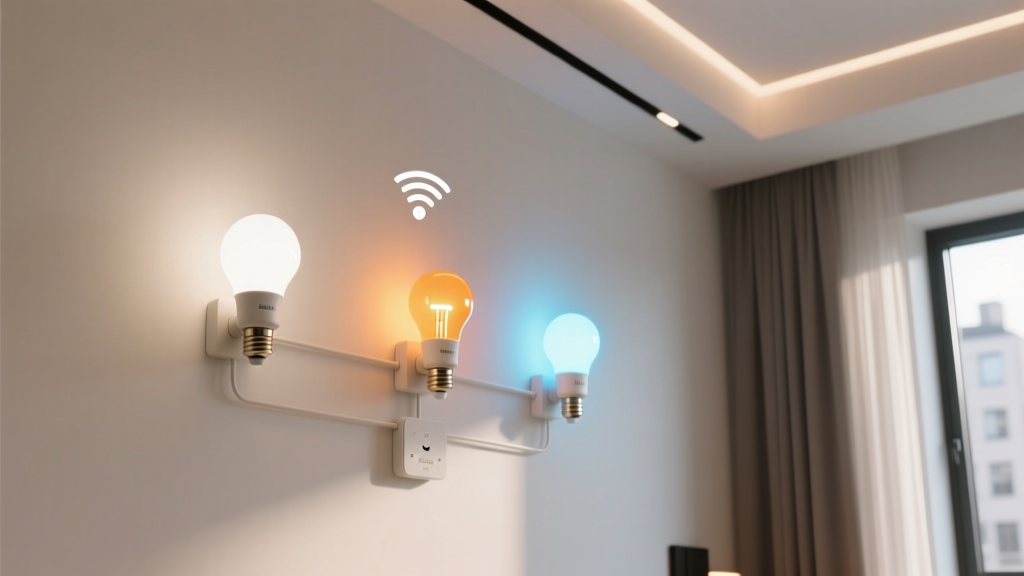
Smart Lighting for Renters: Like a Temporary Tattoo, But for Your Ceiling
Think of smart lighting for renters like that limited-edition band tee you love but wouldn’t iron-on permanently. You want the vibe, the control, the “oh wow” factor—without violating your lease, voiding your security deposit, or needing a drill bit named Steve.
I’ve installed (and uninstalled) more smart lights in rental units than I care to admit—mostly in college apartments where the landlord’s idea of “renovations” was repainting the same beige twice and calling it “fresh.” So when I say “lease-friendly,” I mean: no holes, no wires snaking across baseboards, no sticky residue left behind, and zero guilt when you pack up your mismatched IKEA furniture at 3 a.m. on moving day.
Why “Outlet-Only” Is Your New Mantra
Your apartment probably has exactly two power sources: outlets and ceiling fixtures wired into the wall (which you can’t touch without risking a very awkward conversation with your landlord). That means hardwired switches? Off-limits. Rewiring? Absolutely not. But here’s the good news: modern smart lighting doesn’t need to be hardwired to be powerful.
Most renter-safe setups plug in—or screw in—and talk to Wi-Fi just fine. No hub required (unless you want one), no electrician needed, and no “permission slip” beyond “yes, you may use the outlet near the bed.”
The 5 Setups That Actually Work (and Don’t Look Like a Dorm Room Gone Rogue)
1. The “I Just Want Better Bedside Light” Setup — $39
- What: Two TP-Link Kasa KL125 smart bulbs (A19, 800 lumens each, tunable white)
- Where: Standard lamp + matching floor lamp in a 10’ x 12’ bedroom reading nook
- Why it works: These bulbs screw in like any other, don’t need a hub, pair fast via app, and dim smoothly—even at 1%. I’ve used them with cheap Target lamps, and they handle the “warm-to-cool-white” shift like a barista pulling espresso shots. Bonus: voice control via Alexa/Google works instantly, no lag.
- Renter reality check: When you move out? Unscrew, toss back in original packaging, and leave zero trace. Bulbs retain settings until powered off for >10 seconds—so unplugging the lamp overnight won’t reset them.
2. The “Closet That Doesn’t Feel Like a Cave” Accent — $42
- What: Nanoleaf Essentials Starter Kit (2x 12W smart bulbs + 1x Smart Plug)
- Where: Inside a shallow 36”-wide reach-in closet with no overhead light (just a single outlet near the door jamb)
- Why it works: Screw one bulb into a battery-powered LED puck light fixture (yes, those exist—$12 on Amazon), then plug that fixture into the Nanoleaf Smart Plug. Use the second bulb in a small sconce mounted *with removable adhesive hooks* (not screws!). This gives you motion-triggered, warm-white-only light that turns on when you open the closet door and fades off after 30 seconds. It’s subtle, functional, and feels luxe—not jury-rigged.
- Renter reality check: The Smart Plug is key: it lets you control non-smart lights too. And Nanoleaf bulbs don’t require a hub—unlike their canvas panels (which, yes, are gorgeous—but require double-sided tape that *can* lift paint if removed poorly).
3. The “Under-Cabinet Kitchen Glow” — $37
- What: Govee H6159 32” RGBIC light bar (with 3M Command Strips, not glue)
- Where: Under upper cabinets in a galley kitchen (8’ long, 14” deep cabinets)
- Why it works: This bar runs on USB-C (included adapter plugs into outlet), sticks *only* with removable 3M strips (not permanent adhesive), and offers true RGBIC—meaning smooth color blending, not just static zones. I set mine to soft amber (2700K) at 30% brightness for meal prep, and it casts zero glare on countertops. At full brightness? 600 lumens—enough to read a recipe, not enough to blind your roommate at midnight.
- Renter reality check: Remove strips by warming gently with a hairdryer, then peeling slowly from one corner. No residue. No paint lift. If your cabinets are laminate (most rentals are), this is safer than tape-based alternatives.
4. The “Ceiling Fan That Pretends It’s Smart” Hack — $28
- What: Lutron Caseta PD-6ANS-WH Smart Dimmer Switch (battery-powered version) + compatible smart bulb
- Where: A 12’ x 14’ living room with a basic ceiling fan/light combo—no neutral wire, no smart switch access
- Why it works: Here’s the loophole: most rental ceiling fans have a pull-chain light *and* a wall switch that only controls the fan motor. So you leave the wall switch ON (fan only), then install a smart bulb in the light kit. Then add the battery-powered Lutron switch *over* the existing wall plate—it doesn’t replace wiring; it just sits on top and talks to the bulb via its own radio protocol. You get physical dimming + app control + schedules—all without touching a wire.
- Renter reality check: This switch leaves no marks, no screws, no drilling. It mounts with adhesive tape included—and comes off cleanly. Yes, it’s pricier per unit than bulbs alone, but it solves the “I hate pull chains” problem better than any voice command ever could.
5. The “Nightlight That Doesn’t Scream ‘I’m 12’” — $24
- What: Philips Hue Play Light Bar (gen 3, 24” version) + Philips Hue Tap Switch (battery-powered)
- Where: Behind a low-profile TV stand in a studio apartment (8’ x 10’ main space)
- Why it works: The Hue Play bar is thin, low-profile, and plugs into a nearby outlet via its included AC adapter. Mount it with 3M picture-hanging strips (the kind rated for 5 lbs—this bar weighs 1.2 lbs). Pair it with the Tap Switch (a tiny, tactile, wireless button you stick *anywhere* with removable adhesive). One tap = soft white glow; two taps = “movie mode” (deep amber, 15% brightness); three taps = off. No app needed after setup. And unlike cheaper LED strips, it doesn’t flicker or buzz at low brightness.
- Renter reality check: Hue gear holds value. Sell the Tap and bar on Facebook Marketplace post-move—you’ll recoup ~70%. Also: Hue bulbs *do* need a bridge, but the Play bar doesn’t. So you avoid that $60 hub unless you go all-in later.
Landlord-Friendly Removal: The 3-Minute Exit Checklist
You’re not just installing smart lights—you’re curating evidence that you’re a responsible tenant. Here’s how to vanish without a trace:
- Unplug everything. Seriously. Don’t just turn off at the app. Unplug adapters, pull bulbs, detach strips.
- Clean adhesive residue with rubbing alcohol + microfiber cloth. Not vinegar. Not Windex. Rubbing alcohol breaks down acrylic adhesives without harming paint or laminate.
- Test every surface before handing keys back. Run your fingernail along taped edges—if it catches, re-clean. If it glides? You’re golden.
- Leave bulbs in original boxes, plugs in bags. Landlords notice effort. It signals “I didn’t trash your place—I upgraded it quietly.”
Look: smart lighting for renters isn’t about replicating a smart home showroom. It’s about solving real problems—bad closet lighting, harsh under-cabinet glare, fumbling for switches in the dark—with tools that respect your lease, your budget, and your dignity.
And if your landlord walks in, sees your Govee bar glowing softly under the cabinets, and says, “Hey… how’d you do that?”—just smile and say, “It’s removable. Want the link?”