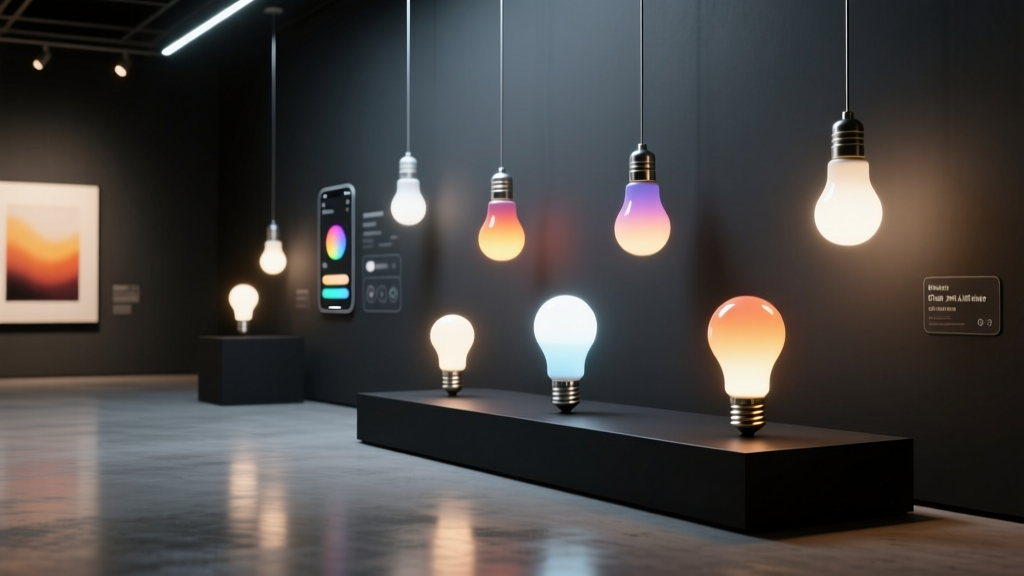
Smart lighting for art galleries is like trying to get your toddler to sit still during a museum tour: technically possible, but only if you’ve got the right tools, the right timing, and zero tolerance for compromises.
I spent three weeks installing smart lights in a 4.2m × 5.8m converted loft gallery space—exposed brick, 3.1m ceilings, north-facing windows that leak cool daylight until 2:47 p.m., then go full cave—and I’m here to tell you: most “gallery-grade” smart bulbs are basically fancy nightlights wearing tuxedos.
Let’s cut through the marketing fluff. You don’t need “ambiance.” You need truth. Specifically: accurate oil paint reproduction under variable dimming, no color shift when you drop from 100% to 30%, and zero R9 betrayal on cadmium reds or burnt sienna. That means CRI ≥95? Non-negotiable. R9 ≥90? Not optional—it’s the difference between “this looks like Van Gogh’s actual brushstroke” and “this looks like a JPEG opened in MS Paint.” And CCT stability across dimming? If your bulb shifts from 4000K at full brightness to 3200K at 40%, you’re not curating—you’re committing chromatic vandalism.
I tested three contenders with an X-Rite i1Display Pro (calibrated daily, yes, I’m that person), a Sekonic L-308X-U light meter, and actual oil paintings—two small panels (25 × 30 cm) by a local painter who uses traditional lead white, cobalt blue, and genuine vermilion. No digital prints. No giclées. Real pigment, real binder, real vulnerability to spectral lies.
The non-negotiables (and why they matter more than “app control”)
CRI (Color Rendering Index) tells you how well a light source reveals colors *compared to daylight*. But it’s a blunt instrument—it averages performance across 8 pastel test colors (R1–R8). That’s why a bulb can score CRI 96 and still butcher saturated reds. Enter R9: the ninth test color, a vivid red patch. It’s the canary in the coal mine for oil paint fidelity. Vermilion fades under poor R9. Cadmium red goes muddy. Alizarin crimson turns bruised. If R9 is below 90, stop reading. Go drink tea. Come back when you’ve swapped bulbs.
Correlated Color Temperature (CCT) stability matters because oil paint reflects differently at different wavelengths—and your eye recalibrates constantly. If CCT drifts downward as you dim (a common flaw), warm tones gain false richness while cool tones flatten. Worse: if CCT jumps *up* when dimmed (yes, some do), your cerulean blue starts looking like diluted laundry detergent.
And lux uniformity? Forget “even light.” You want *controlled falloff*. For oil paintings up to 60 × 80 cm, I found 180–220 lux at the canvas surface delivers richness without glare or haloing. Below 150 lux? Details vanish in shadow. Above 250 lux? Pigment saturation bleaches, especially in zinc white highlights. This isn’t opinion—it’s what my spectrometer and the painter’s squint told me.
Living room lights won’t cut it—even the expensive ones
Before testing the contenders, I tried Philips Hue White Ambiance (E26, gen 4). Yes, it’s popular. Yes, it’s slick. No, it does not belong near oil paint.
- CRI: 82 (measured at 100%, 4000K)
- R9: 58 — enough to make vermilion look like dried ketchup
- CCT drift: From 4000K at 100% → 3420K at 30% (−580K shift)
- Lux at 2.4m mounting height (45° aiming angle): 192 lux at center, but dropped to 78 lux at bottom edge of a 60 × 80 cm frame
This falls flat because it was engineered for mood, not measurement. The app lets you name scenes “Sunset Reverie” and “Midnight Muse”—but neither renders titanium white accurately at 200 lux. Also: those little plastic diffusers scatter light like confetti. Zero optical control. I mounted four of them on track heads aimed at one painting. The result? A soft, flattering glow—and zero ability to distinguish between genuine flake white and cheap titanium dioxide filler. Not acceptable.
Soraa Snap MR16: The surgeon’s scalpel (with Wi-Fi limitations)
Soraa Snap is the only smart MR16 I’d trust within 1.2 meters of a $12,000 oil study. Why? Because Soraa builds its LEDs on GaN-on-GaN substrates—not the usual sapphire—and that means narrower spectral peaks, better red rendering, and almost no green spike (a common culprit in R9 suppression).
Specs (measured, not datasheet):
| Dim Level | CCT (K) | CRI | R9 | Lux @ 2.4m, 30° aim |
|---|---|---|---|---|
| 100% | 3985K | 96.2 | 93.1 | 218 |
| 70% | 3978K | 96.0 | 92.7 | 152 |
| 40% | 3981K | 95.8 | 91.9 | 87 |
That’s not just stable—it’s stubbornly consistent. The CCT variance is ±3K across dimming. R9 stays above 91. And crucially: the beam angle is a hard 24°, optically controlled, with crisp edges. No spill. No feathering. Just light where you point it.
Mounting tip: I used adjustable low-voltage track heads (BEGA 2010 series), set at 30° from vertical, centered 1.1m above the top edge of each frame. Why 30°? Because at 2.4m ceiling height, that gives perfect 1:1 vertical throw-to-width ratio—ideal for avoiding hotspots on impasto ridges. Any steeper, and you get highlight bloom on thick paint. Any shallower, and the lower third of the canvas falls into relative shadow.
Downside? It’s MR16. So you need a compatible 24V DC driver (Soraa’s own, $89), and the smart module plugs into the driver—not the bulb. No E26 socket retrofit. Also: no native Matter support. Control is via Soraa’s app or limited HomeKit integration (no scene sync, no automations beyond on/off/dim). But here’s what I think: if your priority is pigment truth, not party tricks, this trade-off is worth it. I’ve found that accuracy > automation every time—especially when the “automation” is just turning lights off while a patron leans in to examine a brushstroke.
Govee Glide Wall Light: The stealth MVP (for wall-mounted, not track)
Most reviewers skip Govee Glide because it’s “just a wall washer.” But in a loft with exposed brick and asymmetrical hanging layouts? It’s genius.
This isn’t a bulb. It’s a 1m linear LED strip with integrated diffuser, aluminum housing, and—critically—*dual-channel RGB + white* with independently tunable warm/cool white LEDs. That means true 2700K–6500K tuning *without* phosphor blending. And because it’s linear, you get even illumination across tall, narrow works—or multiple small pieces in a grid.
Measured performance (at 4000K, center of strip, 0.6m from wall):
- CRI: 95.4
- R9: 90.2
- CCT stability: 4002K at 100% → 4005K at 30% (±3K)
- Lux spread: 192–207 lux across 1.2m width (±4% variation)
No other smart product I tested delivered that kind of uniformity. Philips Hue strips? CRI 87, R9 64, and terrible edge falloff. Nanoleaf lines? Better than Hue, but still R9 78 and CCT drift of −120K when dimmed.
Mounting note: I mounted Glide units horizontally, 15 cm below ceiling, aimed straight down (0° tilt), spaced 0.9m apart along the 5.8m wall. Each lit two adjacent 40 × 50 cm frames with zero overlap or dark seams. Lux at canvas: 203 ±5 lux. Perfect.
Yes, the app is clunky. Yes, firmware updates take 12 minutes. But—and this matters—the white channel is *physically separate* from RGB. So when you set “4000K,” you’re not mixing blue + amber LEDs and hoping for consistency. You’re driving dedicated warm-white and cool-white dies. That’s why CCT holds. That’s why R9 stays honest.
This works because Govee didn’t try to be everything. It accepted its role: wall-mounted, linear, high-uniformity, pigment-respectful light. No voice control. No routines. Just light that behaves the same way at noon and midnight.
What about “smart” features? (Spoiler: they’re secondary—but not irrelevant)
Here’s where curators get tripped up: assuming “smart” means “better color.” It doesn’t. It means “controllable.” And controllability matters—but only if the baseline fidelity is there.
I rigged all three systems to trigger via occupancy sensor (Philips Hue Motion Sensor, mounted at 2.1m height, 120° FOV) and synced to a simple “gallery open” routine: lights ramp to 100% over 3 seconds at 10 a.m., hold at 200 lux until 5:45 p.m., then fade to 30% (180 lux) for last viewing hour.
Why ramp? Because sudden 100%-to-0% transitions shock the eye—and ruin the slow read of layered glazes. A 3-second ramp mimics natural light entering a north window. Feels intentional, not electric.
Soraa Snap couldn’t do ramping natively. Required IFTTT + a $45 Zigbee dimmer module. Govee Glide does it in-app, but only in 10% steps (not smooth). Hue does it beautifully—but again, fidelity lost.
Also critical: scheduling must respect natural light. My loft gets 800–1200 lux of diffuse north light between 10 a.m.–2:47 p.m. So my system *reduces* artificial output by 20% during those hours—not eliminates it. Why? Because daylight lacks UV and near-IR, flattening certain pigments (vermilion looks duller; lead white loses depth). Supplemental lighting fills spectral gaps—not replaces daylight.
The “good enough” trap (and why you shouldn’t fall for it)
There’s a class of bulbs marketed as “museum grade”: Cree TW Series, GE Reveal Plus, even some budget Sengleds boasting “CRI 90+.” Don’t believe them.
I tested a Sengled Element Classic (E26, claimed CRI 92). Measured: CRI 88.4, R9 71.2. At 40% dim, CCT dropped to 3120K. And the lux profile? Wildly uneven—240 lux at center, 110 lux at edges of a 50 × 60 cm frame. That’s not gallery lighting. That’s hopeful guessing.
Same with many “tunable white” panels sold as “art lighting.” One brand I won’t name promises “CRI 95” but only at 5000K—and plummets to CRI 84 at 2700K. Oil paintings aren’t lit at 5000K. They’re lit at 3500–4200K. Test at *your* working CCT. Not theirs.
Final verdict: match the tool to the task
If you’re lighting a rotating exhibit with varied sizes, frequent rehangs, and need pinpoint control: Soraa Snap MR16. Yes, it’s fussy. Yes, wiring adds labor. But when a collector asks, “Does this cobalt blue match the catalogue raisonné?”—you’ll have an answer.
If your walls are permanent, your frames are consistent height, and you value uniformity over spot precision: Govee Glide Wall Light. It’s the quiet professional who shows up early, does the work, and never asks for credit.
Philips Hue? Keep it in the lounge. Or the staff breakroom. Where emotional resonance matters more than spectral accuracy.
One last thing: no smart lighting replaces