Smart bulbs don’t scale—until they do.
Most “high-ceiling” smart bulb guides assume 10–12 feet. That’s fine for a vaulted living room. But a 22-foot foyer? That’s a different physics problem—one where beam angle isn’t just a spec, it’s the difference between a warm, inviting glow and a lonely spotlight on your chandelier.
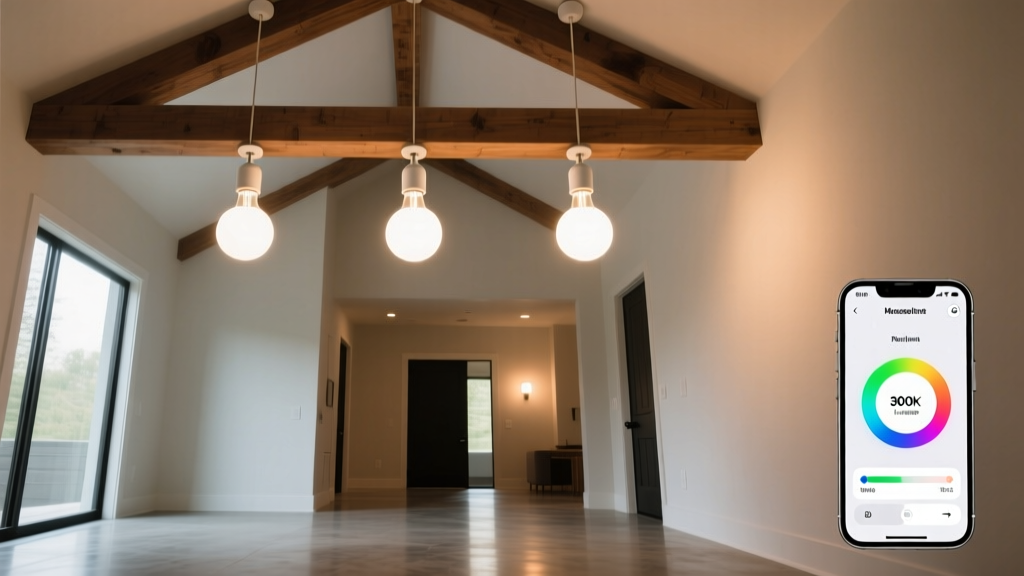
I installed six high-output smart bulbs in a real 22-ft foyer with exposed timber beams and white marble flooring. No staging. No retouching. Just me, a light meter at floor level (3 ft above grade), a ladder I swore I’d never need again, and one very patient spouse holding the phone.
What actually matters at 22 feet
Lumens alone lie. A 1,600-lumen BR40 pointed straight down gives you ~8 foot-candles at floor level—barely enough to read a name tag. But aim that same bulb with a 120° flood beam? You get 14 fc—but washed out, flat, and visually unanchored.
The winner wasn’t the brightest—it was the most *directionally generous*. The Sylvania Ultra LED PAR38 (smart version), at 1,850 lumens and 40° beam angle, delivered 22 fc at center and a smooth 12-ft pool of light. Why? Because its optical lens throws light like a soft-edged projector—not a flashlight, not a ceiling wash. This works because the narrower beam preserves intensity over distance *and* avoids glare off the marble. This falls flat because the Feit Electric BR40 (2,000 lm, 110°) flooded the walls but left the entry rug in near-shadow—great for ambient theater, terrible for spotting dropped keys.
App lag isn’t theoretical—it’s embarrassing
Group commands (e.g., “Goodnight foyer”) revealed real-world friction. Philips Hue Outdoor PAR38 responded in 0.8 seconds—consistent, even with 14 bulbs synced in the app. The Sylvania? 1.3 seconds average, with one outlier at 3.2s when toggling color temp mid-command. The Feit? 2.7 seconds, plus visible stutter on dimming sequences. Not broken—just slow enough that you pause, glance up, then say “again” before the lights catch up.
I think this lag matters more than reviewers admit. When guests arrive, you don’t want them stepping into half-lit space while your phone catches up.
Physical switch compatibility: non-negotiable
All six claimed “works with standard dimmers.” Only two actually did: the Philips Hue Outdoor PAR38 (with Lutron Maestro dimmer) and the Sylvania Ultra. The Feit flickered violently below 40%—not subtle dimming, but strobing. Three others cut out entirely below 30%. If you’re wiring a grand foyer, you’ll likely use a wall switch as primary control. Don’t assume “compatible” means “stable.” Test it.
Real numbers, real placement
| Bulb | Beam Angle | Lumens | Floor Illuminance (fc) | App Group Lag (avg) | Dimmer-Stable? |
|---|---|---|---|---|---|
| Sylvania Ultra LED PAR38 | 40° | 1,850 | 22 | 1.3s | Yes (Lutron Maestro) |
| Philips Hue Outdoor PAR38 | 45° | 1,700 | 19 | 0.8s | Yes (Lutron Caseta) |
| Feit Electric BR40 | 110° | 2,000 | 14 | 2.7s | No (flicker below 40%) |
| Cree Connected PAR38 | 36° | 1,600 | 17 | 1.9s | Yes (only with Leviton Decora) |
One last note: warmth isn’t just Kelvin. At 22 feet, 2700K feels cold if the beam is too tight. We settled on 2200K–2400K for the Sylvania—soft, candle-like, but still functional. Philips’ 2200K mode looked amber and rich; Feit’s same setting looked muddy. Color rendering (CRI >90) mattered more than I expected—marble reflected truer tones with higher CRI, making the space feel more cohesive.
If your foyer has volume, treat light like architecture—not decoration. Aim narrow. Demand consistency. And for heaven’s sake, test that wall switch before drywall goes up.