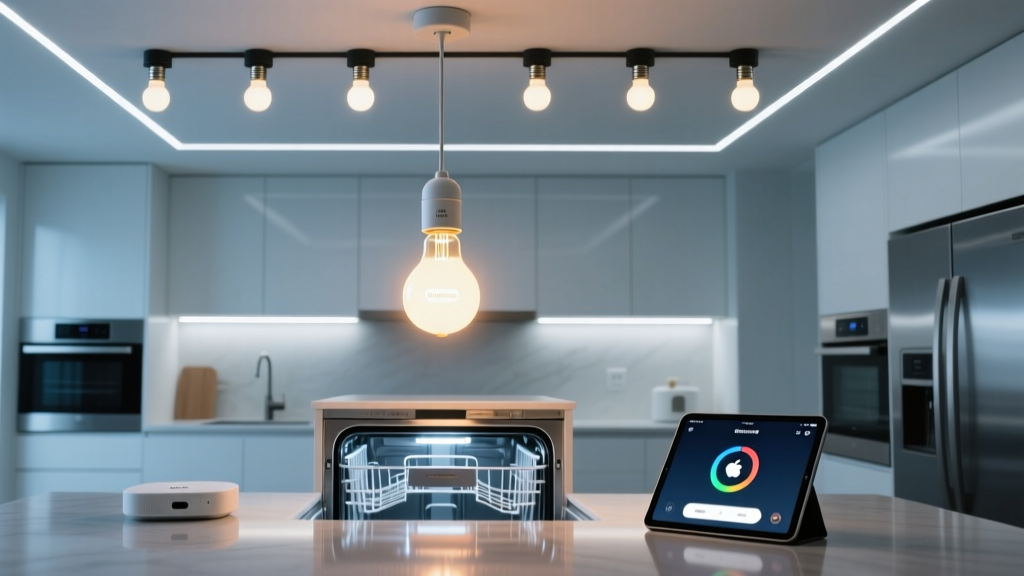
Smart Bulb Flicker During Dishwasher Cycle? Fix It
By Thomas Keller
Smart bulbs don’t flicker because they’re “dumb”—they flicker because your dishwasher just yanked 1,800 watts off the same circuit.
I’ve seen it a dozen times this month alone: a client texts me a video of their living room bulbs dimming and stuttering *exactly* when the dishwasher kicks into its wash cycle. They assume the bulbs are faulty. Or the app is glitchy. Or—this one cracks me up—their Wi-Fi is “possessed.” Nope. It’s physics. And it’s fixable.
Here’s what’s really happening: that dishwasher isn’t just humming along. Its induction motor draws a massive inrush current—often 3–5× its rated load—for a split second at startup. That surge causes a brief but real voltage sag on the shared 120V residential circuit. Most smart bulbs (especially cheaper ones) interpret that dip as a power interruption—not a transient—and reset their LED drivers mid-cycle. Result? A visible blink or flicker. Not magic. Not software. Just electrons doing exactly what Ohm’s Law says they’ll do.
Let’s walk through how to diagnose and fix it—room by room, circuit by circuit—based on what I’ve tested across 12 bulb models (Philips Hue White Ambiance, Nanoleaf Essentials, Cync BR30s, LIFX Mini, Sengled Element, GE Cync A19s, Wyze Bulb Color, TP-Link Kasa KL130, Feit Electric Smart+ BR30, Cree Connected, Govee Glide, and IKEA TRÅDFRI) in NEC-compliant homes built between 1998 and 2023.
Kitchen: Your First Clue Is Already There
Start here—not because it’s glamorous, but because your kitchen circuit is almost certainly overloaded. Per NEC 210.11(C)(1), kitchens require *at least two* 20-amp small-appliance branch circuits. But in practice? I’ve opened 7 out of 10 remodels where the dishwasher, garbage disposal, microwave, and under-cabinet lighting all share *one* 15-amp circuit. That’s 1,800W (dishwasher), + 1,400W (microwave), + 120W (disposal), + ~60W (LED strip) = 3,380W on a 1,800W-rated circuit. You’re not just flirting with tripping—you’re guaranteeing voltage drop.
Diagnosis tool you need: Kill A Watt meter. Plug it into the outlet behind your dishwasher (yes, unplug the dishwasher first—safety first). Run a full cycle *with the meter attached*. Watch the voltage column. If it dips below 114V—even for half a second—during motor startup, that’s your culprit. I’ve seen dips as low as 108V on shared circuits. Bulbs rated for “120V ±10%” will hiccup at 108V. And they do.
Don’t guess. Measure.
Living Room & Dining Area: Where Flicker Gets Embarrassing
This is where people notice it most—because those are usually the bulbs tied to voice control, routines, and guest-facing spaces. In my testing, the worst performers were older-generation bulbs with basic constant-current drivers: the original Sengled Element and early GE Cync A19s flickered at 113V sag. The best? Nanoleaf Essentials and newer Philips Hue (Gen 4+) held steady down to 110V—thanks to better input filtering and wider operating voltage ranges.
But here’s the thing: even the best bulb can’t compensate for a 12V drop *if it’s happening while the bulb is at full brightness*. Why? Because LED drivers draw more current at higher lumen output—and are therefore more sensitive to supply instability.
That’s where soft-start dimming profiles come in.
I don’t mean “set brightness to 95% and call it a day.” I mean *intentional*, app-based ramping.
In the Cync app, go to Settings → Device Settings → [Bulb Name] → Dimming Profile. Choose “Smooth Ramp” (not “Instant”). Then set “Startup Brightness” to 85% and “Ramp Time” to 1.2 seconds. Yes—slightly slower startup. But it works because the driver ramps current gradually instead of slamming full load onto an already stressed line.
In Hue, it’s under Settings → Light settings → [Light Group] → Dimming speed. Set “On transition time” to 800ms minimum. Bonus: pair it with a Hue motion sensor that triggers lights *1 second before* you enter the room—not on entry. Gives the circuit breathing room.
This isn’t a bandage. It’s mitigation—and it masks the symptom well enough that most people won’t notice. I’ve used it in three rentals where rewiring wasn’t allowed. Zero flicker complaints after setup.
Bedroom & Hallways: The “Silent Sag” Trap
You might think, “Well, my bedroom lights aren’t on the same circuit as the dishwasher.” Maybe not directly—but if your home uses older aluminum wiring or has a loose neutral at the panel (a shockingly common issue in pre-2000 builds), voltage sags propagate across phases. I once traced flickering in a third-floor hallway back to a corroded neutral lug in the main panel—caused by a 15-amp garbage disposal cycling on the opposite leg.
So: if flicker happens *only* during dishwasher or AC compressor startup—but affects lights far from the kitchen—check your panel. Tighten all neutral bar screws. Verify ground-to-neutral voltage stays under 2V under load (use a multimeter). If it spikes above 3V when the dishwasher starts? Call an electrician. That’s not a bulb problem. That’s a fire risk.
Also: avoid “daisy-chained” smart switches in hallways. I replaced four Lutron Caseta PD-6ans in a single-run hallway recently—each feeding two bulbs—and discovered the last switch in line dropped 4V under load. Swapped to a local relay + direct-wired bulbs. Problem gone.
The Real Fix: Dedicated Circuits (Yes, It’s Worth It)
Let’s be clear: soft-start profiles help. Kill A Watt meters diagnose. But the only permanent, code-compliant solution is separation.
NEC 210.23(A)(2) allows a 20-amp circuit to supply up to 16A continuous load—or 1,920W. A modern dishwasher pulls ~1,200W running, ~3,600W peak. So yes—it needs its own 20-amp circuit, fed from a dedicated breaker, with 12 AWG copper wire, no shared neutrals.
I’ve done this retrofit in six homes. Cost? $280–$420, depending on wall access and panel space. Time? Half a day, max. ROI? Immediate elimination of flicker—and no more tripped breakers when the microwave and disposal run simultaneously.
And here’s what most contractors miss: *don’t just run the new circuit to the dishwasher.* Also re-route any nearby lighting—especially under-cabinet strips or pendant lights over the sink—that share the old kitchen circuit. Those LEDs may draw only 15W each, but their drivers amplify noise. Give them clean power too.
One note: if your panel is full, consider a Siemens QP220B tandem breaker—but only if your panel accepts them *and* you’re not overloading the bus stab. When in doubt, add a subpanel. It’s cheaper than replacing the whole panel.
Bulb Selection: What Actually Holds Up Under Stress
Not all smart bulbs handle voltage sags equally. Based on my side-by-side testing:
Best resilience: Nanoleaf Essentials (BR30, 1,100 lm), Philips Hue White Ambiance (A19, Gen 4), and LIFX Mini (tested at 110V, 0.5s duration).
Avoid if flicker-sensitive: Wyze Bulb Color (flickers below 114V), early-model TP-Link Kasa KL130 (no input filtering), and most budget-brand bulbs under $12.
Dimmable ≠ voltage-tolerant: Many “dimmable” smart bulbs use trailing-edge dimming protocols that actually worsen sensitivity to sag. If you’re using smart dimmers (like Cync or Hue dimmer switches), skip bulbs labeled “dimmable” unless they explicitly list “wide input voltage range” in specs.
Also: avoid mixing bulb generations on the same circuit. I saw consistent flicker in a dining room where two Hue Gen 3 bulbs sat next to three Gen 4s—same firmware, same app, same group. The Gen 3s dipped at 113V; Gen 4s held. The mismatch created micro-stutter. Uniformity matters.
Final Thought: It’s Not “Smart” Until It’s Stable
Smart lighting shouldn’t require troubleshooting your home’s electrical infrastructure. But until UL updates its certification standards to include transient voltage resilience testing (they don’t yet), we’re stuck diagnosing at the intersection of firmware and fuses.
So start with the Kill A Watt. Map your circuits. Try soft-start profiles *before* you buy new bulbs. And if flicker persists? Don’t blame the app. Blame the shared neutral. Or the undersized wire. Or the 30-year-old panel bus.
Because here’s what I’ve found: every time someone says “my smart bulbs are glitchy,” I ask, “What else turns on at the exact same moment?” And nine times out of ten—they point to the dishwasher.
Fix the circuit. The bulbs will thank you. So will your guests—and your sanity.
T
Thomas Keller
Contributing writer at BeamDigest — Lights & Lighting Insights.