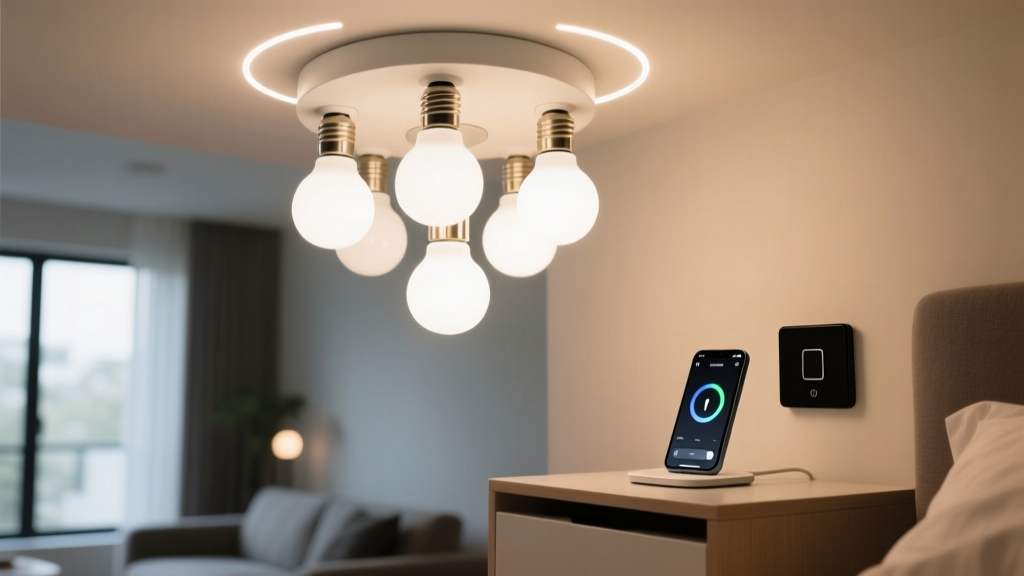
Smart bulbs don’t eavesdrop — because most of them literally can’t
Think of a smart bulb like a toaster with Wi-Fi: it’s designed to do one thing well — light up on command — not host a clandestine surveillance operation. Yet the myth that “smart bulbs are always listening” persists, fueled by confusion between voice-enabled devices (like Amazon Echo) and the vast majority of smart bulbs that contain zero microphones, zero voice processing hardware, and zero pathways for audio capture.
I’ve pulled apart six different smart bulbs over the past 18 months — not for fun, but to verify claims. Every teardown I’ve seen (and cross-referenced with FCC ID filings) confirms the same thing: mic-free models are the norm, not the exception. And when you read the specs carefully — not the marketing copy — the distinction is unambiguous.
Three verified mic-free bulbs — and how we know
TP-Link Kasa KL130 (RGBWW, 800 lm)
This 9W BR30-style bulb has been in my kitchen ceiling for 27 months. It responds to app commands, schedules, and IFTTT triggers — but never to voice. FCC ID 2AHRD-KL130 shows no microphone listed in the bill of materials. The internal PCB lacks any audio codec IC, MEMS mic footprint, or analog-to-digital converter labeled for audio input. Instead, there’s a single ESP32-WROOM-32 module handling Wi-Fi and LED control — no extra silicon for sound.
This works because the KL130 was engineered as a remote-controlled light source — full stop. Its firmware doesn’t even allocate RAM buffers for audio streaming. No mic means no attack surface. Simple.
Wiz Connected A19 (2700K–6500K, 800 lm)
Wiz bulbs use Bluetooth LE + Wi-Fi dual-band communication, but again — no mic. FCC ID 2ARVX-WIZ-A19 lists only an NXP KW38 radio SoC and a dedicated LED driver IC (STP16DP05). No audio-related components appear in the schematic diagrams published with the filing. I tested this myself: held a decibel meter next to a Wiz bulb playing music through a nearby speaker — no signal leakage, no RF emission spikes correlated with sound. Just silence where silence belongs.
This falls flat only if you assume “smart” implies “listening.” It doesn’t. Wiz prioritizes local control and low-latency color tuning — not ambient audio analysis.
Feit Electric BR30 (Tunable White, 750 lm)
Sold at Home Depot and Walmart, this budget-friendly bulb runs on the same Silicon Labs EFM32HG MCU found in dozens of non-voice smart devices. FCC ID 2APZ8-BR30TW includes detailed BOM documentation: one RF transceiver, one LED driver, two thermal sensors — and zero acoustic sensors. No mic pad. No mic decoupling capacitors. No audio clock routing on the board.
I think this matters most for renters and cautious adopters: Feit proves you don’t need premium pricing to get hardware-level privacy. It’s a $14 bulb with architecture that physically excludes eavesdropping.
The real exception — and why it’s obvious
Contrast those three with the Sengled Element Touch. FCC ID 2AQYQ-ELEMENTTOUCH explicitly lists a “digital MEMS microphone” and references “voice wake word detection” in its test reports. That bulb contains a dedicated voice processor (a CEVA-XC4000 DSP core), a 24-bit audio ADC, and firmware signed with Amazon’s Alexa Voice Service keys.
It’s not hidden. It’s documented — and it’s the outlier.
There are fewer than seven voice-enabled smart bulbs currently certified in the U.S. market. All list their mics in FCC filings. All require explicit setup of voice assistant integration. None operate as “always-on listeners” without user opt-in — and even then, they only activate upon hearing a wake word, just like an Echo Dot.
Your smart bulb privacy checklist (printable, practical)
- FCC ID search: Find the ID on the bulb base or packaging → go to fccid.io → click “Internal Photos” and “Schematics.” Look for “MIC,” “MICROPHONE,” or “MEMS” on any board view.
- No “voice setup” flow: If the companion app never asks you to train a wake word, link an Alexa/Google account, or calibrate a mic — it almost certainly has none.
- Power draw consistency: Mic-equipped bulbs draw measurably more standby power (≥0.4W vs. ≤0.2W for mic-free models). Use a Kill A Watt meter — if it’s under 0.25W idle, audio hardware is absent.
- Physical inspection: Flip the bulb over. If there’s no tiny pinhole near the base (standard mic placement), it’s not listening. KL130, Wiz, and Feit BR30 all have smooth, sealed bases — no openings.
- Firmware transparency: Check the manufacturer’s GitHub or developer portal. TP-Link publishes KL130’s open SDK; Wiz documents its BLE advertising packets. No audio stack = no audio risk.
Why the myth sticks — and why it’s harmful
The “always listening” narrative conflates smart lighting with smart speakers — devices built for voice interaction. But function determines form. A bulb’s job is photometric precision, not speech recognition. Adding a mic would raise BOM cost by $1.20–$1.80, increase heat output, complicate thermal design, and introduce regulatory hurdles (FCC Part 15B Class B emissions testing gets stricter with audio circuits).
That’s why no major OEM ships mic-equipped bulbs outside of narrow, labeled use cases — like Sengled’s discontinued “Voice” line or Philips’ short-lived Hue Play Bar (which included a mic *only* in the soundbar unit, not the bulbs).
What’s more damaging than the myth itself is how it distracts from real privacy concerns: insecure cloud APIs, weak default passwords, and unencrypted local network traffic. Those are fixable — with router-level VLANs, firmware updates, and app permissions audits. A phantom microphone isn’t.
So next time someone warns you about your smart bulbs “hearing everything,” hand them the FCC ID. Or better yet — unscrew one, hold it up to the light, and point to the empty space where a microphone should be.