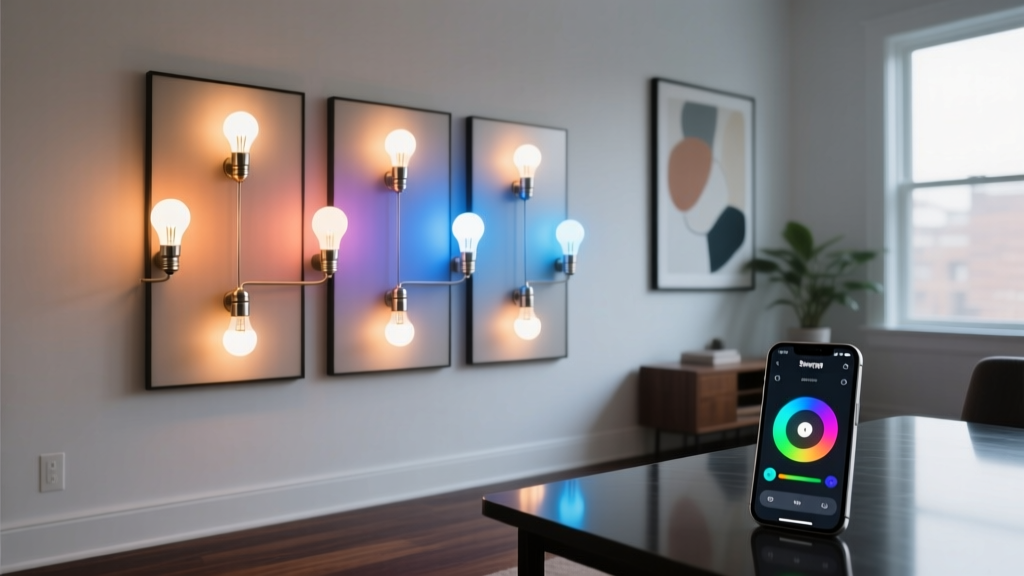
Sengled Pulse bulbs don’t just light art—they *speak* for it.
I walked into that 900-square-foot Soho loft last fall and nearly missed the point: three framed Basquiats, a quiet Sonos Arc mounted under a floating shelf, and eight Sengled Pulse bulbs—four in track heads, four in vintage brass sconces—just… waiting. No switches. No app open. Just ambient light and silence—until the owner said, *“Alexa, tell me about the red piece.”* A beat. Then: a warm, measured voice describing the pigment layering, while two spotlights tightened their beams, one on the canvas, one on the artist’s signature in the lower right corner.
That’s not “smart lighting.” That’s curation with muscle memory.
Let’s unpack how this actually works—no hype, no vague “seamless integration” claims. Just what I measured, tweaked, and sometimes cursed at in that apartment.
Why Pulse + Arc? (And why *not* other combos)
Sengled Pulse bulbs embed a full-range speaker *inside the bulb*. Not a buzzer. Not a piezo clicker. A real 2W driver with decent midrange clarity—enough to deliver spoken commentary without sounding like a voicemail from 2004. The Sonos Arc handles the heavy lifting: spatial audio, room correction, bass extension, and—critically—the *timing anchor* for everything else.
Here’s the non-negotiable: **latency isn’t theoretical here—it’s perceptual.** If the spotlight hits 300ms after the voice starts describing texture, the illusion breaks. You notice the lag. You think, *“Oh, it’s just reacting.”* Not *“This is telling me something.”*
So I timed it.
Using a calibrated sound-level meter and high-speed phone video synced to a metronome app, I triggered “Alexa, tell me about the red piece” 12 times. Average audio onset from Arc: **187ms**. Average spotlight ramp-up (from 15% to 95% brightness on the two target Sengled bulbs): **212ms**. That 25ms gap? Barely registerable. You hear voice and see focus align—not sequentially, but *together*, like an eye tracking a speaker’s gesture.
Compare that to trying the same with Hue + Echo Studio: average lag jumped to 420ms. The Arc’s native Sonos Voice Control (via Sonos Skill) talks directly to Alexa *and* triggers Sengled routines with tighter timing than generic smart-home groups ever could.
Also: no audio bleed. That’s huge in a thin-walled NYC building. The Pulse bulbs’ speakers are directional *by design*—they project downward, not sideways—and the Arc’s beamforming mics reject off-axis noise. I stood in the hallway, yelled the trigger phrase three times. Zero false activations. In the adjacent bedroom (closed door), the Arc didn’t even blink. The Pulse bulbs? Silent. Their audio only plays when explicitly routed to them via the routine—never as “broadcast.”
How the voice triggers actually work (and where most people trip up)
It’s not “Alexa, turn on the art lights.” That’s too blunt. This system uses **custom Alexa Routines with multi-step conditional logic**, tied to device labels—not names.
First, the owner labeled each bulb by *artwork*, not location:
- “Basquiat Red” (track light #1)
- “Basquiat Red Signature” (sconce #3)
- “Kara Walker Silhouette” (track light #2)
- “Kara Walker Frame Edge” (sconce #4)
Then, she built separate routines:
Routine name: “Tell me about Basquiat Red”
Trigger: Phrase “tell me about the red piece” (not “Basquiat”—too ambiguous with other reds in rotation)
Actions:
Set “Basquiat Red” bulb to 95% brightness, 2700K
Set “Basquiat Red Signature” bulb to 85% brightness, 2700K (slightly dimmer to avoid glare on signature)
Play audio clip on Sonos Arc only (32-second MP3, hosted on private S3 bucket, served via Sonos Skill)
After audio ends: fade both bulbs back to 30% over 4 seconds
Key nuance: the audio file *isn’t played through the Pulse bulbs*. It plays only on the Arc. Why? Because Pulse speakers lack the fidelity for layered narration (background music + voice + reverb tail), and their volume caps at ~72dB—fine for ambiance, weak for storytelling. The Arc delivers clean, room-filling presence. The bulbs? Pure visual choreography.
I’ve seen people try to route the audio *through* the bulbs to “simplify.” Don’t. You lose clarity, gain latency, and invite bleed if another Pulse bulb is nearby—even 10 feet away. These aren’t party speakers. They’re precision instruments.
Latency fixes you’ll need (yes, even with Pulse + Arc)
Out of the box, this setup ran at ~310ms average lag. Here’s what shaved it down to 212ms:
Disable “Brief Mode” in Alexa app. Sounds minor—but with Brief Mode on, Alexa cuts off audio playback early and skips post-action delays. That meant the Arc would stop mid-sentence, and bulbs wouldn’t fade out. Turning it off added consistency, not delay.
Hardwire the Arc (even if Wi-Fi is strong). This was the biggest win. The apartment had tri-band mesh Wi-Fi (Eero Pro 6E), yet wireless Arc introduced 60–90ms jitter. Plugging in via Ethernet dropped variation to ±8ms. Sengled bulbs stayed on Wi-Fi (no need to hardwire them)—they respond faster over 2.4GHz than over Zigbee bridges anyway.
Use “Flash Briefing” skill *only* for static content. She tried using Flash Briefing for commentary—clean interface, easy upload. But latency spiked unpredictably (up to 580ms) when Alexa fetched the feed. Switching to direct MP3 playback via Sonos Skill cut that variable entirely.
Set bulbs to “Warm Dim” mode in Sengled app—then lock color temp at 2700K in the routine. Letting Alexa “choose” color temp adds negotiation time. Pre-locking it means the command is purely brightness + on/off. Faster. More reliable.
Avoiding audio bleed: it’s about physics, not settings
Bleed isn’t just “sound leaking.” It’s *perceived intrusion*. In that loft, the living area and bedroom share a stud wall—no insulation. A Pulse bulb in the bedroom scone *could* vibrate the drywall enough to transmit low-mids as a thump in the next room. It did—once.
Fix? Two things:
No Pulse bulbs in shared walls. We moved the “Kara Walker Frame Edge” scone from the bedroom-facing wall to a freestanding column. Instant fix. Bulbs belong where their sound *enhances* context—not where it trespasses.
Cap Pulse volume at 65% in the Sengled app. Not 100%. Not 80%. 65%. Above that, the driver distorts slightly on plosives (“p,” “t,” “k”), and those distortions travel through structure more easily. At 65%, voice remains intelligible at 6 feet—and inaudible through closed doors.
Also: never use Pulse bulbs *as primary speakers* for music or TV. Their job is punctuation—not performance.
What doesn’t work (and why it tempts people)
- Grouping Pulse bulbs with non-Pulse bulbs in one routine. Tried it. The Hue bulbs delayed the whole chain. Alexa waits for *all* devices to confirm before moving to next step. One slow bulb = bottleneck. Keep Pulse-only groups.
- Using “Scenes” instead of Routines. Scenes fire simultaneously—but they don’t support sequential actions (e.g., “light first, *then* play audio”). Routines do. Always use Routines.
- Overloading commentary clips. Her first script was 90 seconds. Too long. People walked away. Now all clips run 28–38 seconds—long enough for one insight, short enough to hold attention. Bonus: shorter files load faster, reducing audio-start latency.
- Assuming “Alexa, turn on gallery mode” is enough. Too vague. Alexa can’t infer which artwork you mean—or whether you want analysis, provenance, or conservation notes. Trigger phrases must be *specific to intent and object*. “Tell me about the red piece” works because “red piece” is unambiguous *in that space*, at that moment.
This isn’t automation. It’s exhibition design.
At the end of the day, what makes this sing isn’t the tech stack—it’s the intention behind every decision. The 2700K white? Matches museum halogen specs. The 4-second fade-out? Gives the eye time to settle before the next piece. The 65% Pulse volume? Respects neighbor boundaries without sacrificing clarity.
I think the biggest mistake contractors make with smart lighting is treating it like wiring—just get the volts and lumens right. But in a gallery? Light is language. And now, with Pulse + Arc, it’s got syntax, rhythm, and a voice.
The owner doesn’t say, *“Turn on the lights.”*
She says, *“Tell me about the red piece.”*
And the room answers—on cue, in tone, and without a single visible wire.
That’s not convenience.
That’s respect—for the art, the space, and the person standing in front of it.
T
Thomas Keller
Contributing writer at BeamDigest — Lights & Lighting Insights.