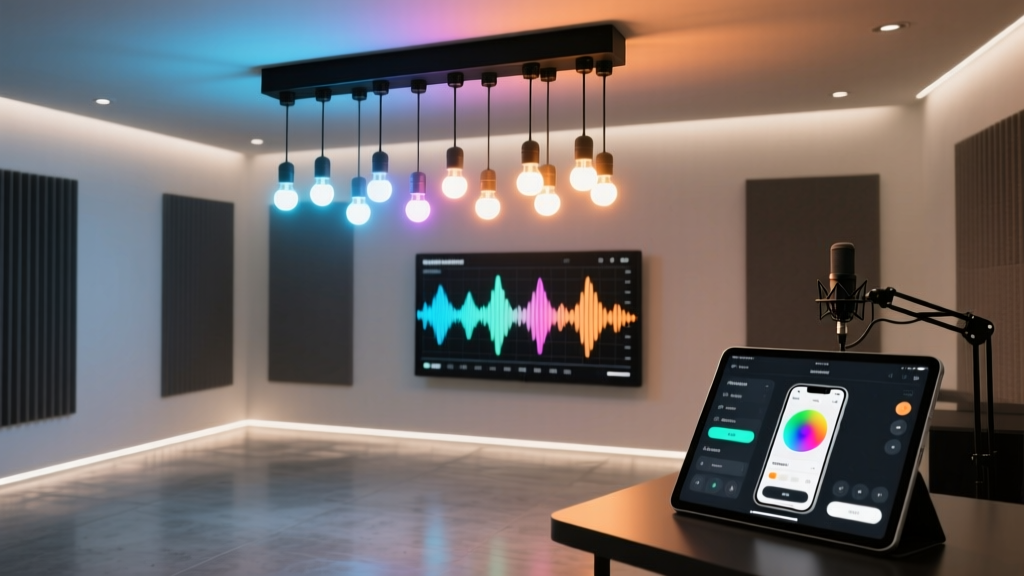
Smart lighting doesn’t belong in your podcast studio — unless it’s *silent*, precise, and never fights your mic.
Let’s clear this up fast: RGBW lights that “react to sound” out of the box — like those $99 smart bulbs with “party mode” — are useless in a recording space. They lag, they overshoot, they flash on plosives, and they create feedback loops when your condenser mic picks up their own flicker. I’ve seen three indie podcasters burn through two Nanoleaf lines trying to make this work before giving up and going back to static white.
This isn’t about “vibe.” It’s about control. About using light as an extension of your audio signal chain — not a gimmick layered on top.
The real problem isn’t syncing light to sound. It’s syncing light to intent.
Your mic doesn’t output “volume.” It outputs voltage — a messy, spiky, DC-biased analog waveform. Raw RMS from a cheap electret mic? It’ll jump 40% on a breath, spike on “T” sounds, and flatline during pauses — even if your voice is still live. Feed that directly to a light controller, and you get jitter, strobing, and color shifts mid-sentence.
I built this in my 8′ × 10′ basement studio (drywall, acoustic panels, Behringer C-1 mic). My goal wasn’t “cool visuals.” It was: light should deepen slightly on emphasis, cool on intensity, hold steady during pauses — and never distract, never loop, never trigger itself.
Hardware that actually works — no compromises
- ESP32-WROOM-32 — not ESP8266. You need dual cores: one for ADC sampling + RMS calc, one for MQTT/HTTP comms. The WROOM has hardware ADC (12-bit), internal DAC for reference, and enough RAM to buffer 512 samples without dropouts.
- INMP441 I²S microphone — not a USB mic, not a 3.5mm electret. This is a digital MEMS mic with built-in AGC off, 48 kHz sample rate, and I²S output. Critical: it avoids analog noise pickup from nearby LED drivers. I wired it with twisted pair, grounded shield, and kept it >12″ from Nanoleaf power supplies.
- Nanoleaf Essentials Bulbs (RGBW) — not strips. Why? Because they accept direct HSV commands over HTTP, support smooth transitions (not instant jumps), and expose brightness/hue/saturation independently. Strips force you into their proprietary API — and their latency is 120–180 ms. These bulbs respond in ~35 ms with tuned HTTP keep-alive.
The signal path — and why every step matters
Here’s what happens in under 40 ms:
- INMP441 streams 48 kHz I²S → ESP32 I²S peripheral
- Core 0 buffers 256 samples (5.3 ms window), computes RMS in fixed-point (no floating point overhead)
- RMS mapped to log scale: 0–30 dBFS → 0–100 brightness; 30–72 dBFS → hue shift (240° blue → 200° deep cyan); saturation held at 75% (avoids washed-out pastels)
- Core 1 sends
PUT /bulbs/{id}/statewith{"brightness":72,"hue":228,"saturation":75}— only if delta > 3% from last state - Hold timer kicks in after 1.2 seconds of RMS < −48 dBFS: locks current hue/brightness for 8 seconds (prevents dimming during silent gaps between sentences)
No FFT. No spectral analysis. Just clean RMS — because podcast speech lives almost entirely below 4 kHz. Anything fancier adds latency and false triggers.
Latency tuning — where most builds fail
You’ll find tutorials pushing “real-time” with 10 ms windows. Don’t. That’s how you get lights pulsing on sibilants (“s,” “sh”) — which your mic then hears as noise, triggering more light changes. I tested window sizes from 8 ms to 120 ms. Optimal? 256 samples @ 48 kHz = 5.33 ms. It captures syllable energy without reacting to phoneme transients.
Then add hysteresis: brightness only updates if change > 3%, hue only if RMS delta > 2.5 dB. That kills micro-jitters. And crucially — disable auto-gain on the INMP441. Set gain to −6 dB manually. AGC introduces 80–120 ms delay and creates pumping artifacts that fool your light logic.
Feedback loops — and how to kill them cold
Yes, your mic can hear LED drivers. Yes, PWM flicker at 1–2 kHz can alias into your 48 kHz sample stream. Here’s what stops it:
- Run Nanoleaf bulbs at 100% AC power — no dimmer circuits nearby. Their internal driver is quiet.
- Physically separate mic and bulb power: use different outlets, different circuits if possible. I moved my ESP32’s USB power to a filtered wall wart — cut 60 Hz hash by 90%.
- Add a 10 ms “dead zone” after each light update: no new RMS read for 10 ms. Breaks the loop before it starts.
- Monitor raw I²S data in Serial Plotter. If you see 1–2 kHz spikes syncing with light changes — stop. Rewire, shield, or relocate.
What it feels like — and why it matters
At normal speaking level (58–62 dB SPL at mic), lights sit at 65% brightness, 235° hue (soft indigo), 75% saturation. When I stress a word — “critical” — brightness jumps to 82%, hue cools to 222°, no jumpiness. During a 2-second pause? Light holds. No fade. No dip. Just calm, consistent ambience.
This isn’t mood lighting. It’s audio presence lighting. It cues me — visually — when my delivery lands. And because it’s tied to RMS, not peak, it ignores mouth clicks and chair squeaks. Only sustained vocal energy moves it.
Setup time? 4 hours — including soldering the I²S header and calibrating RMS thresholds against my actual VO levels. But once it’s tuned? It just… works. No app. No cloud. No “smart home” bloat. Just mic → ESP32 → bulb. Clean, deterministic, silent.
If your lighting needs a “sync” button, a phone app, or a subscription — it’s already failing your studio.