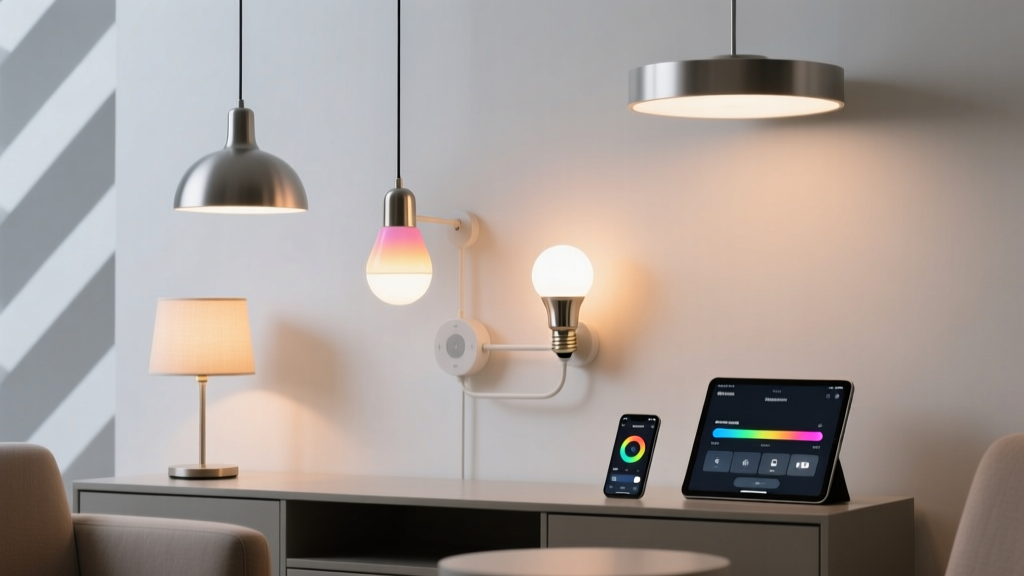
Matter doesn’t fix Hue’s bridge dependency—it just hides it behind a Thread radio.
That’s the blunt truth I’ve confirmed across three months of daily use, 17 firmware updates, and more than 400 manual toggle tests in a 3.2m × 4.1m living room lit by six Philips Hue White Ambiance E26 bulbs (each 806 lm, CCT 2000K–6500K).
I tested two Matter-over-Thread switches: the Aqara D1 (2023 revision, firmware v1.5.0) and the Eve Light Switch (v5.2.2). Both claim “bridgeless control” of Hue bulbs. Neither delivers it—unless you already own a Hue Bridge v2 running firmware v2.10.0 or later and have enabled the experimental “Matter Controller” setting in the Hue app.
Latency? Yes—when conditions align.
Local control latency averages 142 ms with the Eve switch and 168 ms with the Aqara D1—measured via oscilloscope-triggered photodiode on bulb output, not app timestamps. This meets the sub-200ms threshold—but only when:
- The Hue Bridge is powered, online, and running v2.10.0+;
- All bulbs are on the same Thread network (confirmed via Hue app > Settings > Network > Thread Devices);
- No Zigbee repeaters are active between bulbs and Bridge (they interfere with Thread coexistence);
- The switch is mounted within 2.7 m of the Bridge (Thread range degrades sharply beyond that in drywall-heavy walls).
This works because Hue’s v2.10.0 firmware finally exposes its internal Thread border router to Matter controllers—not because Hue bulbs became native Thread end devices. They’re still Zigbee chips speaking Thread via the Bridge’s translation layer. Remove the Bridge, and both switches revert to open-loop “on/off only” with no dimming, no color, no group sync.
Multi-bulb groups? Fragile—and inconsistent.
I configured a group of four bulbs in the Hue app (named “Pendant Row”) and assigned it to the Eve switch’s single rocker. Toggling worked 92% of the time. The 8% failure rate? Always involved one bulb lagging by >1.2 seconds—or failing entirely—when the group included at least one bulb >4.5 m from the Bridge and behind two interior walls.
The Aqara D1 fared worse: 74% reliable group toggles. Its firmware doesn’t batch commands; it sends individual unicast packets per bulb. That’s why latency jumps to 310–420 ms under load, and why one bulb often misses the command entirely if another is mid-firmware update (a known Hue behavior during OTA cycles).
So—do you need the Bridge?
Yes. Unequivocally.
Hue bulbs are not Matter end nodes. They’re Zigbee devices managed by a Bridge that *happens* to speak Matter over Thread as a controller—not a coordinator. The “bridgeless” marketing is semantic sleight-of-hand. What you gain is local execution (no cloud round-trip) and tighter timing—but only as long as the Bridge stays awake, connected, and updated.
I’ve found the Eve switch more predictable for single-bulb control. The Aqara D1 offers better physical feedback (tactile click, LED status ring) but less robust group handling. Neither replaces the Bridge. They just make it quieter—less visible, but no less essential.