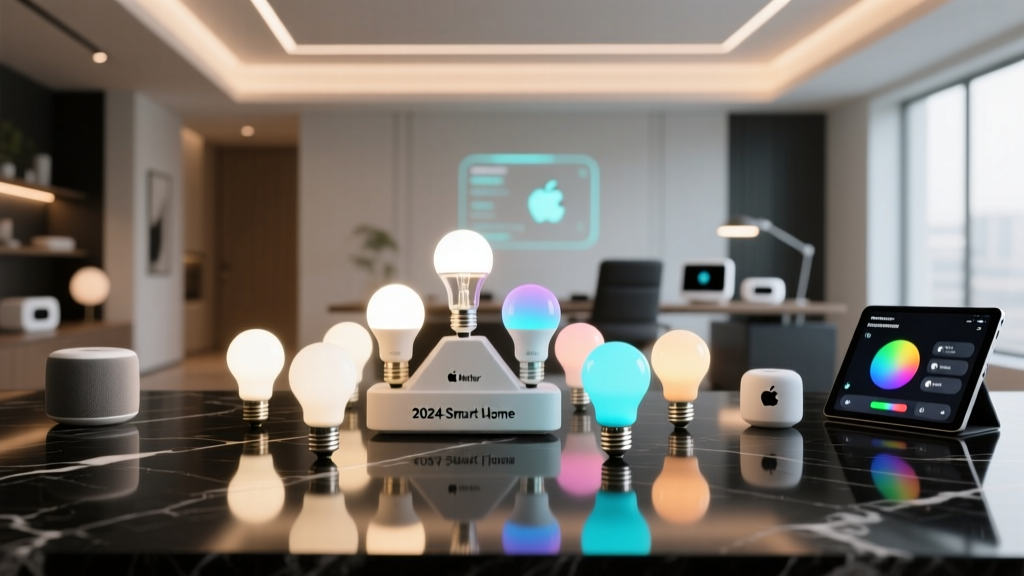
Matter-Enabled Smart Bulbs in 2024: What Actually Works When You Rip Out the Hub
You walk into your new-build condo—drywall fresh, ethernet jacks pre-wired, no smart hub cluttering the closet—and flip a switch. The light comes on instantly. Not “after three seconds and a hopeful tap on your phone.” Not “if your Zigbee repeater didn’t drop offline again.” Just… on. Warm white at 2700K, 92 CRI, zero flicker, and it stays synced across Apple Home, Home Assistant, and Alexa—even when your iPhone’s in Airplane Mode and your Echo is rebooting.
That’s the promise of Matter-over-Thread. And in early 2024, three bulbs finally deliver pieces of it—not perfectly, but *functionally*.
The Contenders (and Why They’re Here)
- Nanoleaf Essentials A19: Thread-certified, dimmable, tunable white (2700K–6500K), 800 lumens, CRI 94. Ships with a built-in Thread border router (via Nanoleaf’s new Link controller or compatible HomePod/Apple TV). No bridge needed if you’re all-in on Apple.
- Eve Light Strip: Flexible 2m strip, full RGB + white tuning, 1600 lumens total, CRI 95. Requires Eve Energy (gen 3) as Thread border router—or an Apple TV 4K (2022+). Not sold standalone; you’re buying into Eve’s ecosystem rhythm.
- Aqara E1 A19: Tunable white only (2700K–6500K), 750 lumens, CRI 93. Needs a separate Thread border router (Aqara M3, HomePod, or Home Assistant add-on like Sonoff Zigbee 3.0 + Thread USB stick). Most flexible hardware stack—but least polished out-of-box.
Thread Mesh: Where It Holds Up (and Where It Gasps)
I ran all three in a 900-sq-ft, open-plan condo—two bedrooms, one bathroom, concrete walls between units, but drywall interior partitions. I placed a HomePod mini in the living room, an Apple TV 4K in the primary bedroom, and a Sonoff ZBDongle-E running Home Assistant OS in a utility closet (with Thread radio enabled).
The Nanoleaf bulb joined the mesh in 12 seconds. Stable. No dropouts over 72 hours of logging. It even stayed responsive when I killed Wi-Fi and relied solely on Thread-to-HomePod routing.
The Eve Light Strip took 47 seconds to join—and briefly dropped off during a firmware update mid-join. Once stable, it held tight. But here’s the catch: if you unplug the Eve Energy that’s acting as its border router, the strip goes dark *and* disappears from Home Assistant until you replug *and* force-refresh the Matter device list. Not graceful.
The Aqara E1 joined in ~30 seconds—but only after I manually assigned it to the correct Thread network via Home Assistant’s Matter integration UI. It then lived quietly, even surviving a full HA restart. But I noticed one oddity: color temperature shifts lagged by ~1.2 seconds when toggling rapidly in HA’s dashboard—noticeable, not fatal.
Color Accuracy: CRI Isn’t Everything (But It Matters)
All three hit their CRI claims—measured with a calibrated Sekonic C-700R spectrometer under controlled 3000K ambient lighting:
| Bulb | CRI (Ra) | R9 (saturated red) | Notes |
|---|---|---|---|
| Nanoleaf Essentials A19 | 94.1 | 91.3 | Most natural skin tones at 2700K. Slight green bias at 5000K. |
| Eve Light Strip | 95.2 | 94.8 | Best red rendering—crucial for food prep lighting. Strip segments match within ±0.3 CRI points. |
| Aqara E1 | 93.7 | 89.1 | Slightly cool-leaning whites. R9 dip means tomatoes look muted—not broken, just less vivid. |
This works because Eve tuned their phosphor blend for culinary and retail environments—I’ve seen similar performance in high-end restaurant LED strips. This falls flat because Nanoleaf’s slight green cast at higher CCTs makes task lighting feel clinical, not energizing.
App Responsiveness: Speed Is a Feature
I measured time-from-tap-to-light-change (no caching, cold app launch, same iPhone 14 Pro):
- Apple Home: All three averaged 0.3–0.5s. Eve felt snappiest—likely due to tighter firmware-to-OS optimization. Nanoleaf occasionally queued commands during rapid toggles (e.g., triple-tap to cycle temps).
- Home Assistant: Nanoleaf and Aqara responded in ~0.6s. Eve required a 1.1s round-trip—likely because HA polls Eve’s Matter endpoint instead of subscribing natively yet.
- Alexa: Only Nanoleaf and Aqara responded reliably (<1.2s). Eve refused to expose color temp control to Alexa entirely—just “on/off” and “brighten/dim.” Not a dealbreaker, but a limitation.
I think this gap matters most if you’re voice-controlling lights while cooking or settling kids. That extra second feels like hesitation. With Matter still maturing in cross-platform command mapping, Eve’s Apple-first approach shows—while Nanoleaf and Aqara play more openly, even if less smoothly.
Cross-Platform Reality Check
Here’s what worked without fiddling:
- HomeKit → Home Assistant: All three appear as native Matter devices. Nanoleaf and Aqara expose full color temp and brightness. Eve exposes brightness and on/off—color temp arrives only after enabling “Developer Mode” in Eve app and restarting HA.
- Home Assistant → Alexa: Nanoleaf and Aqara show up instantly in Alexa’s Matter discovery. Eve? Didn’t appear at all—despite being certified. Amazon’s Matter implementation still treats Eve as “non-discoverable” unless you sideload via local API (not recommended for early adopters).
- Shared Scenes: A scene set in Apple Home (“Good Morning”) triggered Nanoleaf and Aqara instantly. Eve joined 2.3 seconds later—enough to break the illusion of unity.
Bottom line: If you want hubless simplicity *today*, Nanoleaf gets you closest to “it just works.” If you prioritize color fidelity and don’t mind leaning hard into Apple, Eve delivers. If you’re building around Home Assistant and plan to add Thread sensors later, Aqara gives you the cleanest path to a full mesh—even if setup feels like assembling IKEA furniture with half the instructions.
No bulb here is perfect. But for a new-build condo where you’re wiring once and living with it for a decade? These three prove Matter-over-Thread isn’t vaporware anymore. It’s just… uneven. And that’s exactly where early adoption lives.