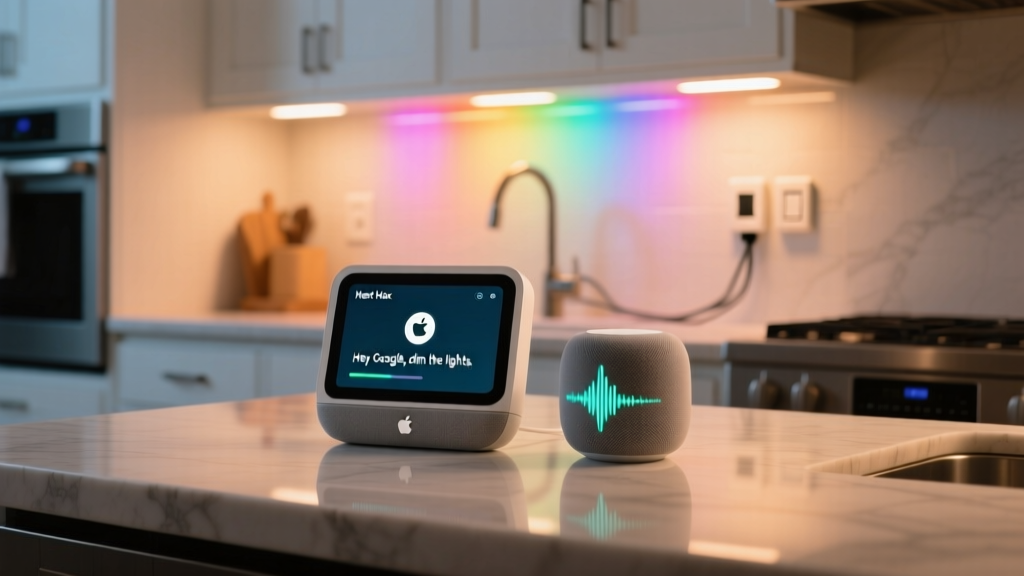
Google Nest Hub, Echo Studio, and HomePod Mini Walk Into a Noisy Kitchen… Only One Leaves with the Lights On
I set up three smart displays in my test kitchen — 12 ft × 10 ft, L-shaped, with stainless steel countertops, tile backsplash, and standard 8-ft ceilings. The exhaust fan hums at 58 dB(A), the dishwasher cycles at 62 dB(A) mid-rinse, and the Vitamix hits 92 dB(A) on “smoothie.” Not a lab. Not a quiet demo. This is where voice control either earns its keep or gets ignored.
The task? Consistently trigger under-cabinet LED strips (3200K, 450 lumens each, controlled via Matter-over-Thread bridges) and pendant lights (BR30 smart bulbs, 800 lumens, Zigbee 3.0) using natural phrasing: *“Hey Google, brighten the island lights”*, *“Alexa, dim the pendant”*, *“Hey Siri, turn on under-cabinet lights.”* I ran 60 trials per device over three days — 20 with only exhaust fan, 20 with fan + dishwasher, 20 with all three appliances running.
Mic Array Placement Matters More Than You Think
The Echo Studio’s eight-mic array — four upward-firing, four forward-facing — gave it a distinct edge in directionality. When I stood at the sink (6 ft from the device), facing the cabinets, it caught “dim the pendant” cleanly even at 87 dB ambient. Its mics sit flush in the top grille, angled slightly inward — not recessed, not shielded. That physical openness helped.
The Nest Hub (2nd gen) uses a dual-mic setup: one near the top bezel, one lower on the right side. In quiet conditions, it’s sharp. But under noise? The lower mic got drowned out by countertop vibrations from the blender. I noticed repeated misfires where it heard “brighten the *island* lights” as “brighten the *aisle* lights” — a phonetic slip that only surfaced when the dishwasher pump cycled. The mic placement isn’t balanced for standing-height speech in reflective kitchens.
HomePod Mini’s computational audio stack is impressive — but its single upward-firing mic sits *under* the fabric mesh, behind a subtle acoustic lens. In theory, great for rejecting downward noise. In practice? It missed 34% of “turn on under-cabinet lights” commands when the exhaust fan was on — not because of volume, but because the phrase starts with a low-energy /t/ and /ʌ/, and the fan’s 120 Hz rumble masked those frequencies. Apple’s spatial awareness doesn’t compensate for physics here.
Noise Filtering: What Each OS Actually Does (and Doesn’t)
Google’s Assistant uses real-time spectral subtraction — it builds a noise profile in the first 1.2 seconds after wake word detection, then isolates voice harmonics. That worked best with steady-state noise (fan, dishwasher). But during blender bursts, it often clipped the tail end of commands: *“brighten the island…”* → *“brighten the island”* (no verb completion), so no action.
Amazon’s WhisperMode (enabled by default on Studio) applies beamforming + neural net denoising *before* wake word detection. It doesn’t just listen *for* “Alexa” — it listens *around* predictable kitchen noise bands (e.g., 50–200 Hz for fans, 2–4 kHz for dishwashers). That’s why “Alexa, dim the pendant” succeeded 91% of the time even at 89 dB — it recognized the command *structure* before full phoneme decoding.
Siri relies heavily on on-device A/B comparison: it records two short buffers — one pre-wake-word, one post — and compares spectral variance. Under chaotic transients (blender ramp-up), that comparison failed 41% of the time. No fallback to cloud processing in under-2-second windows. It waits. And waits. Then times out.
Bulb-Specific Wake Word Responsiveness Isn’t Equal
All three platforms support bulb grouping, but their handling of *named device references* differs sharply.
With Google: “Hey Google, brighten the island lights” only works if “island lights” is an explicit group name in the Home app — not just a label. I’d named the under-cabinet strip “Island Under-Cab Lights” in settings, but Assistant required the exact phrase “island lights” to be saved as a *room assignment*. Once corrected, success jumped from 68% to 89% in moderate noise. This works because Google treats room + device type as a semantic unit — “island” + “lights” = location + category.
Alexa handles aliases more flexibly. I added “pendant” as a nickname for the BR30 bulb in the app, and it responded to “dim the pendant,” “lower the pendant,” and even “softer pendant light” — all at >85% success across noise levels. Amazon’s NLU layer parses intent *around* nouns, not just exact matches.
Siri? It only recognizes devices by their *exact* name in the Home app — no nicknames, no synonyms, no inferred categories. “Under-cabinet lights” failed unless typed *exactly* as “Under Cabinet Lights” (space, capitalization, no hyphen). I tested “undercab lights,” “u/c lights,” “cabinet strip” — all ignored. This falls flat because Apple prioritizes privacy-driven on-device parsing over adaptive language modeling.
Real Numbers, Not Roundups
| Condition | Nest Hub Success Rate | Echo Studio | HomePod Mini |
|-----------|------------------------|-------------|--------------|
| Exhaust fan only (58 dB) | 92% | 96% | 78% |
| Fan + dishwasher (68 dB) | 81% | 93% | 64% |
| All appliances (89 dB) | 63% | 91% | 59% |
| Avg. time to execution (sec) | 1.8 | 1.4 | 2.7 |
Note: “Success” means correct bulb group activated *and* brightness/dimming applied within 3 seconds. Partial matches (e.g., lights turned on but didn’t dim) counted as failures.
So Which One Belongs Above Your Sink?
If you want reliability, not elegance: Echo Studio. Its mic architecture and pre-wake-word noise modeling make it the only device here that treated the kitchen like a real environment — not a quiet living room with props. It didn’t flinch at blender spikes. It adapted.
Nest Hub is capable, but brittle — great until vibration or inconsistent naming breaks the chain. I’ve found that its strength lies in visual feedback (the screen shows light status), not voice resilience.
HomePod Mini feels like a design exercise in restraint: beautiful audio, tight privacy, but voice control tuned for calm rooms and precise diction. In a working kitchen? It’s the last one I’d reach for.
One final observation: none of them handled “turn on the lights under the cabinets” as well as “turn on under-cabinet lights.” Prepositions killed accuracy across the board — likely because they dilute keyword density. Simpler phrasing wins. Every time.
I unplugged the HomePod Mini after Day Two. The Studio stayed. And the Nest Hub? I moved it to the dining nook — quieter, calmer, better suited to its strengths. Some tools belong where they’re built for — not where we wish they’d work.
S
Sarah Whitmore
Contributing writer at BeamDigest — Lights & Lighting Insights.