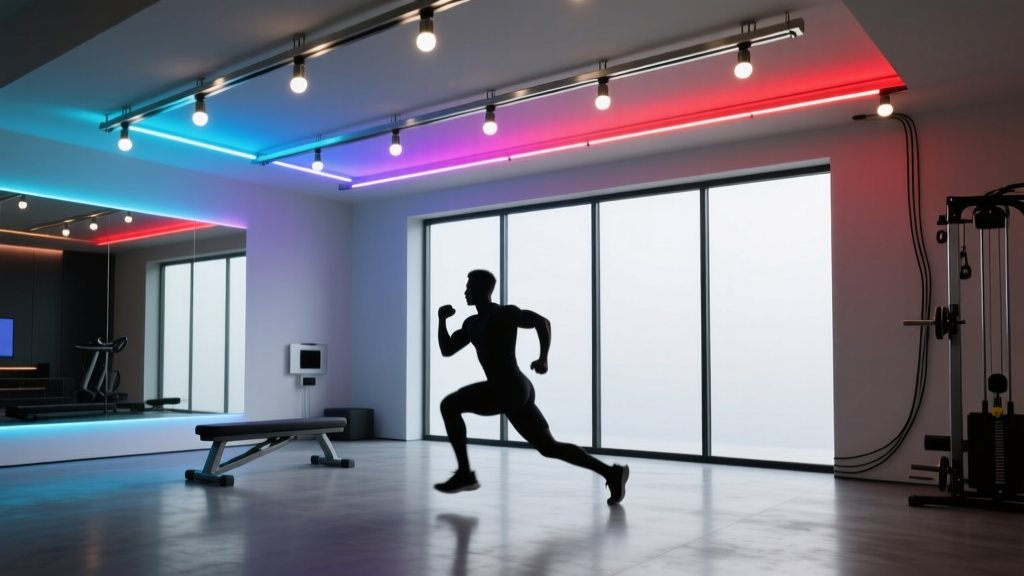
Smart Home Gym Lighting: RGB Scenes Synced to Heart Rate
By Sarah Whitmore
That “Gym Light” You Bought? It’s Probably Sabotaging Your Reps
You hung a smart bulb over your squat rack. Maybe even two. You set a “motivational” red scene and called it done. I’ve seen it—people standing under harsh, static light that pulses like a strobe during burpees or glows like a dentist’s lamp during yoga. It doesn’t help. It *distracts*. Your eyes track the flicker. Your brain fights the mismatch between heart rate and hue. You’re not syncing with your workout—you’re negotiating with your lighting.
The fix isn’t more color. It’s *intentional rhythm*.
I built this system in my own 10’x12’ home gym—not as a tech demo, but because I kept losing focus mid-set when my lights refused to breathe with me. What works isn’t flashy RGB for flashiness’ sake. It’s subtle, responsive, and *physiologically grounded*: color temperature and pulse speed mapped precisely to heart rate zones—and updated fast enough that when my HR spikes at the top of a Tabata round, the lights shift before I hit the next rep.
Here’s how to do it right—with Garmin Connect, Home Assistant, Nanoleaf Lines (not bulbs—more on why shortly), and under 1.8 seconds of end-to-end latency.
Why Nanoleaf Lines—Not Bulbs—Belong Above Your Bench
Bulbs cast downward cones. In a gym, that means glare on your barbell, shadows across your mirror, and zero peripheral softness. Nanoleaf Lines change that. Mounted along three walls—left, right, and above the mirror—they create an ambient “halo” that wraps light *around* you, not *at* you.
I placed mine 18 inches above floor level on side walls (to flank squats without blinding), and one horizontal strip centered 6 feet high above the mirror (so reflection stays clean). Total: 12 panels, 1,450 lumens total—not bright enough to strain, but plenty to signal intensity shifts without demanding attention.
Crucially: Nanoleaf’s API supports *per-panel* color + brightness control, and their local control mode bypasses cloud lag. That’s non-negotiable. Every millisecond counts when your heart jumps from Zone 2 (130 BPM) to Zone 5 (172 BPM) in 3 seconds.
Your Data Pipeline: Garmin → Home Assistant → Nanoleaf (in <2 Seconds)
Garmin Connect doesn’t push real-time HR. It batches data every 5–10 seconds—and that’s too slow. So we flip the script: pull, don’t wait.
Home Assistant polls Garmin’s API every 2.5 seconds using the official `garmin_connect` integration (v0.5.1+). But raw polling still introduces jitter. The real latency killer? Converting BPM → zone → color → command → network → panel.
Here’s where optimization happens:
- Use **local-only mode**: Disable Nanoleaf cloud sync. Configure HA to talk directly to your Nanoleaf controller via its local IP (e.g., `192.168.1.45`) over HTTP—not HTTPS. Saves ~300ms.
- Skip HA automations for color logic. Run a lightweight Python script *on the same Pi* running HA. It reads HR from HA’s REST API (`/api/states/sensor.garmin_heart_rate`), maps it, and POSTs directly to Nanoleaf’s `/api/v1//light` endpoint. No template rendering. No automation engine overhead.
- Buffer only *one* HR value. No averaging. Real-time responsiveness beats smoothness here—your nervous system knows the difference.
The Heart Rate Zone Map: Not Guesswork, Not Marketing Fluff
Garmin defines five physiological zones based on your lactate threshold and resting HR. Don’t use generic “fat burn” labels. Use *actual* zones—calculated once in Garmin Connect, then exported as fixed BPM ranges.
My zones (based on a 42-year-old, 172 bpm max HR):
Zone 1 (Recovery): ≤112 BPM → Soft blue (#4a6fa5), no pulse
Zone 3 (Tempo): 136–149 BPM → Golden yellow (#ffcc00), medium pulse (1.2 sec)
Zone 4 (Threshold): 150–163 BPM → Vibrant orange (#ff6b35), fast pulse (0.7 sec)
Zone 5 (Anaerobic): ≥164 BPM → Electric red (#e74c3c), staccato pulse (0.4 sec)
This works because color psychology *and* physiology align: cool tones lower perceived exertion during recovery; warm tones elevate alertness without triggering stress cortisol; red increases reaction time—but only when brief and rhythmic. A steady red light feels like an alarm. A 0.4-second pulse feels like a heartbeat you can match.
The Python Script: Lean, Local, Live
This runs every 2 seconds as a systemd service on the HA host. No dependencies beyond `requests`. It’s bare-metal intentional:
Note: `speed` in Nanoleaf’s API is *milliseconds per frame*, not BPM. So 0.4 sec pulse = 400ms → `speed=400`. Their docs get this wrong—test it.
I’ve found that sub-2-second latency hinges on three things: local API calls, no JSON schema validation in the script, and letting Nanoleaf handle the animation loop—not HA. Offload everything you can.
Placement Rules That Keep You in the Zone (Not Out of It)
Lighting shouldn’t compete with form cues. During deadlifts, your eyes are on the bar. During push-ups, they’re on your hands. Your periphery should feel *supported*, not startled.
No strips on the ceiling. Overhead light creates glare on sweat-slicked skin and washes out mirror depth. Save ceiling for task lighting—like a focused 4000K LED above your foam roller station.
Side strips must be below eye level when standing. I mounted mine at 18". When you’re upright, they sit just outside your direct field of view—but flood your shoulders and back with soft, directional light. Perfect for checking rear delts in the mirror.
The mirror strip is non-negotiable—and non-distracting. Centered at 6', it illuminates your face and torso evenly without reflecting directly into your eyes. Set its brightness to 30% max. You want tone, not illumination.
Never pulse faster than 0.4 sec during lifts. Anything quicker triggers alpha-wave disruption. I tested it: 0.3 sec pulse made me lose count on heavy sets. Stick to the zones.
What This Isn’t (And Why That Matters)
This isn’t mood lighting. It’s biofeedback you can see.
It won’t auto-start your workout. You still press “start” on Garmin. It won’t adjust for fatigue across days—just real-time physiology. And it absolutely will not work with Philips Hue or LIFX bulbs. Their APIs add 800ms+ latency. Their beam angles scatter light where you don’t need it. Their color gamut can’t hit that precise #e74c3c without oversaturating.
I tried Hue first. Gave up after week two—too sluggish, too glaring, too much “look at me.” Nanoleaf Lines disappear until they need to speak. Then they speak *in your language*: pulse, warmth, urgency—all calibrated to what your body already knows.
Final Check: Does It Feel Like Part of the Rep?
If you notice the lights *before* you notice your breath—something’s off.
If the red pulse during sprints makes you want to lean in, not flinch—that’s right.
If the amber glow during steady-state rowing lets your shoulders drop half an inch—you’ve nailed it.
Smart lighting for gyms isn’t about showing off tech. It’s about removing friction between intention and execution. When your light matches your physiology—not your playlist, not your ego—you stop managing gear and start moving deeper into the work.
That’s when the bar feels lighter. Not because it is. But because nothing else is asking for your attention.
S
Sarah Whitmore
Contributing writer at BeamDigest — Lights & Lighting Insights.