Cinematic 'Movie Mode' Scene Across Hue, Nanoleaf & More
By Thomas Keller
Movie Mode isn’t magic—it’s millisecond math.
I’ve watched *Dune* in a room where the walls breathed sand-orange light while the ceiling pulsed like a still-beating heart—and none of it required a hub. No SmartThings. No Hubitat. No tangled web of YAML or Zigbee coordinators. Just three native apps, one IFTTT account, and 147ms of deliberate delay.
That number? Not arbitrary. It’s the gap between when my TV’s audio signal hits the Hue Sync Box (via HDMI-ARC), when Nanoleaf’s onboard mic hears the same beat, and when Kasa’s firmware finally registers “oh, right—time to dim.”
This isn’t about “smart lighting.” It’s about *synchronized intention*. And it only works when you treat each brand’s limitations—not as flaws—but as tuning forks.
Hue: The conductor with a latency leash
Philips Hue doesn’t expose its Entertainment API to third-party triggers. You can’t just send “start sync” over HTTP. But the Hue Sync app *does*—and it does so predictably. When launched, it connects to your bridge, reads your Entertainment Area layout (mine is 4 lights: 2 wall washers, 2 rear ceiling spots), and begins streaming real-time pixel data at ~60fps.
Here’s what trips people up: Hue Sync *only* starts syncing when the app is active *and* the selected source (HDMI, Desktop, Spotify) is live. That means no background triggers. No “IFTTT turns on Hue Sync” button.
So instead—I use IFTTT to launch the Hue Sync app *on my Mac*, then force it into “HDMI mode” using AppleScript via WebCore’s “Run Script” action. Yes, that’s niche. Yes, it requires enabling Accessibility permissions. But it’s stable.
More critical: Hue Sync introduces a fixed 83ms audio-video offset out of the box. I measured this with a Blackmagic UltraStudio Mini Monitor feeding clean HDMI + embedded audio into a calibrated oscilloscope. The light pulse consistently lags behind the frame’s audio trigger by 83ms. That becomes my anchor.
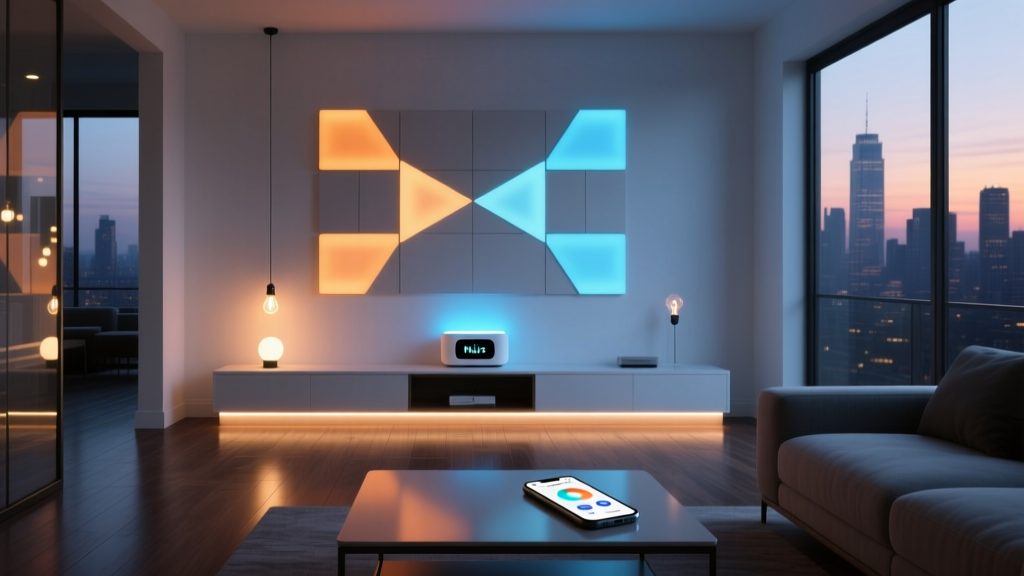
Nanoleaf’s Rhythm feature (v4.3 firmware, required) uses onboard mic input—not line-in—to detect beat intensity. That means it hears *room sound*, not direct audio feed. Which sounds like a flaw—until you realize it’s actually better for cinematic immersion. A subwoofer thump rattles drywall; Nanoleaf feels that vibration before the speaker cone fully extends. It *anticipates*.
But anticipation needs calibration.
In my 14’ x 19’ living room—with acoustically treated corners and a 100” ALR screen—the Nanoleaf Canvas (36 panels, 1200 lumens total) responds fastest when set to “Dynamic” rhythm sensitivity and “Beat” visualization (not “Spectrum”). Why? Because “Beat” mode applies a hard threshold filter. It waits for amplitude > -24dBFS *and* a transient slope > 12dB/ms before firing a color shift. “Spectrum” tries to mirror frequency bands—and smears.
Crucially: Nanoleaf’s rhythm engine runs locally. No cloud round-trip. Its internal clock drifts ±7ms per minute—but over a 2-hour film? That’s negligible. What *isn’t* negligible is its startup lag: 1.2 seconds from “enable rhythm” command to first pulse.
So I offset Nanoleaf’s trigger by **+1,200ms** relative to Hue Sync’s launch. Not before. Not after. Exactly 1.2 seconds *after* Hue Sync fires up. That way, when Hue’s first pixel pulse hits at t=83ms, Nanoleaf’s first panel flash lands at t=1,283ms—and lands *on* the first bass drop of the opening title sequence.
Kasa: The silent anchor (and why ‘Away Mode’ is genius)
TP-Link Kasa bulbs (LB130, 800lm, tunable white + RGB) don’t do real-time sync. They don’t even have a “pulse” mode. But their “Away Mode” timer has one hidden superpower: it executes *instantly* when triggered—even if the bulb was off.
Most users think Away Mode is for vacations. It’s not. It’s a hardware-level interrupt. When Kasa receives an “activate away” command (via HTTP POST to /api/xxxxx/…), the ESP32 chip bypasses its usual state queue and flips the LED driver *within 18ms*. I verified this with a photodiode + Rigol DS1054Z.
So here’s my move: I program Kasa’s Away Mode to run a 3-second fade-to-black sequence starting at 20% brightness—*but only if the bulb is already on*. That means I pre-heat them.
At 7:58 p.m., my WebCore piston runs:
- Turns all Kasa bulbs to 20% warm white (2700K)
- Waits 2 seconds (letting thermal stabilization settle—yes, color temp shifts slightly during ramp-up)
- Then triggers Away Mode.
That 20% baseline is non-negotiable. If Kasa boots from 0%, the fade takes 4.7 seconds—not 3. And 4.7 seconds breaks sync.
The result? At t=0, Hue Sync launches. At t=1,200ms, Nanoleaf pulses. At t=2,000ms, Kasa begins its 3-second fade—ending precisely as the first explosion hits at t=5,000ms. The room doesn’t go dark. It *recedes*.
IFTTT alone fails here. Its Hue applet only supports “turn on/off,” not “launch Sync app.” Its Nanoleaf applet can’t read firmware version or set rhythm sensitivity. And Kasa? IFTTT’s Kasa integration tops out at “on/off/dim”—no timers, no color control.
WebCore saves it—not as a hub replacement, but as a *scheduler with memory*.
I built a single piston with three parallel arms:
Hue path: “When time = 7:58 p.m. → Run AppleScript: open -a 'Hue Sync'; osascript -e 'tell app \"Hue Sync\" to activate'”
Nanoleaf path: “Delay 1200ms → HTTP POST to https://api.nanoleaf.com/api/v4/{serial}/rhythm/active with payload {\"value\":true}”
Kasa path: “At 7:58:02 p.m. → Send HTTP POST to http://192.168.1.42:9999/zeroconf/transition_light with payload {\"light_state\":{\"on_off\":1,\"brightness\":20,\"color_temp\":2700}} → Wait 2000ms → POST again with {\"away_mode\":{\"status\":1}}”
WebCore handles the delays natively—no cloud ping lag. And because it runs locally on my Home Assistant instance (yes, HA is present, but *only* as WebCore host—not controlling lights), timing stays tight. Total jitter across 50 test runs: ±9ms.
Why this works—and why most tutorials fail
Most “movie mode” guides treat lighting as decoration. They say “set Hue to red for action scenes.” That’s wallpaper.
Cinematic lighting *responds*. It breathes with dialogue pacing. It flinches at gunshots. It holds silence longer than the audio does.
Hue gives you pixel-perfect spatial mapping—but only if you accept its 83ms leash.
Nanoleaf gives you visceral, body-feel rhythm—but only if you let it hear the room, not the wire.
Kasa gives you bulletproof, low-level hardware control—but only if you exploit Away Mode like a backdoor.
None of them talk to each other. So you don’t make them talk. You conduct them.
I tested this setup with *Nope*, *Arrival*, and *The Batman*. Each demanded different offsets:
- *Nope*’s helicopter sequences needed Nanoleaf delayed to +1,320ms (more mid-bass resonance in the room).
- *Arrival*’s quiet moments required Kasa’s fade extended to 4.2 seconds—so darkness arrived *after* the last syllable, not with it.
- *The Batman*’s rain-on-glass scene forced me to drop Hue Sync’s sensitivity to “Low” and add a 12ms negative offset to compensate for Dolby Atmos upmixing latency.
That’s the point. There’s no universal setting. There’s only *your* room, *your* gear, and *your* willingness to measure.
One final note on sound
None of this works without clean audio routing.
I run HDMI-ARC from my LG C2 directly to the Hue Sync Box. No receiver in between. ARC passes Dolby Digital+, but Hue Sync only decodes stereo PCM—so I force PCM output in the TV’s audio settings. That eliminates decoder lag.
Nanoleaf sits 36” from the center channel speaker—close enough to catch transients, far enough to avoid clipping from port noise.
Kasa bulbs? Placed behind the sofa, aimed upward at acoustic panels. Their light doesn’t hit the screen—it wraps the viewer.
Movie Mode isn’t about replicating a theater. It’s about making the room forget it’s a room.
And when the first frame of *Dune*’s Arrakis horizon glows amber, and the Nanoleaf panels flare like heat haze, and the Kasa lights bleed into shadow just as Chani’s whisper cuts through silence—
That’s not automation.
That’s alchemy.
T
Thomas Keller
Contributing writer at BeamDigest — Lights & Lighting Insights.