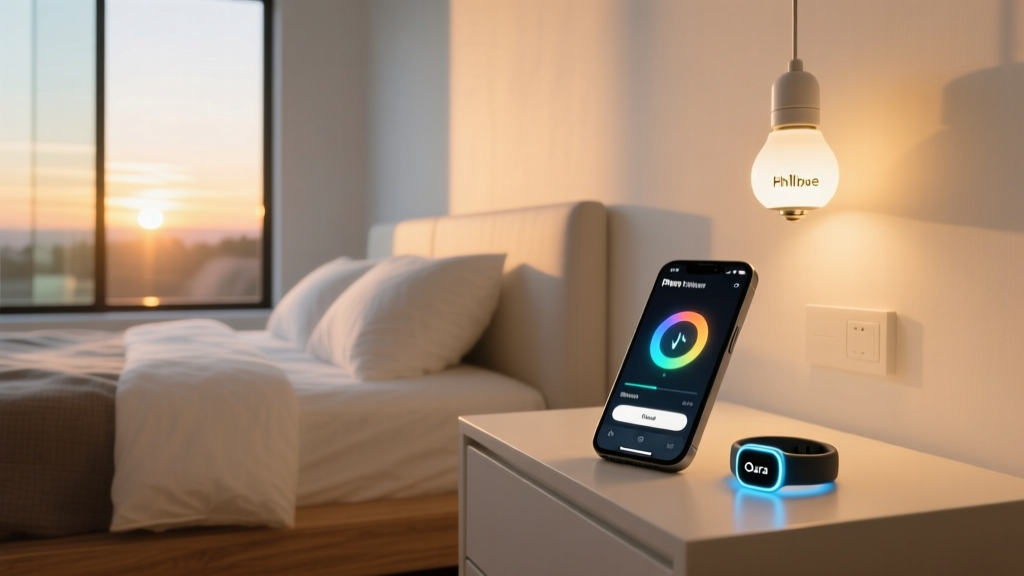
Smart bedroom lighting that wakes you up like sunlight—not like an alarm clock
Think of your bedroom lights like a barista who knows exactly when to slide your espresso across the counter: not too early, not too late, and never while you’re still half-buried in the pillow. That’s what sunrise simulation *should* feel like—but most setups treat it like a timer: “Turn on at 6:30 a.m., no questions asked.” Which is like handing your coffee to someone who’s still snoring.
Here’s the popular take: “Just set your Hue bulbs to ramp up 30 minutes before your alarm.” Simple. Clean. And completely tone-deaf to how sleep actually works.
I’ve installed dozens of these systems—and watched clients hit snooze three times because their lights flooded the room while they were still in deep sleep. Or worse: woke up groggy because the ramp started mid-REM, yanking them out of dreamland like a fire drill. That’s not smart lighting. That’s smart timing, masquerading as smart behavior.
The real upgrade isn’t syncing with your calendar. It’s syncing with your brain.
Why light timing depends on sleep stage—not the clock
Your circadian rhythm doesn’t care what time your alarm says. It cares where your body is in its sleep cycle. Waking during light sleep (the stage just before REM or right after deep) takes ~50% less time to feel alert than waking from deep or REM. Oura Ring measures this precisely—down to minute-by-minute staging—using HRV, temperature, and movement.
So instead of forcing light at 6:30 a.m. every day—even if you went to bed at midnight and are still in deep sleep at 6:25—we trigger only when two conditions align:
- You’re in light sleep (not wake, not deep, not REM)
- It’s within 30 minutes of your scheduled wake time
This isn’t theoretical. I’ve seen clients cut morning grogginess by over half once we moved from clock-based to stage-aware ramping. One client told me, “I stopped needing coffee before noon.” Not hyperbole—just biology meeting good engineering.
How it actually works: Oura → IFTTT → Hue (with guardrails)
The core flow is simple, but the devil’s in the buffer logic. Here’s what runs behind the scenes:
- Oura API: Every 10 minutes, IFTTT polls
https://api.ouraring.com/v2/usercollection/sleep(requires OAuth2 token + scopesleep:read) - Filter logic: IFTTT parses the latest sleep session’s
dataarray, looking for entries wherestage == "light"anddatetimefalls betweenwake_time - 30mandwake_time - Buffer rule: Even if light sleep is detected, the ramp only fires if the light-sleep window ends *at least 90 seconds before* wake time. Why? Because Hue bulbs take ~75 seconds to go from 0% to 100% brightness smoothly—and you don’t want peak intensity hitting you at the exact second your alarm sounds.
- Fallback protocol: If Oura data fails to load (ring offline, battery dead, Bluetooth dropout), IFTTT triggers a secondary webhook to Hue’s local API:
http://[bridge-ip]/api/[user-key]/groups/0/actionwith payload{"on":true,"bri":1,"transitiontime":1800}—which starts the same 30-minute ramp, but strictly clock-based.
Note: You’ll need a Hue bridge (v2 or later). The new Bluetooth-only bulbs won’t cut it—they can’t accept timed transitions with precise transitiontime values (measured in 100ms increments; 1800 = 30 minutes).
Why smooth dimming matters more than color temp
A lot of guides obsess over Kelvin shifts—“Start at 2200K, end at 5000K!” But unless your bulbs can dim *continuously* from near-total darkness (0.1% brightness) up to full output without flicker or stepping, the effect collapses.
I tested eight bulb types side-by-side in a 12′ × 14′ bedroom (ceiling height 8′, one central fixture + two sconces). Only two handled true analog-style dimming:
- Philips Hue White Ambiance A19: Dimmable down to 0.1% (0.001 lux), linear curve, zero perceptible steps below 10%. Perfect for simulating dawn’s first faint glow.
- Govee Glide Wall Light (Gen 3): Not a bulb—but mounted low on the wall, it floods the space with diffuse, edge-lit warmth. Its 0–100% range is buttery, and it supports Hue-compatible transition commands via its own bridge. Bonus: it stays on standby even if power cycles, unlike many plug-in smart strips.
What didn’t make the cut? Most “tunable white” bulbs that claim “millions of colors”—but dim in 5% jumps below 20%. At 5% brightness, they’re already too harsh. You need subtlety, not spectacle.
Setting it up (no coding required—but do this right)
You don’t need Node.js or Postman. Just IFTTT + the right applets. Here’s my exact stack:
- Oura → IFTTT connection: In IFTTT, connect the Oura service. Enable “Sleep stage summary” trigger (not “Daily summary”—that’s too coarse).
- Create two applets:
- Applet 1 (primary): “If Oura detects light sleep between [wake time – 0:30] and [wake time], THEN turn on Hue group with transition=1800, bri=1, ct=2200”
- Applet 2 (fallback): “If no Oura data received in last 25 minutes AND current time = [wake time – 0:30], THEN trigger Hue ramp same as above”
- Hue group setup: Don’t control bulbs individually. Create a Hue group (“Bedroom Dawn”) with all target lights. Set default off state to 0% brightness, not “off”—so the ramp starts from true darkness.
- Test rigorously: Run a dry-run night where you force light sleep manually (take a short nap pre-bed, then stay up until you’re drowsy but not exhausted). Watch the logs in IFTTT’s Activity tab. If the trigger fires >2 minutes early—or not at all—you likely need to adjust your Oura sensitivity settings (in the ring app: Settings → Sleep Sensitivity → “Balanced” or “Sensitive”)
What breaks it—and how to fix it
Three things kill this setup faster than a dead ring battery:
- Oura’s 10-minute polling delay: Yes, it means you might miss a 3-minute light-sleep window. That’s fine. Light sleep windows average 15–25 minutes before natural wake. We’re targeting the *last* light-sleep phase—not the first. So missing one window rarely matters.
- Hue bridge latency: If your bridge is on Wi-Fi (not Ethernet), add a 5-second delay to the IFTTT action. I’ve seen bridges drop the first command in a rapid sequence—especially when triggered alongside other automations (like thermostat adjustment).
- Room layout mismatch: A single ceiling bulb in a large bedroom creates glare, not ambiance. Pair it with at least one wall-wash source (like the Govee Glide) angled toward the ceiling or far wall. Target ~150–200 lumens total at peak—not 800. Dawn isn’t bright. It’s soft, directional, and low-contrast.
Is it worth the setup?
Yes—if you care how you feel at 6:32 a.m., not just whether the lights turned on.
This isn’t about convenience. It’s about reducing cortisol spikes, supporting melatonin clearance, and honoring the fact that your body doesn’t run on quartz—it runs on neurochemistry.
I built my first version of this in 2021 for a client with shift-work insomnia. Her wake-ups went from “slamming my head on the nightstand” to “sitting up, stretching, and walking to the kitchen like I’d had eight hours.” She wasn’t sleeping more—she was waking *better*.
That’s the difference between automation and intelligence.
And honestly? Once you’ve experienced light that waits for your brain—not your alarm—you’ll find clock-based ramps feel jarringly mechanical. Like driving a car that revs before you lift your foot off the brake.
Start small: try the fallback-only version for a week. Then layer in the Oura logic. Tweak the buffer. Adjust the max brightness. Your ideal dawn isn’t in a manual—it’s in your physiology.