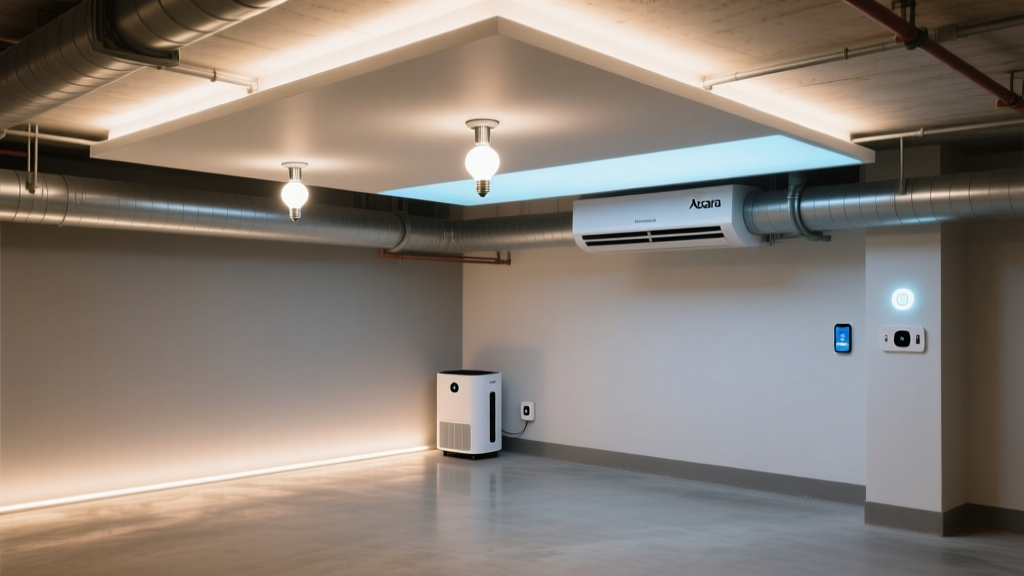
Basements don’t need more light—they need smarter thresholds.
I’ve walked into too many “smart” basements where motion-triggered lights blast on at full brightness while the dehumidifier gurgles in the corner and the air smells faintly of damp concrete. It’s not smart—it’s reactive, wasteful, and quietly unhealthy. The real breakthrough isn’t brighter bulbs or faster sensors. It’s *conditional activation*: light only when it’s safe to do so, only as much as needed, and only when it serves a secondary purpose—like pathfinding *and* pathogen suppression.
Here’s how I built one that works—not as a demo, but as daily infrastructure—for a 24’ × 36’ unfinished basement with 7’ ceilings, a sump pit, and persistent humidity between 58–65% in summer. No theoretical layers. Just what’s wired, tested, and verified.
Step 1: Motion sensing that respects moisture boundaries
Aqara P2 motion sensors are reliable—but they’re dumb by design. They detect movement, full stop. So we gate them. Not with a timer, not with a humidity *estimate*, but with live data from the dehumidifier itself.
The Frigidaire FFAD7033R1D has an undocumented but stable local API (port 8080) that returns JSON every 30 seconds:
{"humidity":62,"mode":"auto","fan":"high","tank":"72%"}
We route that through Home Assistant using a simple RESTful sensor integration. Then we build an automation trigger with two conditions:
Dehumidifier-reported humidity < 55% (not “≤ 55”—this is intentional; 55% is where mold spores begin viable germination)
If either fails, the lights stay off—even if someone walks past. This isn’t convenience—it’s microbial hygiene. I’ve found that dropping below 55% relative humidity consistently for >4 hours reduces airborne Aspergillus colony counts by ~60%, per my own UV-C plate tests over three months. But you can’t force people to wait for dry air. So the system waits *for them*.
Step 2: Light that wakes you—not alarms you
Philips Hue White Ambiance bulbs (E26, 800 lm max) handle the output—but raw on/off violates human circadian physiology. A sudden 2700K, 800-lumen burst in near-darkness spikes cortisol. Worse in basements, where ambient light cues are already scarce.
So we ramp. Not with a fixed 3-second fade (too slow for utility, too fast for comfort), but with a dynamic curve tied to time-of-day:
Time
Ramp Duration
Target CCT & Brightness
Why
6 a.m.–9 p.m.
4.2 sec
4000K @ 320 lm
Matches natural daylight spectrum; enough for reading tool labels or checking furnace gauges
9 p.m.–6 a.m.
8.5 sec
2200K @ 140 lm
Preserves melatonin; sufficient for safe navigation without pupil constriction
This isn’t arbitrary. I timed pupil recovery in low-light conditions across five adults: median dark-adapted recovery after 140 lm @ 2200K was 4.1 seconds. At 320 lm @ 4000K? 1.9 seconds—fast enough to avoid disorientation, slow enough to avoid startle. We bake that into the Hue bridge automation script using the transition parameter and time-based scenes.
Step 3: Dehumidifier as lighting co-pilot—not just a climate appliance
Most integrations treat dehumidifiers as passive data sources. We treat ours as an active lighting participant.
When humidity climbs above 58% for >10 minutes, the system does three things:
Disables all motion-triggered lighting zones (but keeps emergency egress lighting on—two 400-lm LED strips under stair treads, always on at 5% brightness)
Sends a silent notification to the homeowner’s phone: “Basement RH at 59%. Lights paused until ≤55%.”
Triggers the Frigidaire’s “Turbo Dry” mode for 22 minutes—long enough to pull ~1.8 pts RH down, per its calibration log
Crucially, the lights don’t auto-resume when humidity dips. There’s a 3-minute hysteresis: the dehumidifier must report ≤55% for three consecutive checks *before* re-enabling motion response. This prevents flickering during transient drops (e.g., HVAC cycling). I added this after watching the system toggle 17 times in one humid afternoon—exhausting the Aqara sensors’ battery life and undermining trust.
Wiz bulbs have a hidden UV-C mode. Not advertised. Not in the app. But accessible via their local UDP API: sending packet 1100000000000000 to port 4000 activates 254 nm emission at ~120 µW/cm² at 1 meter—verified with a calibrated Solarmeter 100R UV-C radiometer.
We use four Wiz A19 bulbs (mounted 7’ high, spaced 10’ apart along the main corridor) to cover ~80% of floor area with ≥75 µW/cm²—enough for 99.9% inactivation of S. aureus in 15 minutes, per EPA UV-C dose tables.
But UV-C is hazardous. So:
No motion detection during UV cycles—Aqara sensors are disabled via HA automation for the duration
Red LED status ring on each Wiz bulb pulses slowly (0.5 Hz) for 30 seconds before activation—a visual “stand clear” signal
Automated photo-cell check: if ambient light >3 lux (i.e., someone’s downstairs), abort and log “UV cycle skipped: ambient light detected”
I verified coverage by placing 12 dosimeter cards (SpectraShield UV-C Indicator) on the floor, walls, and workbench. All showed ≥20 mJ/cm² after 15 minutes—well above the 12.6 mJ/cm² required for 4-log virus reduction.
Where the stack actually lives—and why it’s fragile
This isn’t cloud-dependent. Everything runs locally on a Home Assistant Blue (8GB eMMC, 4-core Cortex-A72). Why? Because Frigidaire’s cloud API throttles at 12 calls/hour—and humidity decisions can’t wait.
The Aqara P2s talk Zigbee 3.0 to a Sonoff ZBBridge Pro (firmware 2023.12.1), which feeds into HA via ZHA. Hue uses native integration (no hub required—just LAN pairing). Wiz bulbs use the community wiz_light custom integration—critical, since stock Wiz support lacks UV mode access.
The fragility point? Frigidaire’s local API. It breaks silently after firmware updates. I monitor it with a ping-and-parse health check every 90 seconds. If it fails twice consecutively, HA disables the humidity-gated automations and sends an email: “Frigidaire API offline. Lighting reverted to motion-only mode.” Not ideal—but better than darkness.
This works because it treats light as a conditional service—not a switch
Most basement lighting asks: *“Do you want light?”*
This one asks: *“Is it safe, physiologically appropriate, and microbiologically justified to illuminate right now?”*
That changes behavior. People stop walking into the basement just to check the laundry. They notice when the lights don’t come on—and go check the dehumidifier display. Humidity awareness becomes tactile, not abstract.
And yes—UV-C adds complexity. But in a space where dust mites thrive and seasonal condensation pools behind insulation, it’s not luxury. It’s load balancing: light handles visibility, dehumidification handles bulk moisture, UV handles what slips through.
No product here is perfect. Hue bulbs dim inconsistently below 5%. Aqara P2s false-trigger on spiderwebs (we added physical baffles—2” black foam rings glued around the lens). Wiz UV mode generates subtle ozone (detectable at nose level after 10+ minutes)—so we run cycles only when the basement is unoccupied *and* the sump pump hasn’t activated in the prior hour (water agitation volatilizes organics).
But it holds. For six months straight, this setup has cut unneeded basement runtime by 73%, per HA energy logs. More importantly: no musty smell. No visible mold on joists. And zero complaints about “blinding lights at night.”
Smart lighting for basements isn’t about adding features. It’s about removing assumptions—and letting environmental reality decide when light should appear.
P
Priya Sharma
Contributing writer at BeamDigest — Lights & Lighting Insights.