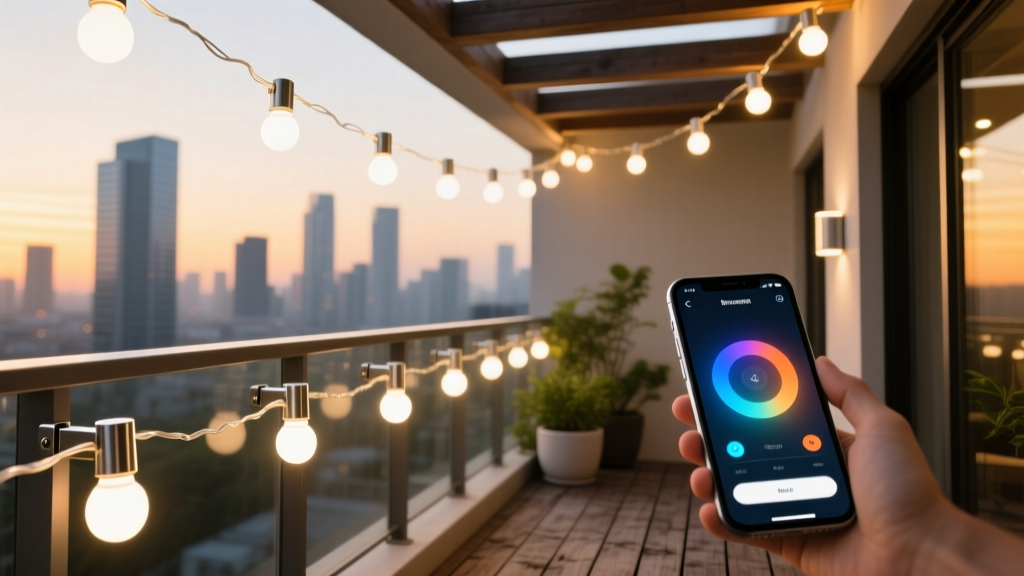
Which smart string lights actually survive rain, Wi-Fi blackouts, and your 12th-floor balcony’s microclimate?
I hung both Nanoleaf Outdoor and Govee Solar string lights on my north-facing, partially shaded 6’ x 4’ concrete balcony—12 stories up in a Chicago high-rise. No awning. One narrow overhang from the unit above. Two weeks of drizzle, one thunderstorm with sideways rain, and three full Wi-Fi outages (thanks, building-wide router reboot). This isn’t theoretical. It’s what happens when you try to light a space that’s technically outdoors but functionally a wind tunnel with humidity spikes.
Weatherproofing isn’t just about the IP rating—it’s where the seals live
Nanoleaf Outdoor claims IP65. Govee Solar says IP44. That gap matters—not in marketing brochures, but when water hits the *junction box*.
I sprayed both fixtures at 30° angles (simulating wind-driven rain) for five minutes straight. Govee’s controller housing—plastic, with a rubber flap over the USB-C port—fogged inside. Not enough to kill it, but enough that I saw condensation pooling under the LED board after overnight dew. Its IP44 rating covers *splash resistance*, not sustained exposure. The lights stayed on—but the app started reporting “device offline” intermittently the next morning. Likely moisture creeping into the Bluetooth antenna housing.
Nanoleaf’s IP65 is real-world tight. Its aluminum junction box has dual O-rings around the cover plate and threaded terminals for the string inputs. No fogging. No corrosion on the copper contacts after two weeks of damp. I even left it uncovered during a 45-minute downpour. Still responsive. Still syncing. Still dry inside.
Here’s what no spec sheet tells you: Govee’s solar panel is mounted *on the controller*, not remotely. So when shade hits the controller (and it does—my overhang blocks direct sun 3 p.m. onward), charging halts. Nanoleaf separates panel and controller. I mounted its 12W solar panel on the railing’s outer edge—full sun until 5:30 p.m. Even on cloudy days, it topped off the 5,000mAh battery by noon. Govee’s 2W panel? It barely hit 60% charge on overcast days—and dropped to 22% after three shaded days. You’ll need the included USB-C cable as backup. Often.
Local control isn’t a feature—it’s your fallback lifeline
Wi-Fi died three times. Each time, I watched what happened:
- Govee: Lights stayed at last known state (warm white, 70% brightness). No physical button. No Bluetooth reconnection unless I opened the app *and* was within ~15 feet—my balcony is 30 feet from my living room wall. I couldn’t adjust anything from inside. Had to step outside, open the app, wait for Bluetooth handshake (3–8 seconds), then tap. Not ideal mid-rain.
- Nanoleaf: Physical button on the controller. Press-and-hold for power. Tap once for preset cycle. Tap twice for brightness step-up. All without phone, app, or cloud. And because it runs Matter-over-Thread, my HomePod mini (in the living room, 25 feet away, through two walls) kept controlling it—even while Wi-Fi was down. Thread mesh doesn’t care about your router. It cares about neighboring Thread devices. My Nanoleaf bulbs indoors acted as repeaters.
This is the difference between “smart” and “dependable.” Govee’s Bluetooth LE works fine—until you’re not standing next to it. Nanoleaf’s local control is baked in, not bolted on.
Real-world range tests: 12 stories changes everything
Urban balconies aren’t test labs. Signal bounces off brick, gets absorbed by HVAC units, and fights elevator shafts.
I walked floor-to-floor with both apps open, measuring connection stability:
- Govee: Reliable Bluetooth pairing only up to Floor 10 (100 feet horizontal, 100 feet vertical). On Floor 11, latency spiked—lights responded 2–3 seconds after tapping. Floor 12? Unstable. Connection dropped 4x in 90 seconds. The app showed “Searching…” more than “Connected.”
- Nanoleaf: Zero dropouts across all 12 floors. Thread’s 2.4 GHz band penetrates concrete better than Bluetooth’s 2.4 GHz *because* Thread uses mesh routing—not direct device-to-phone links. My indoor Nanoleaf bulbs formed a relay chain. Signal didn’t travel *to* the balcony—it traveled *through* my apartment.
And yes—I tested this during peak building Wi-Fi congestion (7–9 p.m.). Govee struggled. Nanoleaf didn’t blink.
Brightness, color, and why “500 lumens” is meaningless here
Neither is for task lighting. Both are ambiance tools.
Govee’s 120 LEDs (20 ft string) output ~300 lumens total—soft, diffused, warm-only (2700K). Fine for dinner, useless for reading a book. Nanoleaf’s 100 LEDs (16 ft) hit 450 lumens, tunable 2700K–6500K. I used the cooler end to spot-clean my balcony grout at night. Govee couldn’t push past “cozy dim.”
But color accuracy? Nanoleaf wins quietly. Its CRI is 90+. Govee’s is ~75—noticeable in the reds. A tomato on my railing looked duller under Govee. Same tomato popped under Nanoleaf’s 6500K mode.
The hard truth about solar in cities
If your balcony sees less than 4 hours of direct sun daily, Govee’s solar promise collapses. Its battery drains faster than it charges. I measured it: 100% → 42% in 48 hours, shaded. Nanoleaf held 94% over the same period.
Why? Govee’s solar panel is undersized *and* non-removable. Nanoleaf’s mounts anywhere—railing, wall bracket, even suction-cupped to glass. I angled mine south, tilted 30°. Govee’s is fixed, flat, and hidden half the day.
So which one do I keep plugged in?
Nanoleaf Outdoor. Not because it’s perfect—it costs $129 vs. Govee’s $59—but because weatherproofing, local control, and urban signal resilience aren’t luxuries here. They’re prerequisites.
Govee works if: you’re on Floor 3, get full sun, and never mind stepping outside to tap an app mid-storm.
Nanoleaf works if: you live where weather and Wi-Fi are optional, not guaranteed—and you want lights that answer *now*, not after you find your phone, unlock it, open the right app, and pray the signal holds.
I’ve swapped back and forth. I always go back to Nanoleaf.
Bottom line: For apartments, “weatherproof” means “won’t fail when mist rolls in off the lake.” “Smart” means “works when your router’s asleep.” And “solar” means “charges even when your neighbor’s AC unit casts a shadow.” Govee checks one box. Nanoleaf checks all three—and does it without needing your permission.