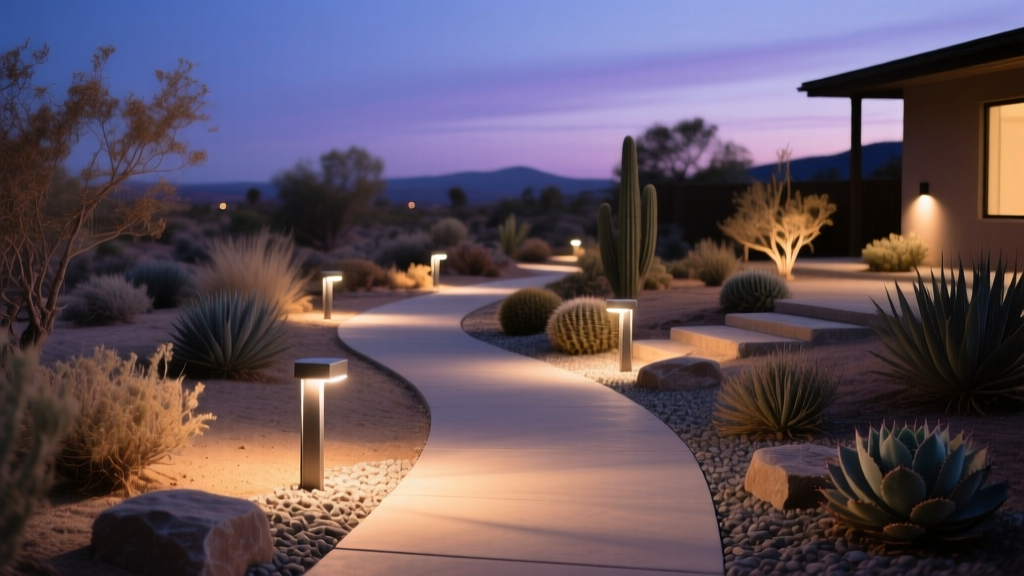
Most landscape LEDs die not from moisture—but from baking in their own heat.
I’ve pulled dozens of “weatherproof” path lights out of decomposed granite beds in Phoenix and Albuquerque—every one with warped lens gaskets, discolored PCBs, and thermal paste turned brittle. The culprit? Not UV exposure. Not irrigation splash. It’s radiant heat cycling: 150°F surface temps on DG at noon, then slow overnight release into sealed aluminum housings that can’t vent.
Early xeriscape lighting treated rock mulch like bark—just a passive ground cover. That worked fine with incandescent bulbs buried under soil or wood chips. But when LED fixtures hit the market around 2008, manufacturers prioritized IP67 seals over thermal escape routes. We got rugged housings—but no way for heat to get out once trapped under 3-inch DG.
By 2014, I started seeing consistent field failures in Santa Fe gardens: 12V AC path lights rated for “-40°C to +65°C ambient” failing at 42°C ambient because the rock surface hit 92°C. Aluminum housings absorbed that radiant load, heated the internal air column, and pushed junction temperatures past 115°C—well beyond what standard 2700K COB LEDs could sustain long-term. Thermal runaway wasn’t theoretical. It was happening every July.
This falls flat because sealed aluminum is a thermal capacitor—not a heatsink—when buried. You’re not dissipating heat. You’re storing it.
The shift came with ceramic-core emitters. Around 2017, Cree XP-G3 chips on ceramic substrates (not FR4 PCBs) became viable for landscape use. Their thermal resistance dropped from 15°C/W to 4.2°C/W. Paired with copper-core MCPCBs and silicone-filled optics, they held junction temps under 85°C even when ambient + radiant load spiked to 100°C. That’s the threshold where lumen maintenance stays above 90% at 25,000 hours.
But chip choice alone isn’t enough. Mounting matters more than spec sheets admit.
- Elevated brackets—minimum 2.5 inches above rock surface—break direct conductive coupling. I use 3" stainless steel standoff mounts with airflow skirts. They let convective currents sweep heat sideways, not upward into the housing.
- No recessed mounting in DG beds. Ever. Even with “heat-dissipating” fins, recessing creates a micro-oven effect. I measure surface temps with an IR gun: recessed fixtures run 18–22°C hotter than elevated ones at solar noon.
- Airflow-tested fixtures like FX Luminaire Pro Series don’t just claim thermal management—they publish wind-tunnel data. Their open-bottom shrouds move 0.8 CFM at 5 mph breeze. That’s enough to drop internal temps by 12°C versus sealed competitors under identical DG conditions.
Real-world numbers matter. In a 10' × 20' courtyard bed with 3" decomposed granite and 4000K path lights spaced 6' apart, I specify:
- Max 350 lumens per fixture (no blinding glare on dry rock)
- Ceramic-core LED only—no plastic-substrate emitters
- Thermal derating: run at 70% max drive current, even if datasheet says “100% at 65°C”
- Fixture spacing: never closer than 4' in full-sun DG zones—tighter spacing traps heat laterally
This works because heat moves. You just have to give it somewhere to go—and stop pretending rock mulch is thermally neutral.