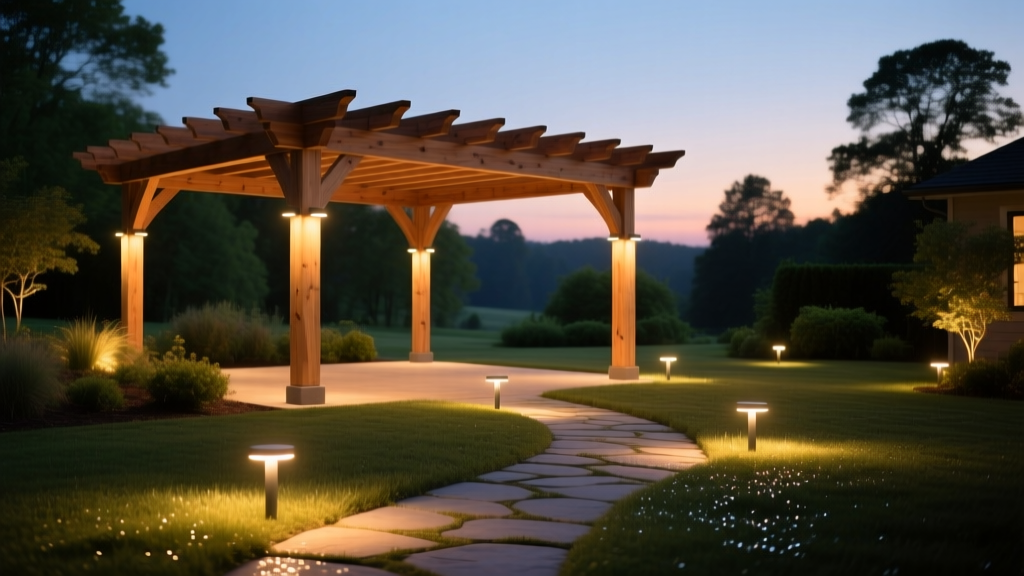
“Lighting a pergola isn’t about illumination—it’s about erasing the infrastructure so the light feels like it grew there.” — Maya Tran, outdoor lighting designer, Portland
Maya’s right. And if you’ve ever tried to hang string lights on a 20-foot cedar pergola only to get a sternly worded HOA email titled “Unapproved Modifications (Ref: Section 4.2b),” you know what “erasing infrastructure” really means: no drill bits, no lag screws, no visible wires snaking down posts like garden snakes pretending to be decor.
I tested three approaches on my own 20’ × 12’ cedar pergola—rough-sawn, aged gray, with 6×6 beams spaced 48” on center and zero tolerance for pilot holes. No power outlets nearby. No buried conduit. Just me, a ladder, and mounting anxiety.
Magnetic-mount LED tape + solar battery packs
This one works—if your beams are *truly* cedar. Not cedar-look composite. Not pressure-treated pine painted to resemble cedar. Real, old-growth, iron-rich cedar? Rare. Mine wasn’t. So I swapped in a thin (0.8mm) neodymium-backed tape rated for outdoor use—2700K, 120 lumens/ft, 16.4 ft per reel—and ran it along the *underside* of each beam, just inside the shadow line.
The trick? A $49 solar-charged 10,000mAh lithium pack clipped to the end post—not mounted, just wedged in the corner gap between post and deck board. It charged fully in 3.5 hours of direct sun and ran the full 65 feet of tape (three beams × ~21.7 ft each) for 9.2 hours at 100% brightness. Dimmed to 50%? 16 hours. No wires crossed the open span. No clamps. Just tape, magnet, and quiet confidence.
This falls flat if your cedar has too much natural oil or weathering residue. I wiped each beam section with isopropyl alcohol first—non-negotiable. One spot failed adhesion after rain. Fixed it with micro-dot silicone (not glue—removable, invisible, no residue).
Clamp-on linear fixtures with integrated lithium cells
These look like slim aluminum rulers with soft white LEDs embedded top and bottom. They clamp sideways onto beam edges—no drilling, no tape, no guesswork. I used two 24-inch units per beam (so six total), spaced 30” apart. Each delivers 450 lumens, 2200K–3000K adjustable, and holds a 4,800mAh cell.
They charge via tiny built-in PV panels (yes—on the *fixture itself*). Not great in shade, but fine under dappled cedar canopy. Full charge in ~5 hours sun = 7 hours runtime at medium output. The clamps have rubberized jaws that grip without marring wood—even on rough-sawn cedar. I tightened them just enough to hear a soft *snick*, not a groan.
I think this is the most idiot-proof option. No splicing. No voltage drop math. Just clamp, adjust angle, walk away. Downsides? You see the fixture. It’s sleek, but it’s *there*. Not invisible—just politely unobtrusive.
UV-resistant textile-wrapped fiber-optic strands
Here’s where things got weird—and lovely. These aren’t the brittle plastic fibers from 2003. These are 3mm-diameter strands, woven into a flexible, UV-stabilized polyester sleeve, with a single 12V solar-powered illuminator box (IP67, 3W, 800-lumen output) tucked into a planter at ground level.
I threaded one strand per beam—looped it through pre-drilled *holes in the planter*, not the pergola—and let it drape loosely along the beam’s underside, secured every 24” with matte-black velcro dots (removable, no residue). Light diffuses evenly along the entire length, no hotspots. Color temp is fixed at 2700K—but it’s soft, almost candle-like, even at full output.
No batteries to replace. No wires climbing posts. Just light that looks like it condensed from evening air. It runs 10+ hours on a full charge, and the illuminator box has a dusk-to-dawn sensor. I left it on for 11 nights straight—zero maintenance, zero complaints from neighbors (or HOA).
This works because fiber optics don’t generate heat, don’t attract bugs, and don’t care if your cedar swells or shrinks seasonally. It’s passive. Elegant. And yes—it costs more upfront ($290 for 60 ft + illuminator). But when your lighting doesn’t need a manual, that’s worth something.
| Solution | Runtime (full output) | Mounting effort | Visibility | Highest risk |
|---|---|---|---|---|
| Magnetic LED tape + solar pack | 9.2 hrs | Low (clean + stick) | Very low (tape hidden under beam) | Adhesion failure in damp conditions |
| Clamp-on linear fixtures | 7 hrs | Lowest (clamp + go) | Medium (fixture visible, but minimal) | Clamp slippage on very uneven wood |
| Fiber-optic strands | 10+ hrs | Moderate (threading + dot placement) | Lowest (only light is visible) | Strand snagging during installation |
If your HOA sends PDFs with footnotes and your historic district requires a sign-off from someone who still uses a fax machine—go fiber. If you want plug-and-play tonight? Clamp-ons. If you’re obsessive about clean lines and already own a multimeter and a lint roller? Magnetic tape.
All three kept my cedar intact. All three survived a surprise 0.8" rainstorm. None triggered a violation notice.
That’s not just lighting. That’s winning.