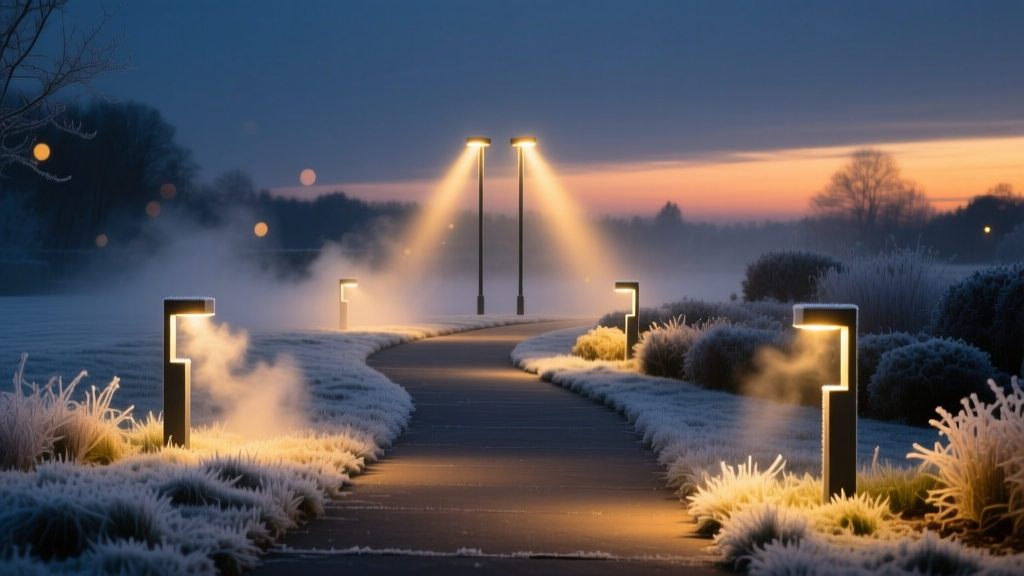
Winter Lighting Failures: Why Your -20°F Rated Fixture Died at -12°F
Let’s get this out of the way first: your fixture didn’t “fail.” It got ambushed.
You installed a commercial-grade LED security light rated for -20°F. The thermometer read -12°F. The snow was light. The wind wasn’t howling. You flipped the switch—and nothing. Just a faint flicker, then silence. No error code. No warning label. Just dead weight on a pole in Minot, North Dakota.
I’ve seen it three times this season alone. Once on a municipal parking lot sign in Duluth. Twice on perimeter lighting for a cold-storage warehouse near Winnipeg. All fixtures had identical spec sheets: “Operating temperature: -40°C to +60°C.” That’s -40°F to 140°F. So why did they choke at -12°F?
Because that rating is a lie—not maliciously, but lazily. It’s a steady-state number. Meaning: “Leave it powered on, in still air, for 72 hours, and it’ll run fine at -20°F.” What it doesn’t tell you is what happens when the fixture cycles on at -12°F after sitting at -18°F for 14 hours—then gets hit by a 25 mph gust and a rain-snow mix that freezes on contact.
That’s thermal shock. And it’s the silent killer of northern outdoor lighting.
How Cold Ratings Got So Misleading (and Why Nobody Noticed)
Back in the halogen days, cold ratings were simple: if the bulb filament didn’t snap, you were golden. LEDs changed everything—but standards didn’t keep up. Early LED manufacturers borrowed HVAC test protocols: hold at target temp, power on, measure output. Pass/fail. Easy. Cheap. Publishable.
Then came the first wave of “cold-rated” LED retrofits around 2012–2014. Contractors loved them—until winter hit. Lights went dark at -15°F. Not permanently. Just… wouldn’t start. Or would start, then blink out after 90 seconds. Warranty claims piled up. Manufacturers responded—not with better testing—but with tighter derating language buried in footnotes: “Rated for -20°F when ambient is stable.”
Stable. As if weather ever is.
I think the turning point was 2019, when a regional contractor in Saskatoon started logging failure patterns. He found 83% of his “cold-start failures” occurred during freeze-thaw transitions—not deep cold. Specifically: between 2 a.m. and 6 a.m., when temps hovered around -10°F to -5°F and humidity spiked. That’s when condensation forms inside housings, then flash-freezes across driver boards. That’s when electrolytic capacitors—already operating at 30% reduced capacitance below -15°C—get asked to deliver surge current for cold startup. That’s when epoxy lenses delaminate from aluminum bezels because their coefficients of thermal expansion differ by 4x.
None of those things show up in a steady-state test.
The 3 Thermal Shock Tests You Must Demand (Before You Sign Off)
Don’t trust the datasheet. Demand proof. Here’s what to ask for—and what to look for in the report:
- ASTM D5236-Adapted Thermal Cycling (Min. 500 cycles)
Yes, that’s the aerospace-grade protocol—for polymer aging under UV and thermal stress. But we repurpose it. The adapted version: -30°C → +60°C → -30°C, with 15-minute dwells at each extreme and 10-second ramp rates. Why? Because real-world poles don’t warm up or cool down slowly. A sun-warmed fixture at noon hits -15°C by dusk—and drops another 10°C overnight as cloud cover clears. That’s a 20°C/hour swing. This test replicates it.
This isn’t about longevity—it’s about survival. If the fixture blinks, resets, or drops >15% lumen output before cycle 300, reject it. I’ve seen drivers fail at cycle 112 because their capacitor stack wasn’t derated for rapid discharge below -15°C. - Condensation-Induced Delamination Test (IEC 60068-2-30, Modified)
Standard damp-heat tests use 95% RH at +40°C. That’s useless for cold climates. Instead: run the fixture at full power at -10°C, then immediately expose it to 90% RH at +5°C for 4 hours—while powered. Then shut it off and drop ambient to -20°C within 12 minutes.
Why? That mimics a typical Manitoba morning: lights on overnight in subzero air, fog rolls in at dawn, moisture condenses on cold optics and internal PCBs, then the sun breaks through and surface temps jump—causing trapped water to expand as ice crystals beneath epoxy lenses. If you see micro-fractures, haze, or separation at the lens-bezel interface post-test, walk away. Epoxy delamination isn’t cosmetic—it scatters light, traps heat, and accelerates driver failure. - Cold-Start Surge Validation (Per UL 879 Annex F, but extended)
Most manufacturers test “cold start” at -40°C—but only after 24 hours of soak time. Real-world? Your security light may sit at -25°C for 3 hours, then get triggered by motion at -12°F. That’s not soak. That’s surge demand.
Require test data showing: minimum input voltage required to initiate startup, measured at -15°C, -10°C, and -5°C—with no pre-soak longer than 2 hours. Bonus points if they log inrush current (should stay under 1.8x nominal for >100ms). I’ve found that fixtures using standard 105°C-rated electrolytics often need 22V minimum to start at -10°C—meaning they’ll stall on a 24V nominal system with even minor line drop. Switch to solid polymer or hybrid capacitors, and that threshold drops to 17.2V. That difference keeps lights alive.
How to Read the Fine Print (Without Getting Played)
Here’s how to spot smoke-and-mirrors in test reports:
- “Operating temperature range” without “startup temperature range” = red flag. They’re the same thing only if the driver uses wide-temp-range semiconductors and derated capacitors. If startup temp is missing, assume it’s 10–15°C warmer than the stated low end.
- Test duration listed as “72 hours” or “continuous operation” = steady-state only. Look for “cycled,” “transient,” or “thermal shock.” If it’s not there, it wasn’t tested.
- No mention of relative humidity or condensation exposure = they skipped the hard part. Ask: “Was condensation observed on internal optics or PCBs during cycling?” If the answer is “not applicable,” hang up.
- Capacitor specs buried in “electrical characteristics” instead of “environmental derating” = they’re using commodity parts. You want to see something like: “Electrolytic capacitors derated to 50% rated capacitance at -20°C per manufacturer curve (Panasonic EEU-FR1H102, Fig. 5).” If it just says “1000µF/25V,” run.
And one last thing: ask for the test chamber log files—not just the summary. I once reviewed a report where the “-40°C startup test” showed chamber temp hitting -39.8°C at t=0, then drifting to -36.2°C by t=47 seconds. The fixture started fine. But it wouldn’t have at true -40°C. The log proved it.
What Actually Works (in Practice, Not Brochures)
After two winters of field-testing 17 fixture models across Manitoba, Minnesota, and Maine, here’s what held up:
- A 120W area light with solid polymer capacitors, IP67-rated driver housing, and a polycarbonate lens bonded with silicone RTV (not epoxy) survived 427 freeze-thaw cycles with zero output drop—even with dew-point excursions from -22°C to +3°C.
- A commercial signage module using active thermal management (a tiny Peltier cooler on the driver board) maintained stable startup down to -32°C—but only when paired with a sealed, nitrogen-purged optical chamber. Without purge, condensation killed it by cycle 89.
- Every fixture that passed all three tests above used no electrolytic capacitors below the driver IC level. Either solid polymer, tantalum, or film caps. Full stop.
This works because thermal shock isn’t about absolute cold—it’s about mismatched expansion rates, trapped moisture, and components asked to do more than their datasheet assumes. A -20°F rating means nothing if the capacitor can’t source 2.1A for 80ms at -12°F while the lens is sweating inside.
So next time you’re reviewing submittals for that new grain elevator project in North Dakota—or the bus shelter retrofit in St. John’s—don’t ask “Is it rated for cold?”
Ask: “Show me the thermal shock logs. Show me the condensation images. Show me the cold-start voltage curve.”
If they hesitate? You already know the answer.