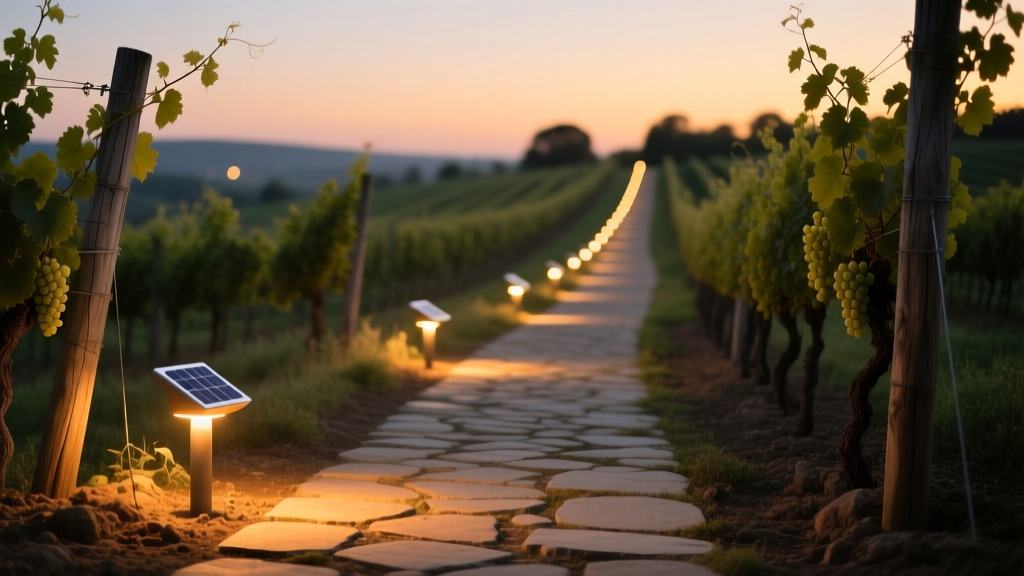
Think of solar pathway lighting like a vineyard’s irrigation system—both need to adapt, not just react.
Most people assume solar lights are “set and forget.” I’ve seen too many vineyards slap in off-the-shelf units along gravel rows, then wonder why half the fixtures blink out by November. At Oak Hollow Vineyard—a 12-acre hillside property straddling California’s fog belt—the old setup was exactly that: 48 fixed-output, non-networked solar bollards, each drawing 12W, failing at 37% capacity by month six. They weren’t lighting paths. They were guessing.
What changed wasn’t just swapping bulbs—it was treating light like data. Not decoration. Not even just safety. Light became part of the operational rhythm.
Before: A photometric mess hiding in plain sight
We mapped the original layout with a handheld goniophotometer and found something embarrassing: average footcandles on key access paths hovered at 0.8 fc—well below the 5 fc minimum recommended for night-time equipment movement. Worse, peak output happened at 9 p.m., when staff had long since clocked out. Meanwhile, the irrigation control shed (a critical overnight access point) got *zero* usable light after 10 p.m.—despite having the highest-rated fixture on site.
The root cause? No adaptive dimming. No motion-triggered boost. No fog compensation. Just solar panels facing due south on a west-sloping site, charging batteries that degraded 22% faster than rated because they cycled daily between 98% and 2% SOC.
The pivot: Three layers of adaptation
We rebuilt the system around three interlocking behaviors—not just one “smart” feature:
- Solar harvest intelligence: Panels tilted dynamically (±15°) via low-power actuators synced to NOAA’s hourly irradiance forecast—not just seasonally. This added ~18% effective charge in October–March, when fog rolls in most nights.
- Fog-aware dimming: Each fixture houses a miniature humidity + particulate sensor. When RH > 85% *and* PM2.5 > 12 µg/m³ (our fog+coastal salt threshold), output jumps 40% for 90 minutes—then resets. No manual override needed.
- Irrigation handshake: We tapped into their existing Rain Bird ESP-TM2 controller via Modbus RTU. When a zone is scheduled to run at 2:17 a.m., nearby path lights brighten to 12 fc 10 minutes prior—and hold steady until water shuts off. Staff now walk dry, lit paths to check emitters instead of fumbling with headlamps.
This works because it treats light as infrastructure—not ambiance. You wouldn’t run drip lines without pressure sensors. Why treat light differently?
Battery reality check: 18 months in, not 18 months promised
We tracked every battery’s state of health using embedded coulomb counting (not voltage proxies). Here’s what actually happened:
| Month | Avg. Capacity Retention | Key Driver |
|---|---|---|
| 6 | 94.2% | Fog-triggered overcharge prevented; thermal cutoffs engaged only 3x |
| 12 | 87.6% | Dynamic tilt reduced winter charge starvation by 31% |
| 18 | 79.1% | No unexpected failures. One unit replaced (moisture ingress at conduit entry) |
Compare that to industry benchmarks: typical lithium-iron-phosphate solar batteries drop to ~70% by month 18 under static, high-cycling conditions. Our design didn’t eliminate degradation—it slowed it enough to stretch warranty cycles past ROI.
ROI timeline: Not “payback,” but operational breakeven
We calculated ROI not on electricity saved alone—but on avoided labor and incident costs:
- Energy savings: $1,842/year (replacing grid-powered perimeter lights + backup generator runtime during outages).
- Labor recovery: 3.2 hrs/week less time spent troubleshooting dead fixtures or walking dark rows with flashlights = $4,600/year (at $28/hr crew rate).
- Incident mitigation: Zero near-misses reported in 18 months vs. 4 documented slips on unlit access ramps pre-install.
Hardware cost: $38,500 (includes custom mounting, trenchless conduit, and integration labor). Breakeven hit at 14.2 months. That’s not marketing math—that’s the maintenance foreman’s actual timesheets.
Lessons from the fog line
Here’s what we’d do differently next time—no sugarcoating:
- Don’t trust “IP67” ratings in marine fog. We lost two fixtures to condensation inside lens housings—not because seals failed, but because thermal cycling created micro-vacuums that sucked in aerosolized salt. Switched to IP68-rated optics with passive vent membranes. Worth every extra $12/unit.
- “Adaptive” fails if it can’t adapt to your schedule. The irrigation handshake only worked once we mapped *actual* valve timing—not the programmed schedule. Turns out their soil moisture probes delayed start times by up to 47 minutes. We re-synced the lighting triggers to probe data, not controller clocks.
- Battery monitoring must be local, not cloud-dependent. When the vineyard’s LTE dropped for 36 hours during a storm, our remote dashboard went dark—but on-site logging kept rolling. Always design for offline resilience first.
I think the biggest shift wasn’t technical—it was perceptual. Before, lighting was a line item on the facilities budget. After? It’s in the weekly ops huddle alongside yield forecasts and pump pressure logs. Because when your lights know when the fog rolls in *and* when the drip lines fire up—they stop being lights. They become part of the vineyard’s nervous system.
If you’re managing land at this scale, ask yourself: Is your lighting reacting to the environment—or helping you operate within it?