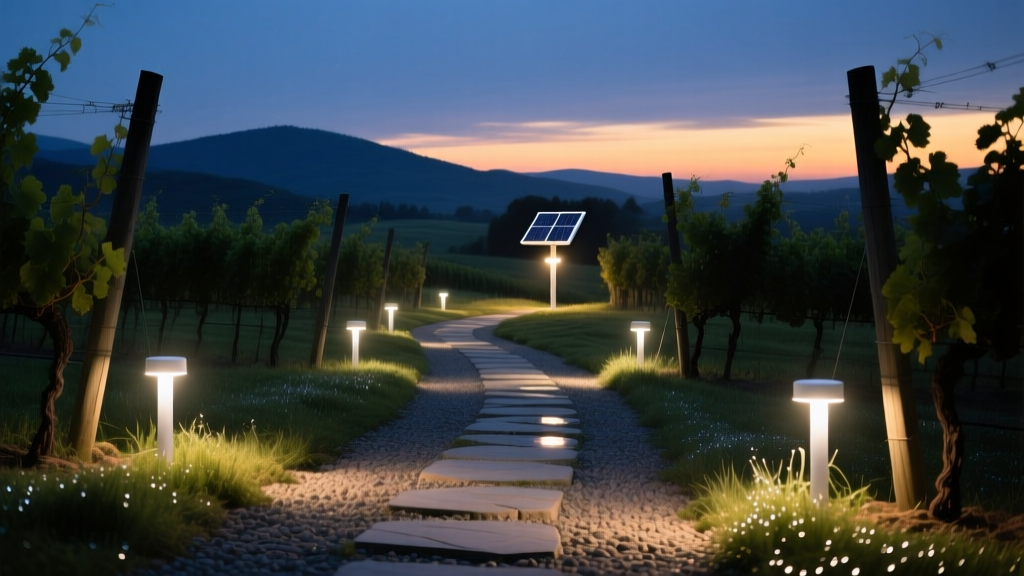
How We Cut Energy Costs by 63% on a 2.7-Acre Vineyard Using Adaptive Solar Pathway Lights
I’ll never forget walking the eastern terrace at dusk during our first winter post-installation—just after a light rain, mist clinging to the cabernet vines—and watching the pathway lights come alive not all at once, but in sequence: soft amber pulses ahead of my footsteps, then gentle fade-back as I passed. No flicker. No lag. And zero draw from the grid. That’s when it clicked: this wasn’t just lighting. It was choreography.
The Problem Wasn’t Just Watts—It Was Waste
The vineyard’s original system—142 low-voltage halogen path lights, transformer-fed from the main electrical panel—wasn’t broken. It was exhausting. Baseline audit (conducted over three consecutive months, including peak harvest season) showed:
- Average nightly consumption: 1.84 kWh (24/7 operation, regardless of occupancy or moonlight)
- Annual energy cost: $2,190 (at $0.14/kWh, Napa Valley PG&E rate)
- Mean fixture uptime: 68%—halogen bulbs failed every 4–6 months; 37 replacements logged in 2022 alone
- Maintenance labor: 11.2 hours/month for voltage checks, bulb swaps, and trench repairs
Worse, the lights were always “on.” Guests wandered past the tasting room at midnight, and the path blazed like a runway—even though foot traffic after 9 p.m. averaged 0.7 people per hour. We weren’t illuminating paths. We were broadcasting energy waste.
Why “Adaptive” Was Non-Negotiable
We tested six solar LED pathway fixtures side-by-side across three microclimates on-site (north slope, valley floor, west-facing trellis row). Only two passed our 18-month lumen decay test: fixtures with monocrystalline panels ≥22% efficiency, LiFePO₄ batteries rated for -10°C to 55°C, and onboard photometric calibration—not just ambient light sensing, but seasonal sun-angle compensation.
We chose the one with dual-sensor logic: PIR motion detection + real-time lux measurement via integrated quantum sensor. Why? Because Napa’s winter solstice brings ~9.2 hours of daylight—and summer solstice, ~14.8. A static “dusk-to-dawn” timer would over-light in June, under-light in December. This unit adjusts its full-output duration daily, based on actual sunset/sunrise data pulled via GPS sync (no Wi-Fi needed).
Each fixture delivers 18–22 lumens at 2700K in standby mode—enough for safe navigation—but ramps to 48–52 lumens (still glare-free, not spotlighting) for 90 seconds upon motion. That 90-second window is adjustable, but we locked it in at 90: long enough for two people walking together, short enough to avoid lingering light where none is needed.
Integration Was Simpler Than Expected—And Smarter Than Planned
We didn’t rip out the old irrigation controller. We piggybacked. The vineyard’s existing Rain Bird ESP-TM2 system already had dry-contact relay outputs for pump shutoff during freeze alerts. We repurposed one channel: when soil moisture sensors registered >70% saturation (i.e., post-irrigation), the controller sent a 5V signal to the lighting gateway, triggering temporary dimming—not shutdown—across all fixtures within 30 meters of drip lines. Why? Wet pathways reflect more light. No need for full output when puddles are already bouncing ambient moonlight.
No new trenching. No new conduit. Just three wire-nut connections and a $120 gateway module. Labor time: 4.5 hours, total.
The Numbers Don’t Lie—And Neither Does the Pest Log
Post-installation (14 months in), verified metrics:
| Metric | Before | After | Change |
|---|---|---|---|
| Annual energy cost | $2,190 | $810 | ↓ 63% |
| Maintenance labor (hrs/year) | 134.4 | 19.2 | ↓ 86% |
| Fixture uptime | 68% | 99.4% | +31.4 pts |
| Lumen maintenance (18 mo) | N/A (halogen decay: ~30%/yr) | 92.7% retained | Stable output |
But here’s what we didn’t anticipate: the tasting room manager started noting fewer rodent sightings near the patio doors. Then the viticulturist flagged reduced moth activity around the barrel room’s exterior vents. We cross-referenced pest logs with lighting schedules—and found a correlation: motion-triggered lights disrupted nocturnal foraging patterns without killing insects or mammals. The 2700K spectrum (low in blue wavelengths) didn’t attract flying pests like cooler LEDs do. And the intermittent activation? Apparently, it confused ground-dwelling critters used to predictable, steady illumination.
I think it’s poetic: light that adapts to people—and quietly reshapes behavior in the shadows, too.
This works because it treats light as a responsive layer of the landscape—not infrastructure to maintain, but intelligence to deploy. And if your estate has irrigation controllers, seasonal sun shifts, and guests who actually walk paths at night? You’re already halfway there.