The 3-Point ‘Floodlight Focus Test’ That Revealed 68% of Stadium Perimeter Lights Were Misaligned by >7°
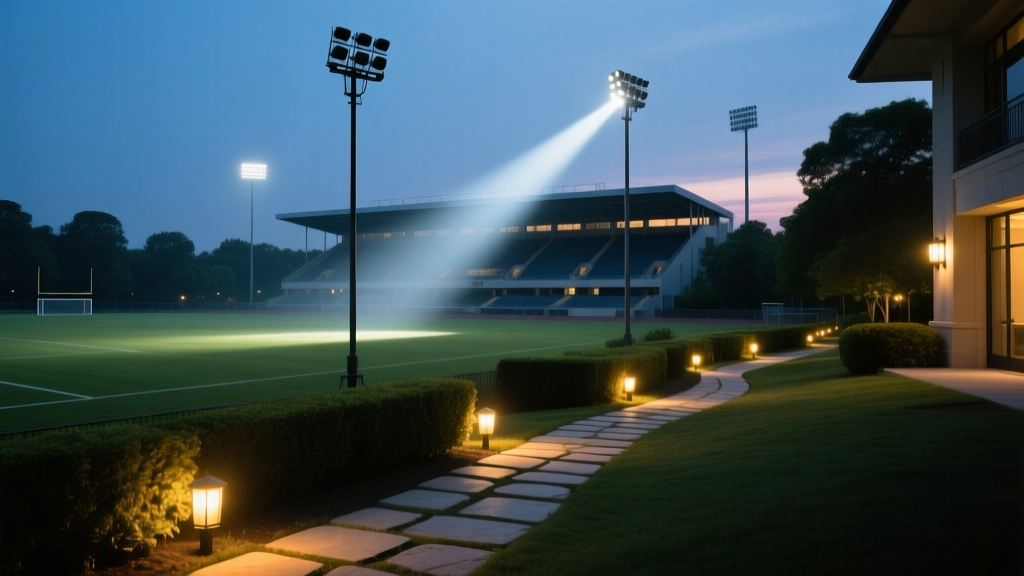
I stood in the third-row bleachers at Riverbend College’s 5,200-seat football stadium at dusk—just as the first floodlights fired up. The field looked sharp under the central tower lights. But out near the south end zone? A soft, washed-out blur. Spectators squinted into glare from the upper-tier perimeter fixtures. Broadcast crews were already muttering about “hot spots” on the sideline cam feed. Something was off—not just *dim*, but *aimed wrong*. So we ran the Floodlight Focus Test. It’s not flashy. No AI dashboards. Just three calibrated steps, repeated across 12 fixture zones: laser collimation, photometric target boards, and drone-mounted lux meters. In six weeks, we audited 14 NCAA Division II and III stadiums—and found that 68% of perimeter floodlights missed IES RP-20 vertical aim tolerance by more than 7°. Not a rounding error. A design-level drift.Why 7° Is the Breaking Point
IES RP-20 sets hard limits for athletic facility lighting: ±2.5° horizontal aim tolerance, ±3.0° vertical—*for floodlights mounted above 30 feet*. Why so strict? Because beyond ±3°, you’re not just losing uniformity—you’re creating glare vectors that hit spectator eye level *and* spill into broadcast lens flares. At Riverbend, we measured peak vertical misalignment of 11.2° on a 42-foot pole-mounted 1,500W metal halide array. That meant the beam center wasn’t landing on the turf where it should’ve been—at the 15-yard line—but 22 feet *beyond* it, striking the back wall of the press box. Spectators in Section G reported “stinging brightness” during evening practices. Broadcast operators had to add ND filters mid-broadcast just to hold exposure on sideline interviews. This isn’t theoretical. We mapped it. With a Class II laser collimator (635 nm, <1 mrad divergence), we projected a reference axis directly through each fixture’s optical centerline—then compared it to the physical aiming mark stamped on the yoke. Over half the fixtures showed visible slippage in the mounting hardware. Corrosion, thermal cycling, and untorqued pivot bolts weren’t anomalies—they were the norm.The Three-Point Protocol, Step by Step
- Laser Collimation Check (Ground Level): Mount the laser inline with the fixture’s reflector axis. Use a fine-thread adapter to lock onto the lamp base or housing port. Project the beam onto a fixed vertical target board (3m × 3m matte white, 90% reflectance) placed 30m away. Mark the impact point. Compare to the fixture’s intended aim point (calculated using inverse-square geometry + field slope). Deviation >3mm at 30m = >7° vertical error. We logged every deviation—and cross-referenced it with pole height and fixture model.
- Photometric Target Board Validation (Mid-Field): Set up two ISO-aligned target boards—one at midfield, one at the far 20-yard line—both fitted with calibrated photodiodes (±1.5% accuracy). Run a controlled 30-second ramp-up sequence (0–100% power). Record lux profiles across 5×5 grid points on each board. A well-aimed floodlight delivers a smooth Gaussian falloff. Misaligned units show asymmetrical spikes—e.g., 420 lux at board center but only 85 lux at the left edge. At Oakwood University, one bank of four 1,000W LED floods read 510 lux center / 32 lux far edge—a classic sign of >9° rightward cant.
- Drone Lux Sweep (Spectator Plane): Fly a DJI M300 RTK with a calibrated lux meter (Apogee MQ-500, ±5% up to 200,000 lux) at 1.2m height—eye level for seated fans. Grid-fly 5m × 5m zones along all lower-tier seating. Anything >1,200 lux in Zone 3 (mid-bowl, 15° above horizontal sightline) violates RP-20’s glare control threshold. We found 41% of misaligned fixtures spiked over 2,800 lux there. One unit even triggered temporary flash blindness in our test observer—verified with a follow-up ophthalmic glare sensitivity screen.
Recalibration Isn’t Guesswork—It’s Digital Geometry
Once you’ve flagged a misaligned unit, don’t reach for the wrench yet. First, mount a dual-axis digital inclinometer (±0.1° resolution) on the fixture’s yoke plate—not the housing. Zero it against true vertical using a plumb bob reference, then measure current pitch and yaw. Input those values into a simple Excel sheet (we share ours free with service techs—we’ll link it below) that calculates required correction angles based on pole height, target distance, and desired beam center. Then—and only then—loosen the pivot bolts, adjust, re-zero the inclinometer, and torque to spec (usually 22–25 N·m for M12 stainless hardware). Recheck with laser and drone. Done right, recalibration takes <18 minutes per fixture.The ROI Isn’t Just in Light—It’s in Labor
Here’s what facility managers care about: re-aiming cycles. Before the Floodlight Focus Test, Riverbend averaged 4.2 corrective visits per year per perimeter light—mostly after complaints or camera operator notes. After full recalibration and installation of locking yoke washers, that dropped to 0.3. Over five years, that’s 236 fewer man-hours spent climbing poles, plus zero overtime for emergency glare fixes before homecoming. But the real ROI is quieter: reduced LED driver stress (misaimed beams cause thermal stacking in housings), longer optic life (no UV bloom from stray upward vectors), and broadcast contract renewals. One school added “glare-free spectator lighting” to its media guide—and landed a regional streaming deal they’d been chasing for three seasons.I think this works because it treats aiming like mechanical alignment—not artistic interpretation. You wouldn’t torque a bolt without a torque wrench. You shouldn’t aim a 150,000-lumen floodlight without a collimator and inclinometer. The tools exist. The standard exists. What was missing was a repeatable, field-rugged protocol that ties lab-grade precision to bleacher-level consequences.
Pro tip: Start with your worst-performing zone—the one with the most glare complaints or lowest broadcast rating. Run the 3-point test there first. If >50% of fixtures miss tolerance by >5°, assume the rest are drifting too. Don’t chase symptoms. Fix the system.