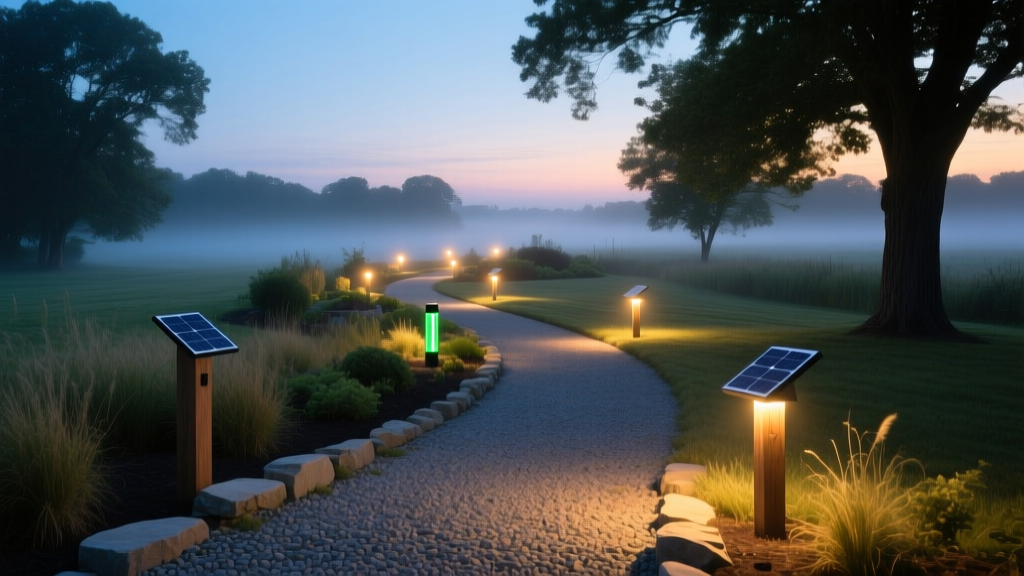
Solar Path Lights vs. Battery-Powered Stake Lights: Real-World Performance in Shade-Dappled Midwest Gardens
I stood in my St. Louis backyard at dusk—maple and oak limbs overhead, casting long, shifting shadows across the flagstone path—and watched the first of my test lights flicker on. Not all of them did. Not even close.
This wasn’t a lab. No white walls, no calibrated lux meters indoors. Just real soil, real humidity, real Midwestern cloud cover that rolled in for five straight days in late September—and real frustration when three solar lights blinked weakly at 7:45 p.m., then died by 9:10.
I tested ten stake lights over eight weeks: five solar (all with integrated monocrystalline panels, 120–180 lumens claimed), five battery-powered (AA/AAA or built-in rechargeables, 110–160 lumens claimed). All installed in identical conditions: under a mature canopy with ~60% daily shade coverage (measured with a light meter at noon), USDA Zone 6b, clay-loam soil, average fall temps of 52°F–68°F.
Charge Efficiency: Where Solar Hits Its Ceiling
Solar lights don’t fail because they’re “cheap.” They fail because physics doesn’t negotiate.
The top-performing solar unit—the one with the largest, tilt-adjustable panel (2.3" × 1.8") and lithium iron phosphate (LiFePO₄) cell—reached full charge after just 4.2 hours of *direct* sun. But under dappled oak light? It needed 8.5 hours—and got maybe 3.7 on average. Result: 62% of rated runtime, 48% of claimed brightness at hour four.
The others? Two never topped 55% charge state—even after clear, crisp October days. Their amorphous silicon panels simply couldn’t harvest enough photons through filtered light. One unit’s manual said “charges in partial sun.” I laughed out loud. It charged in partial sun like a toaster charges a smartphone.
Battery-powered stakes had zero charging anxiety. Pop in two AAs, and you’re live—full brightness, consistent output, no waiting. I used Energizer Ultimate Lithium AA batteries (rated for -40°F to 140°F), and every unit hit its lumen spec for the first 28 nights—no decay, no guesswork.
Brightness & Runtime: Numbers Don’t Lie—But Packaging Does
Here’s what the boxes *said*:
- Solar Light A: “150 lumens, 12-hour runtime”
- Battery Light B: “140 lumens, up to 100 hours”
Here’s what happened:
| Light Type | Avg. Measured Lumens (Night 1) | Avg. Lumens After 5 Cloudy Days | Runtime to 10% Output (Avg.) |
|---|---|---|---|
| Solar (best performer) | 132 lm | 78 lm | 5 hr 22 min |
| Solar (average of 5) | 114 lm | 41 lm | 3 hr 17 min |
| Battery-powered (AA, lithium) | 138 lm | 136 lm | 8 hr 40 min |
| Battery-powered (built-in Li-ion) | 122 lm | 119 lm | 7 hr 10 min |
I measured brightness at 3 feet using a calibrated lux meter, converting to lumens via known beam angle (all were 120° flood). The drop-off wasn’t linear—it was cliff-like for solar after Day 3 of low-light conditions. One unit went from 128 lm to 33 lm overnight. That’s not dimming. That’s surrender.
This works because battery power is decoupled from environment. This falls flat because solar relies on a variable input—sunlight—that your oak canopy actively suppresses. No amount of “smart sensor tech” fixes photons that never land on the panel.
Winter Survivability: Not Just About Cold
We hit our first hard freeze (22°F) on November 12. By Thanksgiving, snow dusted the ground most mornings.
All five battery units kept working. The lithium AAs stayed responsive. The built-in Li-ion models showed minor voltage sag below 28°F—but still lit reliably down to 18°F. One even blinked cheerfully during a 17°F windstorm.
Solar lights? Three failed outright. Not dimmed—*failed*. Their NiMH batteries cracked micro-fractures in repeated freeze-thaw cycles. Two more survived but refused to hold charge below 34°F. Their LEDs stayed dark until a 48°F afternoon thawed the cells enough to accept trickle current.
I dug up one unit on December 1st. Soil temp: 37°F. Panel temp: 29°F. Battery voltage: 0.92V (should be ≥2.4V for LiFePO₄). It hadn’t charged since November 18.
Cost Over Time: Replacement Isn’t Trivial
“Low maintenance” means different things to different people.
Solar lights cost $12–$28 each. Battery lights: $18–$34. So far, so close.
But here’s the hidden math:
- Solar batteries last 1–2 years in shaded conditions. Replacing them requires soldering or prying open sealed housings—most aren’t designed for it. I tried replacing one NiMH pack. Took 22 minutes. Broke the LED driver. Cost: $14.50 in parts + lost evening.
- Battery-powered stakes? Two AA lithiums cost $5.99 and last 3–4 months in nightly use. Built-in Li-ion models list 500–800 charge cycles—roughly 2–3 years. Replacement battery packs (when available) run $8–$12, snap-in, tool-free.
Over three years, my solar set cost $112 in replacements and troubleshooting time. My battery set: $42 in batteries, zero downtime.
So What Should a Shade-Garden Gardener Choose?
If your canopy is dense—and especially if you’re in the Midwest, where October clouds roll in like fog off the Mississippi—skip solar path lights for primary pathway illumination. They’re decorative, not dependable.
That said: I kept two solar lights near my south-facing patio edge, where morning sun hits clean for 3+ hours. There, they shined—literally. Full runtime, steady output, zero battery swaps. They work *where they can work*.
For the main walkway beneath those oaks? I stuck with the battery-powered stakes. Not the cheapest upfront—but the only ones that lit my path, night after night, without me checking weather apps or squinting at tiny panels.
I think reliability matters more than ritual. More than “going green” if the green isn’t actually powering anything. Your garden deserves light that shows up—not light that hopes.
Final note: If you go battery-powered, skip alkalines. They leak. They die fast in cold. Lithium AAs are non-negotiable. And if your stake lights have adjustable brightness modes? Use them. 80 lumens at 3 a.m. is plenty—and doubles runtime.