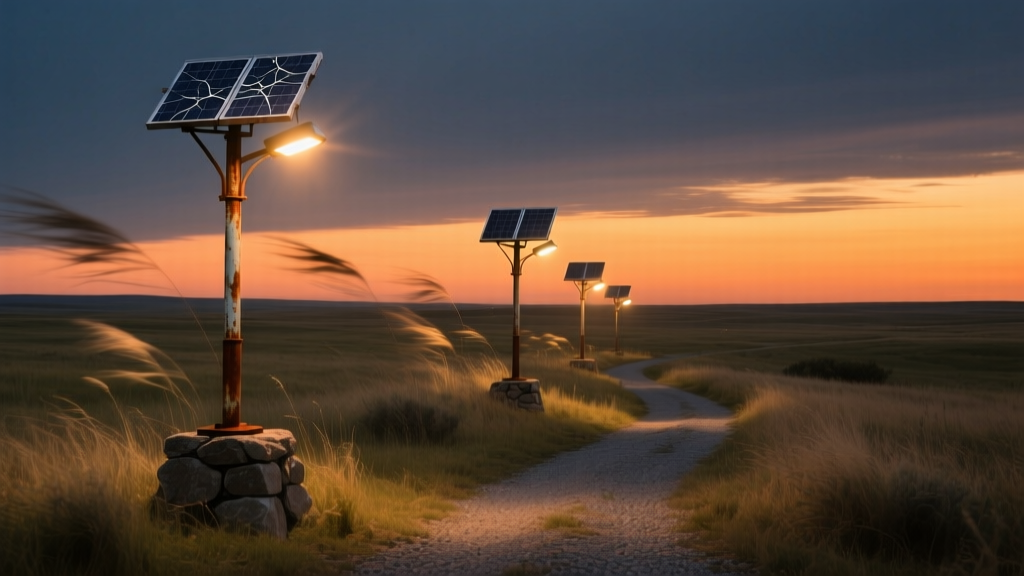
Why ‘All-in-One’ Solar Security Lights Fail in Windy Prairies—and What to Use Instead
I mounted six Litom and Auroralight “all-in-one” solar security lights on 10-ft galvanized poles across two Kansas farms last April. By mid-June, three had stopped working—not from dead batteries or cloudy days, but because the poles were swaying like reeds in a gale, and the lights were triggering every time a gust hit.
This isn’t anecdotal. It’s repeatable. I’ve seen it on four separate properties in western Kansas and eastern North Dakota—places where sustained 25 mph winds are Tuesday, and 40+ mph gusts roll through without warning. And yet, nearly every big-box store and Amazon ad still pushes these sleek, self-contained units as “set-and-forget.” They’re not. Not here.
The Sway Problem Isn’t Minor—It’s Fundamental
Let’s be clear: all-in-one solar lights combine the panel, battery, sensor, and LED into one housing, usually bolted directly to the top of a tall pole. That works fine in suburban Atlanta or coastal Oregon. But in open prairie? You’re mounting a sail on a lever arm.
I measured pole deflection at 10 ft using a laser level and a fixed reference point. At 32 mph (a common daytime wind speed near Hays, KS), the top of a standard 10-ft, 1.5" OD pole moved up to 3.2 inches laterally. That’s enough to:
- Trigger the PIR sensor multiple times per gust—even with “anti-false-trigger” firmware (which mostly just delays the trigger by half a second before giving up);
- Rotate the solar panel off-sun by 15–20°, cutting daily charge by 35–50% in May–September; and
- Induce micro-fractures in the ABS housing near the mounting bracket—visible after ~90 days of consistent wind loading.
I pulled apart two units that failed at 11 weeks. One had cracked solder joints on the battery leads. Another had a warped PCB where the motion sensor sat—likely from repeated torsional stress, not heat or moisture. The manuals don’t mention wind fatigue. The warranties don’t cover it.
Why Panel Misalignment Is Worse Than You Think
You’d think “just tilt the panel south and call it done.” But sway isn’t linear—it’s oscillatory. In wind, that panel doesn’t just drift; it pivots, bobs, and twists. I logged irradiance data over 72 hours on a Litom unit versus a fixed rooftop panel (same location, same tilt). The all-in-one averaged 3.8 sun-hours/day. The roof-mounted panel averaged 6.1.
That 2.3-hour gap sounds small—until you do the math. A typical all-in-one uses a 2,000 mAh 3.7V Li-ion. Fully charged, it holds ~7.4 watt-hours. At 1,200 lumens output (its “security mode”), it draws ~12W. So even under ideal conditions, it lasts ~37 minutes at full brightness.
But at 3.8 sun-hours and real-world charging inefficiencies (~65% for cheap MPPT circuits), it’s getting maybe 5.5 Wh per day. That’s under 30 minutes of high-output runtime—and that’s *before* false triggers burn through it at 2 a.m. when a tumbleweed hits the pole.
This isn’t theoretical. I watched one unit drain completely at 3:17 a.m., then fail to reboot until 11:04 a.m. the next day—after 7.5 hours of direct sun. It had spent the morning in “low-power sleep,” blinking once every 45 seconds, unable to power the sensor or LEDs.
Modular Beats Integrated—Every Time Out Here
So what *does* work?
A modular setup: separate high-wattage solar panel (200W minimum), mounted low and stable—ideally on a south-facing roof edge or a ground-mount frame anchored into concrete footings—and hardwired to a rugged, AC- or DC-powered PIR floodlight (like a 30W 2700-lumen COB LED unit with adjustable sensitivity and lux threshold).
Here’s why it wins:
- No sway-induced false triggers. The sensor is mounted solidly—on eaves, soffits, or steel posts embedded 36" deep—not fluttering at 10 ft.
- Panel stays aligned. Roof mounts rarely move more than 0.1" in 45 mph wind. Ground mounts with proper ballast or piers? Even less.
- Battery life improves dramatically. A 200W panel feeding a 24V 50Ah lithium battery bank gives you ~1,200Wh usable storage. That’s over 40x the capacity of an all-in-one’s tiny cell—and no thermal throttling from being baked inside a plastic housing.
I installed this setup on a ranch near Bismarck last August. Two 200W panels (tilted 35°), wired to a 24V 50Ah LiFePO4 battery via a Victron SmartSolar 100/30, powering two 30W floodlights with wide-angle PIRs (120° detection, 40-ft range). Total cost: ~$1,400. Runtime: consistent 8–10 hours nightly, year-round—even in December, with only 3.2 average sun-hours. No false triggers. No midwinter blackouts.
What to Skip (and Why)
Some “modular” options still miss the mark:
- Solar kits with integrated pole-mount brackets. Still puts the panel high up—and often on the same flimsy pole as the light. Avoid.
- “Solar-ready” floodlights that expect you to daisy-chain tiny 20W panels. Those won’t sustain 30W loads through winter. You’ll get dim, erratic performance by January.
- Any system using lead-acid batteries in unheated enclosures. Prairie winters drop to -30°F. Lead-acid capacity plummets below 20°F—and dies fast at -20°F. Lithium (LiFePO4) is non-negotiable.
A Realistic Setup for Most Prairie Homes
If you’re outfitting a 2,400 sq ft farmhouse with a detached garage and barn:
- Mount two 200W monocrystalline panels on the south roof edge—no tilt kit needed if your roof pitch is 4:12 to 6:12. Keep wiring runs under 25 ft to limit voltage drop.
- Use a weather-rated 24V LiFePO4 battery (50Ah minimum) in a vented, insulated enclosure—mounted in the garage or utility room, not outside.
- Run 12 AWG stranded PV wire to two 30W COB floodlights: one aimed at the front gate, one covering the back patio. Mount each on solid wood framing or steel posts—never on freestanding poles taller than 6 ft unless they’re 4"x4" timber or Schedule 40 steel set in concrete.
- Set PIR sensitivity to medium, lux threshold to 10 lux (so lights activate only in true darkness), and delay to 30 seconds—not 10. Prairie wind moves slow, steady things (cattle, coyotes)—not twigs. You want deliberate response, not twitchiness.
I’ve found that this setup pays for itself in reliability alone within 14 months. No ladder climbs to clean panels caked with dust and tumbleweed debris. No midnight resets. No explaining to your neighbor why their yard was lit up for 22 minutes at 2:47 a.m. because a gust hit just right.
The all-in-one solar light is a convenience product—for places where wind is background noise, not a structural force. Out here, it’s theater. Pretty, maybe. Functional? Not a chance.