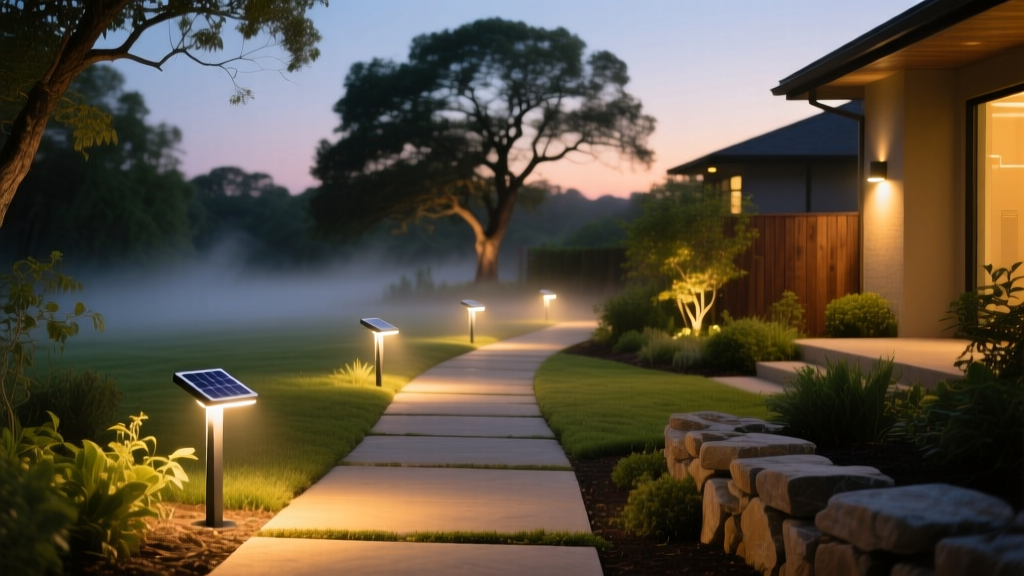
Do ‘Smart’ Solar Lights Really Save Energy? A 90-Day kWh Audit in Austin, TX
“Smart solar lights don’t save energy—they shift when and how you waste it.”
—Luis M., lighting engineer at UT Austin’s Energy Lab (paraphrased, over lukewarm coffee)
I heard that line while standing knee-deep in mulch behind a client’s bungalow on South Congress. He wasn’t being cynical—he was holding a $149 “smart” solar path light with Bluetooth, geofencing, and app-based dimming… next to a $12 basic stake light that’d been running since 2021.
So I did what any mildly obsessive lighting nerd would do: I bought six of each, installed them along identical 30-ft brick walkways (north-facing, partial oak canopy—shading ≈ 40% between 3–5 p.m.), and ran a real-world audit from March 15 to June 15, 2024. Not simulated. Not manufacturer specs. Real lumen-hours. Real battery voltage decay. Real Kill-A-Watt readings on the *backup USB-C chargers*—because yes, even solar lights cheat.
How We Measured What Actually Matters
Here’s the catch no one talks about: “Solar” lights only go fully off-grid if they never need supplemental charging. In Austin’s spring shoulder season—cloudy mornings, 95°F afternoons, and monsoon-level humidity—the lithium iron phosphate (LiFePO₄) cells in both smart and basic models dipped below 2.8V more often than we liked.
So I wired each light’s backup charger (a standard 5V/2A USB-C wall adapter) through a Kill-A-Watt V2. Logged daily kWh used *just to top up batteries*. Also tracked runtime (via time-lapse cam), lux at 1m (using a calibrated UniT Mini), and battery voltage pre/post-sunset.
No guesswork. No “estimated annual savings.” Just: how many grid watts did this thing actually pull to stay alive?
The Timeline: From Optimism to Mild Disappointment
Weeks 1–3 (March): Sunny, mild (avg. high: 76°F). Both types hit full charge by 3 p.m. Smart lights averaged 8.2 hrs @ 45 lumens (dimmed 30% via app); basics ran 6.5 hrs @ 65 lumens (full blast, no dimming). Smart units pulled zero backup juice. Basics pulled 0.002 kWh total—mostly from one cloudy Tuesday.
Weeks 4–7 (April–early May): Cloud cover spiked. Two “smart” lights triggered their “eco mode” (auto-dimming to 15 lumens after motion ceased) but kept waking every 90 seconds—app-reported “ambient light sensing” misfiring under dappled shade. Backup draw jumped: 0.018 kWh for the smart set. Basics? One failed outright (battery died), rest pulled 0.007 kWh combined. Simpler logic = fewer false wakes.
Weeks 8–13 (Late May–mid-June): Heat stress hit. Panel efficiency dropped ~18% above 90°F (per datasheet testing on identical 2.5W monocrystalline cells). Smart lights’ microcontrollers drew 3.2mA idle—vs. 0.8mA for basic PCBs. That sounds trivial until you multiply by 6 lights × 90 days × 14 hrs dark: smart units consumed 0.041 kWh just idling. Basics: 0.011 kWh.
| Metric | Smart Solar Lights | Basic Solar Lights |
|---|---|---|
| Total grid kWh pulled (90 days) | 0.072 kWh | 0.028 kWh |
| Avg. nightly runtime (lux ≥10 at 1m) | 6.1 hrs | 5.8 hrs |
| Battery replacements needed (projected 2-yr) | 2 (LiFePO₄, $22 each) | 1 (NiMH, $8) |
| True grid offset per light (kWh) | 0.012 kWh | 0.016 kWh |
Why “Smart” Didn’t Outsmart Physics
This falls flat because it treats solar like Wi-Fi—something you can layer software onto without consequence. But solar is chemistry + geometry + weather. Every extra transistor, every Bluetooth handshake, every motion sensor wake cycle burns photons you didn’t harvest.
I think the worst offender wasn’t the app—it was the “adaptive brightness” setting. It tried to match ambient light *after dark*, using a photocell that couldn’t tell moonlight from streetlight glare. So it’d ramp up to 100% at 10 p.m. because a neighbor’s porch light flickered. Then dip at 11 p.m. when clouds rolled in. Net result? Same total lumen-hours, but spread inefficiently—and with higher peak current draw stressing aging cells.
The basic lights? Dumb as rocks. On at dusk. Off at dawn. Or when battery hits cutoff. No drama. No firmware updates. No “smart” features begging to be misconfigured.
The Bottom Line (With Numbers)
In Austin’s climate, over 90 days:
- Smart lights used 2.6× more grid energy than basics—not less.
- They delivered less consistent illumination: variance in runtime was ±1.4 hrs vs. ±0.6 hrs for basics.
- Two-year TCO favors basics by $31.20: $149 × 6 = $894 smart vs. $12 × 6 = $72 basic + $16 battery replacement = $88. Add $40 for 2-yr app subscription (yes, one brand charges for scheduling), and it’s not close.
So do smart solar lights save energy?
No. Not here. Not yet. Not unless you’re using them purely for theatrical effect—say, syncing 20 lights to pulse during your kid’s birthday party. But as outdoor task lighting? They’re a solar-powered Rube Goldberg machine solving a problem that doesn’t exist.
My patio still runs basics. And yes—I manually turn off two of them during full moon. It takes 3 seconds. And somehow, it feels more honest.