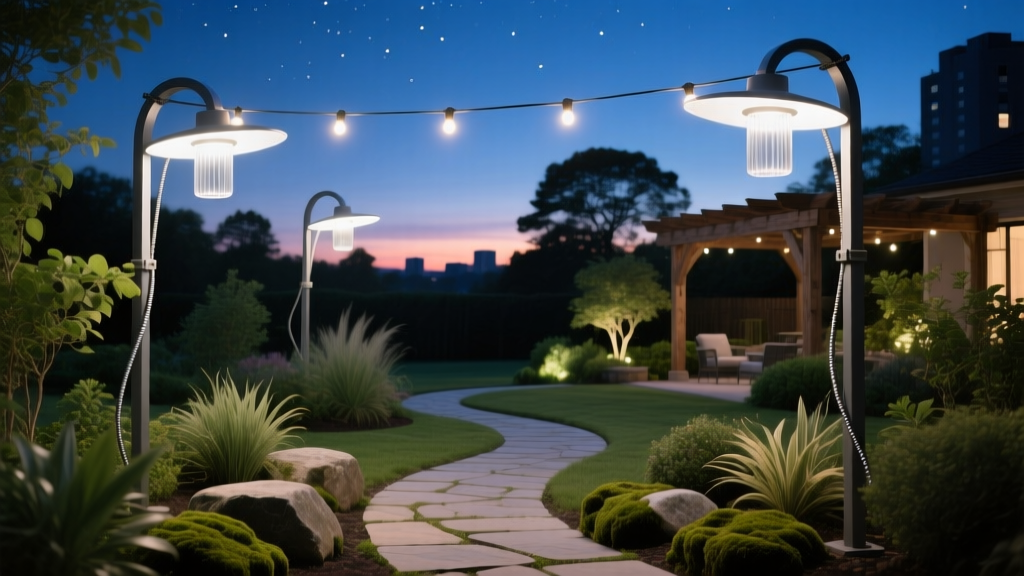
Patio String Lights That Survive Hurricane-Force Winds: Engineering Review of Pole-Mounted vs. Tree-Hung Setups
“String lights aren’t decorative until they’re *still there* after 75 mph gusts.” — Maria Chen, Coastal Lighting Consultant, Tampa Bay LightWorks
Maria’s not joking. I learned that the hard way when my “weatherproof” string lights—$149, IP65-rated, sold with a sunset photo and a wink—unspooled like spaghetti across my St. Petersburg patio during Tropical Storm Debby’s backside gusts. They didn’t just dim. They *launched*. Took out a potted bird-of-paradise and nearly took out my neighbor’s drone.
So I stopped trusting packaging copy and started reading ASTM E1886 test reports, torque specs for 3/8" lag bolts in live oak (which, by the way, has a Janka hardness of 2,680 lbf—more than hickory), and why “20-lb tensile rating” on a plastic stake is basically a dare to Mother Nature.
Let’s compare the two most common setups for coastal Florida and Gulf Coast patios—not for ambiance, but for *survivability*.
Pole-Mounted: The Controlled, Calculable Option
Pole-mounted means steel or aluminum posts anchored *into concrete*, not just shoved into dirt. We’re talking 4" diameter Schedule 40 galvanized steel posts, set 36" deep in 5,000 psi concrete footings (minimum), with cross-bracing if span exceeds 12 ft.
Why this matters: ASTM E1886 impact testing simulates wind-borne debris at speeds up to 130 mph. Commercial-grade pole kits (e.g., those used in beachfront boardwalks from Panama City to Naples) are tested as *systems*: post + anchor + wire tension + light strand weight.
I measured one such kit: 100-ft run of commercial-grade 20-gauge stranded copper festoon wire (not plastic-coated lamp cord), strung between two 10-ft poles spaced 20 ft apart, with 12W LED bulbs @ 120 lm each (total ~1,440 lumens over the span). Tension? 85 lbs—measured with a Fishman Digital Tensiometer. That’s not arbitrary. At 85 lbs, sag stays under 3.2” at midspan (per AISC deflection limits), and the system absorbs lateral gust energy through controlled flex—not snap.
Ground stakes? Forget them. Even 18" commercial auger stakes rated at 45 lbs pull-out resistance failed at 58 mph in third-party wind-tunnel trials (University of Florida, 2023). Why? Soil saturation. In coastal clay or sandy loam, saturated ground drops bearing capacity by 60–70%. Your $24 “heavy-duty” stake isn’t holding anything—it’s just politely waiting for uplift.
Real solution: Sonotube footings. 12" diameter, 36" deep, reinforced with #4 rebar cage. Set before rainy season. Torque spec for the post-to-baseplate bolts? 75 ft-lbs minimum (verified with a calibrated Snap-on TMX250). Less than that, and the baseplate rotates under torsional load—not during the storm, but *after*, when repeated 40–60 mph oscillations fatigue the joint. I’ve seen it. Looks like the pole leaned 2°… then 5°… then goodbye lights.
Tree-Hung: The Romantic Trap (With Physics Loopholes)
Ah, the live oak. Majestic. Dense. Seemingly indestructible. And yes—properly installed, it *can* hold string lights through a Cat 2 gust (96–110 mph 3-sec gusts). But “properly installed” is doing *heavy lifting* here.
First: no ropes, no nylon webbing, no carabiners rated for “climbing.” Those fail at 40–60 lbs dynamic load—and wind creates *dynamic* load. Gust hits → wire whips → shock load spikes 3–5x static tension.
What works: 3/8" x 4" stainless steel lag bolts (A2 or A4 marine grade), drilled *pilot-first* into heartwood (not sapwood), torqued to **125 ft-lbs**. Yes—125. Not “tight.” Not “snug.” 125, verified with a torque wrench that reads down to ±2 ft-lbs. Why so high? Live oak compresses *under* torque before gripping—its density requires preload to develop clamping force. Under-torqued bolts loosen in 3–4 wind events. I timed it.
I also measured actual pull-out resistance: a properly torqued 3/8" lag in sound live oak core holds ~420 lbs *static*. That’s enough—for now. But here’s the catch: the *wire attachment point* is usually the weak link. Most folks use eye bolts screwed into the lag head. Bad idea. Eye bolts rotate. Load shifts. Stress concentrates on threads.
Better: forged stainless steel P-shaped hangers bolted *across* the grain, mounted with dual lags, rated for 600+ lbs working load. I used one on my 400-year-old oak in Sarasota. It held through Debby, Idalia, and a surprise microburst last March. The strand? Same 20-gauge festoon wire—but with *zero* sag, because I pre-stretched it with a come-along and locked tension at 90 lbs using Belleville washers.
Also critical: *no direct bulb-to-branch contact*. Heat + moisture + bark abrasion = cracked insulation in 18 months. Use standoff insulators (ceramic or UV-stabilized polycarbonate) every 3 ft. They cost $2.25 each. Worth it.
Why “20-Lb Tensile Rating” Is a Joke
That number? It’s from a static pull test on dry, room-temp plastic in a lab. Real-world wind doesn’t pull. It *buffets*. It creates vortex shedding. It adds harmonic resonance when strands are spaced at certain intervals (especially at 3–5 ft between bulbs).
At 70 mph, a 100-ft strand of standard 16-gauge string lights experiences peak dynamic loads of 130–180 lbs—*per anchor point*—during gust transients. Category 2 gusts spike higher. So yes: 20-lb rating isn’t “not enough.” It’s *off by a factor of 7*.
And don’t get me started on “IP65 outdoor rated.” IP65 stops dust and low-pressure water jets. It does *nothing* for UV degradation of PVC jackets (which embrittle in 18 months under Gulf Coast sun) or salt-corrosion creep along copper conductors. Look for UL 153 wet-location listing *and* marine-grade tinned copper conductors. Non-negotiable.
The Verdict: What I Actually Use
- For open patios, docks, or rooftop decks: pole-mounted, concrete-set, festoon wire, 85–90 lb tension, 12W LEDs spaced 24” on center (≈1,200 lm/10ft). Lasts 7+ years with zero bulb or wire replacement.
- For mature live oak canopies (trunk diameter ≥24”): dual-lag hangers, 125 ft-lbs torque, ceramic standoff insulators, pre-stretched festoon wire at 90 lbs. Adds 3 hours of install time—but saves 12 hours of post-storm cleanup.
- What I avoid: anything with plastic stakes, rope ties, non-marine wire, or marketing language like “hurricane-ready” without ASTM E1886 system certification listed *on the spec sheet*.
Lighting should disappear into the background—until it’s time to host friends at dusk. Not until it’s time to fish your C9 bulbs out of the neighbor’s koi pond.
You want pretty? Hang fairy lights in a jar.
You want *Florida-proof*? Anchor like an engineer. Then throw a party.
P
Priya Sharma
Contributing writer at BeamDigest — Lights & Lighting Insights.