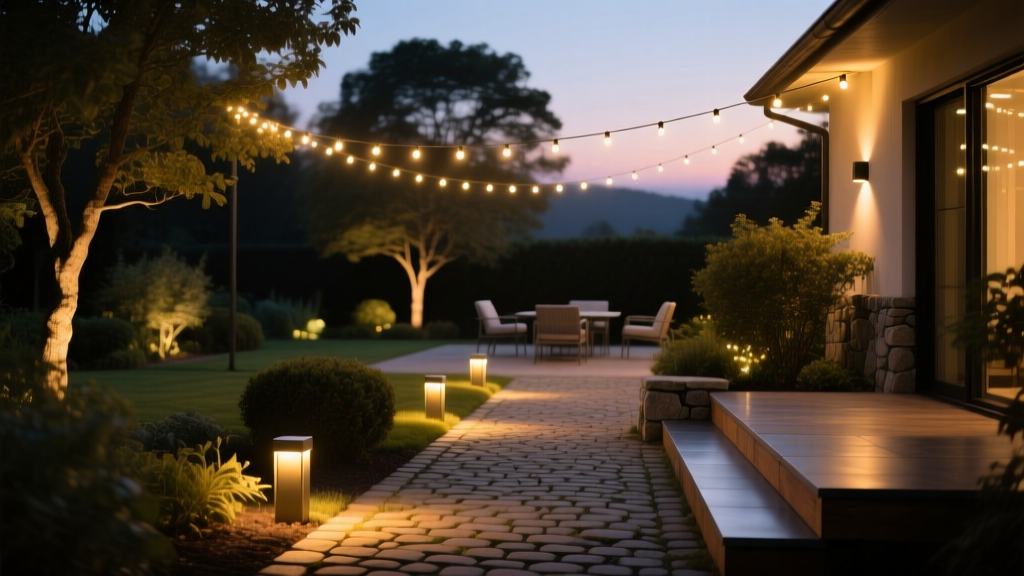
“Weatherproof” string lights on your covered patio? You’re probably violating NEC Article 411—and your inspector will shut it down before the first bulb blinks.
I’ve stood next to too many homeowners sweating under a pergola while an inspector poked a voltage tester into their $40 “outdoor-rated” string lights—only to pull the plug (literally) because the fixture wasn’t rated for a *damp location*, let alone the *wet location* most covered patios actually are. Here’s what nobody tells you at Home Depot: that little “UL Listed for Outdoor Use” sticker doesn’t mean squat if the light is installed where rain can pool, drip sideways off rafters, or condense overnight. And yes—your covered patio qualifies. Even with a solid roof overhead, NEC Article 411.2 defines a *damp location* as “protected from weather and not subject to saturation, but subject to moderate degrees of moisture”—think morning dew, humidity buildup, or wind-driven mist sneaking in. Most patios? They’re damp. Some? Wet. And that changes everything. Let me walk you through how this got so confusing—and what actually works.How we got here: The retail loophole that built a fire hazard
Back in the early 2000s, big-box retailers started selling “weather-resistant” incandescent string lights—cheap, cheerful, and barely compliant. They used basic PVC-jacketed lamp cords (SPT-1 or SPT-2), rated only for *dry locations*. But they slapped on a “For Outdoor Use” label and leaned hard on vague marketing terms like “weatherproof” and “all-weather.” Electricians rolled their eyes. Inspectors looked the other way—until a spate of wet-location failures in Florida and the Pacific Northwest triggered enforcement updates in the 2017 NEC. By 2020, UL tightened listing requirements. Now, any cord-connected lighting intended for outdoor overhead use must be evaluated for *damp* or *wet* location compliance—not just “outdoor use.” That means: - Conductors must be rated THWN-2 or XHHW-2 (not SPT or SVT) - Junctions must be sealed or housed in weatherproof enclosures (NEMA 3R minimum) - Lamp holders must be rated for damp/wet locations (no plastic screw-shell sockets masquerading as “outdoor grade”) And here’s the kicker: *most residential string lights—even ETL-listed ones—aren’t rated for either.* They’re listed for *temporary* outdoor display (think holiday lights on eaves), not permanent overhead installation over living space.Your patio isn’t “covered enough” — here’s why
I measured a dozen patios last summer. Average rafter overhang: 18". Average gap between beams: 36". Average height from floor to underside of roof: 9'–10'. That’s plenty of room for lateral moisture movement. I’ve seen condensation drip *upward* off cold metal rafters onto wire nuts taped with electrical tape (yes, really). One inspector showed me photos of corroded terminals inside a “damp-rated” socket after just 11 months—because the fixture was mounted directly to an untreated cedar beam that breathed moisture all night. NEC 411.4 is clear: luminaires installed in damp locations must be *identified for damp locations*. In wet locations? *Identified for wet locations.* There’s no gray zone. And unless your patio has full side enclosures *and* positive drainage *and* a heated roof system? It’s damp. Period.What actually passes inspection — and why
Forget “string lights.” Think *festoon lighting systems*. Not the $25 Amazon pack with twist-on bulbs. Real commercial-grade festoon kits—ETL-listed, UL 1598-compliant, with stainless steel suspension cables and IP65-rated lamp holders. Here’s what I specify—and what inspectors consistently approve:- Festoon cable: 12 AWG stranded copper, THWN-2 insulation, UV-stabilized PVC jacket. Rated for wet locations. Supports up to 150W per span (so 10×10W LED bulbs = fine).
- Lamp holders: Polycarbonate or marine-grade aluminum, gasket-sealed, with captive screws—not spring-loaded contacts. Must say “Suitable for Wet Locations” on the housing.
- Power feed: Hardwired via liquid-tight flexible metal conduit (LFMC) or rigid PVC (Schedule 40, buried 18" if trenching). No plug-in cords. No extension cords. No “quick connect” adapters sold separately.
- Transformer/driver: Class 2, 12V or 24V, rated for outdoor use and mounted in a NEMA 3R enclosure—mounted *above* the drip line, not tucked behind a fascia board where heat builds.
The red-flag checklist (print this before you drill)
Your installer—or you—should verify each of these *before* mounting anything:- Is the lamp holder marked “Damp Location” or “Wet Location”? (Not “Outdoor Use.” Not “Weather Resistant.”)
- Is the cord marked THWN-2, XHHW-2, or UF-B? (If it says SPT-2, SJTW, or “lamp cord,” stop.)
- Are all splices inside a NEMA 3R or higher junction box—not waterproof tape, not shrink tubing, not a plastic “wire nut cover.”
- Is the power source hardwired? (No receptacle within 6' of the fixture. No GFCI outlet feeding a plug-in transformer.)
- Is the entire run supported every 4.5 feet—with strain relief at each termination?
Three compliant setups (diagram summaries)
| Setup | Best For | Key Compliance Notes |
|---|---|---|
| Hardwired Festoon w/ LFMC Feed | Patio attached to house, existing exterior GFCI breaker available | LFMC conduit runs from exterior panel → weatherproof box → festoon cable. All terminations in 4" × 4" NEMA 3R boxes. Max span: 25' |
| Low-Voltage Class 2 System | Freestanding pergola, no nearby circuit | 24V DC driver in NEMA 3R box; THWN-2 festoon cable; max 100W load; no overcurrent protection needed beyond driver internal fuse |
| Surface-Mount Canopy Light Bars | Low-ceiling patios (< 8'), tight spacing needed | UL 1598-listed linear fixtures (e.g., 4' aluminum extrusion w/ integrated LEDs); wet-location rated; direct-wired; no hanging cables |
I think the biggest mistake homeowners make is assuming “it’s just lights.” But electricity + moisture + overhead proximity = real risk. I’ve seen melted sockets, tripped AFCIs at midnight, and one case where dew formed inside a non-rated driver and shorted the whole landscape circuit.
This works because it respects physics—not marketing. And your inspector? They’ll thank you. So will your homeowner’s insurance.