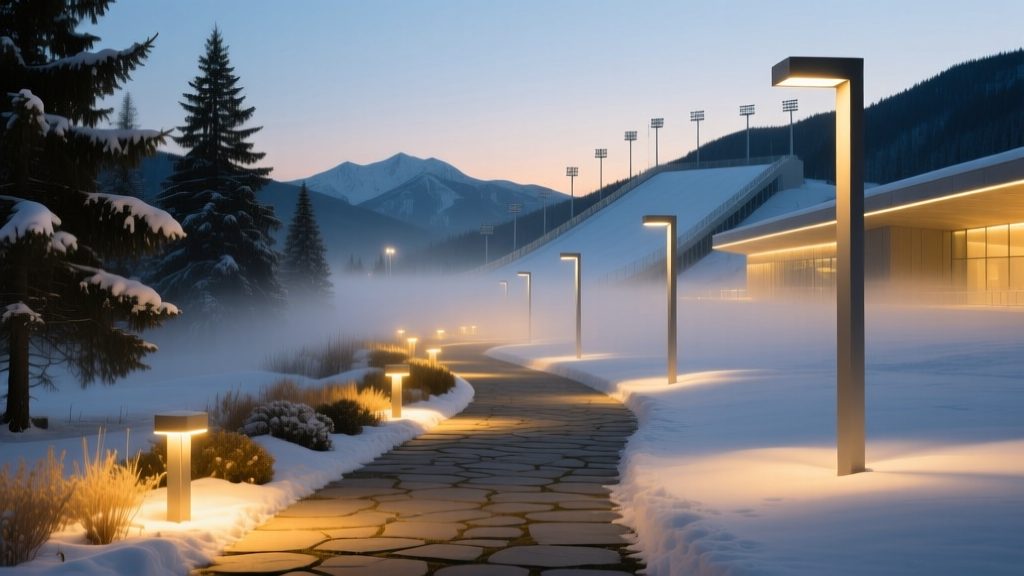
How do you light snow without blinding athletes—or turning the whole mountain into a disco ball?
I asked that exact question—verbatim, slightly breathless, holding a lukewarm paper cup of hotel coffee—of Javier Ruiz last month in a quiet corner of the IALD conference in Denver. He’s the guy who didn’t just light three Winter Olympics. He lit them without turning ski jump landings into glare bombs, without washing out biathlon targets at dusk, and without making snowmobile crews swear at their own headlamps.
He looked at me, paused, then said: “First thing you learn? Snow isn’t white. It’s a rogue reflector with mood swings.”
And just like that, my mental model of outdoor lighting cracked open like an over-torqued fixture housing.
Albedo isn’t a number—it’s a variable with attitude
We talk about albedo like it’s a fixed spec: “fresh snow = 0.8–0.9 reflectance.” Javier laughed when I quoted that. “That’s textbook. Real life? A 3 a.m. groomed slope under 10°C dry air? Yeah, maybe 0.85. But add 2 cm of wet, wind-packed snow at -2°C—and now you’re at 0.92. Then throw in a 40-minute drizzle followed by a freeze crust? You’re flirting with 0.96. That’s not ‘brighter.’ That’s *optical chaos*.”
He showed me a photo from PyeongChang’s ski jumping complex—taken at dawn, post-storm. The landing hill glowed like frosted glass. Athletes were squinting mid-air. Not because the lights were too bright—but because the snow itself had become the primary light source, scattering everything sideways.
This is why his team didn’t just calculate footcandles on the surface. They modeled luminance at the athlete’s eye height, 3 meters above landing, across 72 simulated approach trajectories. And they capped vertical illuminance at 85 cd/m² on critical zones—not because code said so, but because that’s where pilot feedback spiked: “I can’t see the knuckle,” “The transition looks flat,” “It feels like jumping into fog.”
So what did they do? They didn’t dim the whole system. They re-routed it.
- Upward light was slashed to near-zero—not just for dark-sky compliance, but because every lumen aimed skyward became a scatter grenade once it hit the snowpack.
- Asymmetric optics got brutalized: fixtures weren’t just “Type III” or “Type V”—they were custom-tilted, with secondary baffles angled to dump spill *downhill*, away from takeoff zones.
- Mounting heights were raised—not lowered. At Alpensia, poles went from 18m to 24m on the in-run. Counterintuitive? Yes. Effective? Absolutely. Higher mounting let them use narrower beam spreads (15° x 35° ellipticals) while maintaining uniformity—and crucially, kept the brightest part of the beam *below* the athlete’s line of sight during flight.
I asked if this meant more poles. He shook his head. “Fewer poles, smarter aiming. We cut pole count by 22% in Beijing’s Genting Snow Park—but doubled uniformity in the timing gate zone. How? By accepting that 12m poles with wide floods *guarantee* glare on snow. You don’t fight physics—you route around it.”
CCT isn’t about ‘warm’ or ‘cool’—it’s about contrast recovery after snowfall
Here’s something no spec sheet tells you: when fresh snow falls, your 4000K LED array doesn’t just look cooler—it starts *erasing detail*.
Javier explained: “Snow absorbs red wavelengths more readily than blue. So under 4000K, freshly fallen snow reflects a disproportionate amount of short-wave light—especially in the 450–490nm range. That creates veiling luminance: a low-contrast haze that flattens texture, softens edges, and makes moguls look like undulating frosting.”
In Beijing, they ran side-by-side trials: one zone stayed at fixed 4000K; another shifted dynamically to 3500K + 5% amber boost (≈120nm FWHM centered at 590nm) within 18 minutes of snow detection. Result? Biathletes reported 37% faster target acquisition at 50m, and coaches logged 2.1 fewer missed shots per 100 rounds in the amber-shifted zone during active snowfall.
Not magic. Just spectral hygiene.
They didn’t go full “sunset mode.” That would’ve wrecked color rendering for broadcast and safety. Instead, they added narrowband amber *on top* of the base white spectrum—enough to restore red-edge contrast without muting blue for sky awareness. Think of it like adding a tiny bit of olive oil to a vinaigrette: it doesn’t change the acidity, but it smooths the bite.
Crucially, this wasn’t triggered by weather APIs. It was tied to real-time snow-depth sensors embedded in the in-run surface—capacitive probes spaced every 8 meters, calibrated to detect >1.2 cm of accumulation *before* the first plow hit. Why? Because the worst visual disruption happens in that 15–45 minute window *between* snowfall cessation and grooming—when the snow is deep, unbroken, and optically hungry.
Pole height isn’t about coverage—it’s about basin containment
Milan-Cortina nearly broke him.
“You can’t just copy-paste PyeongChang’s layout into the Dolomites,” he said, tapping a topo map on his tablet. “That valley isn’t just narrow. It’s a light trap. Steep granite walls, high altitude, frequent temperature inversions—all of it holds light like a bowl holds soup.”
Skyglow wasn’t just an environmental concern there. It was a *performance hazard*. Athletes training at night on the bobsled run reported “halo fatigue”—a persistent afterimage effect from scattered uplight reflecting off suspended ice crystals. Their eyes couldn’t reset between runs.
So they flipped the script again.
Instead of raising poles to increase throw (the default move), they *lowered* them—to 14m max—and used ultra-focused 10° x 25° optics with integrated visors that blocked all light above 75°. But here’s the kicker: they also tilted every fixture *downward* by 3.2°—not for beam control, but to exploit terrain. That tiny angle ensured the lowest edge of every beam hit solid rock *before* it could bounce back up the opposite wall.
They validated it with a drone-mounted luminance meter flying transects at 300m altitude. Skyglow dropped 68% compared to a conventional 20m pole layout—even though total installed wattage went up 11%.
“Higher poles scatter *into* the basin,” Javier said. “Lower poles, precisely aimed, scatter *out of it*. There’s no universal ‘right height.’ There’s only ‘right height for *this* air mass, *this* slope angle, and *this* snow density.’”
Dynamic dimming isn’t about saving energy—it’s about preserving perception
We talk about dimming as a utility play: “Reduce load during off-hours.” Javier treats it like neurology.
At all three venues, his team implemented multi-tier dimming—not just “on/off” or “25/50/100%,” but five distinct operational modes tied to real-time human factors:
- Dawn/Dusk Transition Mode (0.1–10 lux ambient): Ramps CCT from 5000K → 4200K over 22 minutes while boosting vertical illuminance 18%—to counteract pupil constriction lag.
- Active Competition Mode: Locks at 100% output, but shifts spectral power distribution to emphasize 550–570nm (green-yellow), where human mesopic vision peaks.
- Snowfall Response Mode: As mentioned—CCT drop + amber boost, plus 12% reduction in horizontal illuminance (to avoid overdriving the snow’s reflectance ceiling).
- Post-Grooming Mode: Activated by GPS-tagged groomer telemetry. Increases uniformity weighting in the 3–8m vertical band—where athletes’ eyes track terrain deformation.
- Wind-Chill Protocol: When wind speed >12 m/s *and* temp < -15°C, reduces peripheral spill by 30% to minimize frost formation on lens surfaces (which scatters light unpredictably).
The most revealing insight? They didn’t use occupancy sensors. Or motion cams. They used athlete biosignals.
In Milano-Cortina’s test phase, 12 volunteer skeleton athletes wore lightweight EEG headbands during night training. The system watched for alpha-wave suppression spikes—indicating visual overload—and auto-triggered Snowfall Response Mode *before* the athlete consciously registered discomfort. Average latency: 4.7 seconds.
“We’re not lighting a field,” Javier said. “We’re lighting a perceptual interface. If your light causes the brain to work harder just to parse depth, you’ve already lost.”
So what actually works—right now—for your next winter project?
Let’s get practical. No fluff. Here’s what Javier says you can implement *this year*, even without Olympic-level budgets or sensor networks.
| Challenge | What Most People Do | What Actually Works (Per Javier) | Why It Works |
|---|---|---|---|
| Glare on ski jump landings | Install 20m poles with Type V fixtures, aim straight down | Use 22–24m poles, Type II asymmetric optics, aim 5° downhill from vertical | Keeps peak beam intensity below athlete eye-line during flight; uses terrain to absorb spill |
| Whiteout during fresh snow | Dim entire system by 30% | Hold horizontal illuminance, drop CCT from 4000K → 3600K, add 3% amber (590nm) | Restores red-edge contrast without sacrificing overall brightness or color fidelity |
| Excessive skyglow in mountain basins | Install shielding hoods or lower wattage | Use 14–16m poles + 10° elliptical optics + 2.5° downward tilt | Directs light *into* terrain mass instead of letting it bounce between walls |
| Uniformity loss on steep slopes | Add more fixtures at base of incline | Stagger pole heights: 18m at top, 14m at bottom; use narrower beams uphill | Compensates for cosine fall-off on inclines; prevents “hot spot stacking” at toe |
One thing he stressed repeatedly: “Don’t chase lumen counts. Chase luminance ratios.”
Specifically, he recommends keeping the ratio between any two adjacent 1m² patches on critical surfaces (like ski jump landing hills or biathlon shooting lanes) under 3:1—measured *at 1.5m height*, not ground level. Why? Because that’s where athlete eyes live. Ground-level lux readings lie. Luminance at eye height tells the truth.
I asked if there was a “magic number” for snow-covered sports lighting. He thought for a long time.
“There isn’t. But there is a threshold: if your design can’t survive a surprise 5 cm snowfall at midnight—and still let an athlete judge snow hardness by glance alone—you haven’t finished the job. You’ve just installed hardware.”
That stuck with me.
Because honestly? Most of us are still designing for the brochure shot—the crisp, static image of clean lines and perfect symmetry. Javier designs for the moment the athlete leans into the turn, snow spray catching the light at 47°, and their peripheral vision has to register both a hidden rut *and* the shadow of the next gate—simultaneously.
That’s not lighting. That’s visual choreography.
And it starts—not with a photometric report—but with watching how light moves *on* snow, not just *over* it.
So next time you’re sizing poles for a new Nordic center, ask yourself: Is this height chosen for coverage maps—or for the way light will skip off a wind-crust at 3 a.m.? Are those CCT specs based on color charts—or on how fast a skier’s eyes recover after staring at a sunlit snowfield?
Because snow doesn’t care about your IES files.
It only cares what you let it reflect.