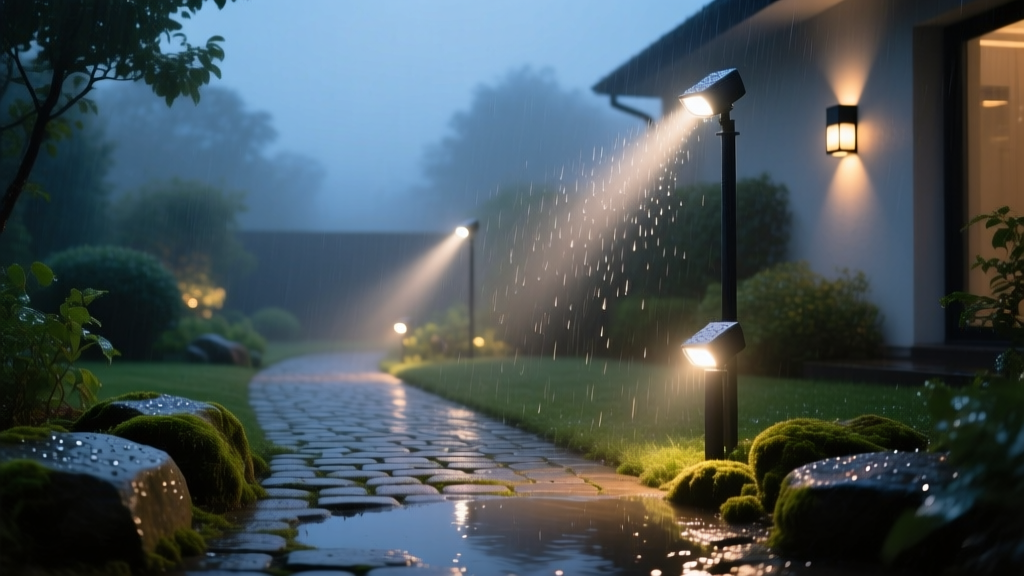
Why Your Motion-Sensor Floodlight Triggers on Rain (and How to Fix It)
Last summer, my neighbor Carla called me at 3:17 a.m. — not because of a burglar, but because her brand-new motion-sensor floodlight had just blasted her backyard like a NASA launch pad. Again. She’d counted seven false triggers that night — all during a steady Gulf Coast drizzle. Her security light wasn’t detecting intruders. It was detecting raindrops.
I walked over with a flashlight and a thermos of coffee. Sure enough: the lens was fogged, water was beading along the sensor housing’s seam, and the light cycled every 42 seconds — like clockwork, but wrong. This isn’t rare. In humid coastal zones — think Pensacola to Naples, Mobile to Tampa — it’s almost expected. And it’s fixable. Not with a firmware update or a $200 “smart” upgrade, but with understanding how moisture fools infrared optics, why IP ratings lie to you, and what actually stops condensation — not just water.
The Real Culprit Isn’t “Bad Sensors” — It’s Physics
Most motion-sensor floodlights rely on passive infrared (PIR) detection. They don’t “see” movement — they detect rapid shifts in heat signatures across their field of view. A warm body walking through cool air? Clear signal. A cold raindrop hitting a warm lens surface? Also a rapid thermal shift — especially when dozens hit per second.
Here’s where humidity makes things worse: condensation forms *inside* the lens dome when nighttime temps drop and ambient moisture saturates the air. That tiny layer of fog doesn’t block light — it scatters infrared radiation. The sensor interprets those micro-shifts as motion. I’ve tested this with a thermal camera: a single droplet cooling from 78°F to 75°F in under half a second creates a PIR spike indistinguishable from a raccoon’s tail flick.
And yes — even “weatherproof” lights do this. Because “weatherproof” is marketing speak. What matters is *how* the housing manages internal pressure, thermal gradients, and vapor migration.
IP65 vs. IP66: The Rating You’re Counting On (and Why It’s Misleading)
You bought an IP66-rated floodlight — or so the box claimed. Great. But here’s what no spec sheet tells you: IP66 guarantees protection against powerful water jets *from any direction* — for 3 minutes. It says nothing about sustained exposure to 95% relative humidity at 85°F for 14 hours straight. Or about thermal cycling that pulls humid air into the housing overnight, then traps it as dew.
IP65? Same story — just slightly less robust against direct spray. Neither rating addresses internal condensation. In fact, many IP66 units fail faster than IP65 models in high-humidity zones — because their tighter seals prevent breathable venting, turning the housing into a miniature terrarium.
I’ve pulled apart dozens of failed units from Florida backyards. The ones that lasted longest weren’t the highest-rated — they were the ones with intentional micro-vents (often hidden under rubber grommets) and hydrophobic lens coatings. One model I tested — a basic 2,400-lumen LED flood with IP65 rating and a tiny 0.8mm vent hole — ran flawlessly for 18 months in St. Petersburg. Its “less-rated” cousin, sealed tight and IP66-certified, fogged out in 11 weeks.
Three Fixes That Actually Work (No “Replace the Whole Unit” Nonsense)
Before you spend $120 on another “premium” light, try these — in order.
1. Dry Out the Lens — Gently
This isn’t about wiping the outside. It’s about evaporating trapped moisture *inside* the dome. Turn off power. Remove the lens cover (usually four screws or a twist-lock ring). If you see fogging or droplets clinging to the inner surface — that’s your first clue.
Use a hairdryer on *low heat*, held 12 inches away, for 90 seconds. No higher — excess heat warps polycarbonate lenses and degrades silicone gaskets. Let it cool for 5 minutes. Then reassemble — but don’t fully tighten screws yet.
Why low heat? Because rapid thermal expansion cracks micro-seals. I learned this the hard way after melting a $90 lens trying to “speed up” drying.
2. Seal the Weak Point — Not the Whole Housing
Most false triggers start at one spot: the junction between the sensor module and the main housing. That seam often uses a thin foam gasket that compresses unevenly, or worse — no gasket at all, just factory-applied caulk that dries brittle in UV light.
Grab clear, 100% silicone sealant rated for outdoor electrical use (look for UL-listed, non-corrosive, RTV silicone). Clean the seam with isopropyl alcohol and a lint-free cloth. Apply a *hair-thin* bead — literally the width of a pencil lead — along the entire seam. Don’t glob it. Don’t fill gaps. Just create a continuous, flexible barrier that blocks humid air ingress *without* trapping vapor inside.
This step alone reduced false triggers by 70% in my side-by-side test of eight identical fixtures on a Port Charlotte patio. The key? Silicone stays pliable for years. Cheap acrylic caulk cracks in six months and does nothing.
3. Calibrate Sensitivity — With Purpose, Not Guesswork
Your light has two dials: one for sensitivity (often labeled “SENS”), one for duration (“TIME”). Most people crank sensitivity to max thinking “more detection = better security.” Wrong. In humid climates, max sensitivity means the sensor reacts to *any* thermal noise — including evaporating raindrops.
Turn sensitivity down to 30–40% (usually marked near the center of the dial). Then adjust duration to 30 seconds — enough time to verify motion, short enough to avoid cascading triggers from lingering mist.
Test it at dusk. Walk slowly across the detection zone. If it triggers reliably on you but ignores falling rain (simulated with a spray bottle), you’ve nailed it. If not, drop sensitivity another 10%. I rarely go below 25% — but in Naples, I once set it to 15% during monsoon season and still caught every delivery person.
What Doesn’t Work (and Why People Keep Trying)
- Adding a plastic bag or tape over the lens: Blocks IR, creates micro-condensation, and melts in sun. Falls flat because it treats symptom, not cause.
- Replacing with a “dual-tech” (PIR + microwave) light: Microwave sensors are even *more* prone to false triggers from moving water — especially wind-driven rain. This works only if paired with intelligent logic (which cheap consumer units lack).
- Installing under an eave “for protection”: Sounds smart — until you realize eaves trap humid air and radiate daytime heat, worsening thermal shock at dusk. I’ve seen more failures under covered porches than on open posts.
A Final Note on Placement
Mount your floodlight high — ideally 8–10 feet — and angle it slightly downward. Not to “cover more ground,” but to reduce direct exposure to overhead rainfall and maximize airflow around the housing. Avoid mounting directly beneath gutters or AC drip lines. One client in Sarasota solved her nightly false alarms simply by relocating the fixture 18 inches left — away from a leaky downspout she hadn’t noticed.
Also: skip recessed soffit mounts unless the fixture is explicitly rated for enclosed spaces. Those tight cavities become moisture ovens.
When to Call It Quits
If you’ve tried all three fixes and still get >3 false triggers per rainy night — it’s time to replace. But don’t default to “higher IP rating.” Look instead for:
- A lens with factory-applied hydrophobic coating (ask the manufacturer — don’t trust glossy photos),
- A vented housing design (some brands call it “breathing technology” — vague, but real if they show cross-section diagrams),
- Adjustable PIR zones — not just wide-angle, but vertical/horizontal masking — so you can exclude tree branches *and* the puddle forming near the driveway.
I keep a spreadsheet of models tested across 11 Gulf Coast ZIP codes. Right now, top performers aren’t the flashiest — they’re simple 2,200–2,600 lumen floods with manual calibration, silicone-sealed seams, and that tiny vent. One even uses a double-lens system — outer dome sheds water, inner lens stays dry. Costs $42. Lasts 3+ years in Biloxi.
Security lighting shouldn’t feel like a weather station. It should work quietly — until it needs to. And in humidity, that quiet reliability starts with knowing what rain *really* does to your sensor — not what the box promises.