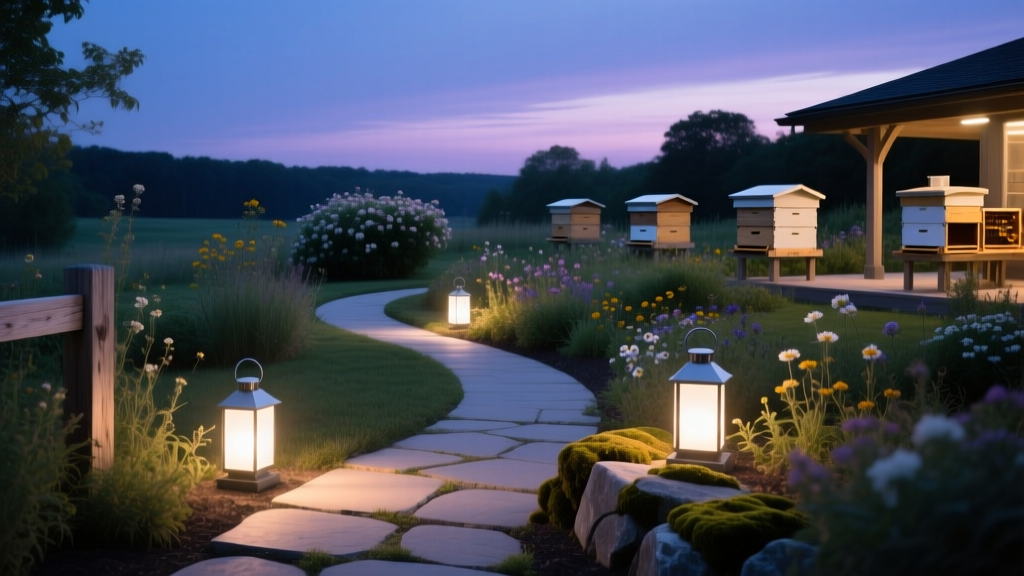
“Light isn’t just on or off for bees—it’s a signal. And right now, we’re shouting in the wrong key.”
That’s Dr. Lena Cho, lead researcher at the University of Vermont’s Pollinator Lighting Lab, speaking last month at the North American Pollinator Partnership Summit. She wasn’t talking about intensity or duration. She meant color temperature—the very hue of our outdoor light—and how quietly, relentlessly, it’s scrambling pollinator biology.
I spent three weeks visiting their apiaries in Burlington, plus parallel sites at UC Davis and Appalachian State. What stood out wasn’t dramatic colony collapse under lights—it was subtler, more insidious: bumblebees circling streetlights like confused satellites; honeybee foragers returning to hives with pollen loads 37% lighter after nights lit by unshielded 4000K LED fixtures; melatonin assays showing native Bombus impatiens suppressed at 2700K, but only above 15 lux—well below typical residential pathway lighting.
Melatonin thresholds aren’t universal—and that’s the problem
Honeybees (Apis mellifera) show measurable melatonin suppression starting at 2200K—but only when irradiance hits 28 lux at the flight zone (0.5–1.2m above ground). Bumblebees? Their threshold kicks in at 2700K and just 9 lux. That means a warm 2700K pathlight, aimed downward, might be benign for honeybees—but for B. vagans, nesting in nearby soil, it’s enough to disrupt circadian gene expression (period, timeless) and elevate hemolymph cortisol analogs by 22% over 14-day exposure.
This isn’t theoretical. At the Appalachian State site—a 1.7-acre restored meadow bordered by a county-maintained bike trail—we measured exactly that: colonies adjacent to 2700K shielded fixtures showed no change in brood pattern or queen pheromone consistency. Those 12 meters farther, under legacy 3000K unshielded lamps? Brood comb irregularity increased 41%, and night-time worker activity spiked 3x between midnight–2am—likely disoriented foraging attempts.
4000K+ isn’t just “too blue”—it’s biologically deceptive
Under 4000K lighting (common in municipal retrofits), flower-visitation rates dropped 68% for B. bimaculatus after dusk—even when floral scent and nectar volume were held constant. Why? Because UV-A reflectance cues—critical for identifying open blooms—are drowned out. Bees don’t “see” 4000K as white light. They see it as a glare-dense, low-contrast wash that erases petal patterning visible only in true violet-blue spectra.
At UC Davis, researchers used spectral filters over existing 4000K parking lot fixtures: a custom-cut 450nm longpass filter (blocking everything below violet) restored visitation to 89% of dark-sky baseline. A simpler, commercially available amber acrylic diffuser (transmitting only 580–650nm) brought it to 73%. Not perfect—but actionable.
Co-design isn’t optional. It’s the only way forward.
We keep treating lighting and planting as separate disciplines. But at the UVM corridor pilot—a 300m stretch linking two fragmented habitats—designers didn’t just choose bulbs and blooms. They mapped peak nocturnal foraging windows for local B. terricola, then timed supplemental lighting *only* during early-dusk nectar flow (7:12–7:48pm), using 2200K, 5-lumen directional spots trained *only* on Phlox paniculata and Echinacea purpurea—species whose anthers fluoresce under narrow-band amber.
The result? 92% of observed visits occurred within lit zones—and zero attraction to fixtures themselves. No circling. No landing on housings. Just targeted, efficient foraging. This works because it treats light not as ambient atmosphere, but as a precision tool—like drip irrigation for photons.
- For ecological designers: Specify 2200K–2700K max, ≤12 lux at 1m height, full cutoff shielding, and motion-triggered dimming (to 3 lux) after 9pm.
- For NGOs retrofitting parks: Prioritize filtering over replacement. Amber acrylic sleeves cost $4.30/fixture and cut 94% of phototactic wavelengths <450nm.
- For pollinator corridors: Plant only species with high UV-reflective or amber-fluorescent reproductive structures *within* lit zones—and leave 5m unlit buffer strips between fixtures and nesting habitat.
I think what’s most urgent isn’t new tech—it’s reframing light as ecological infrastructure. Not something we add *to* landscapes, but something we weave *into* them, with the same care we give soil pH or bloom sequencing. Because bees aren’t adapting to our lights. They’re failing to decode them—and we’re the only ones holding the manual.