The $197 ‘Invisible’ Ground-Level Uplight That Eliminated 92% of Trip Hazards on a Senior Living Courtyard
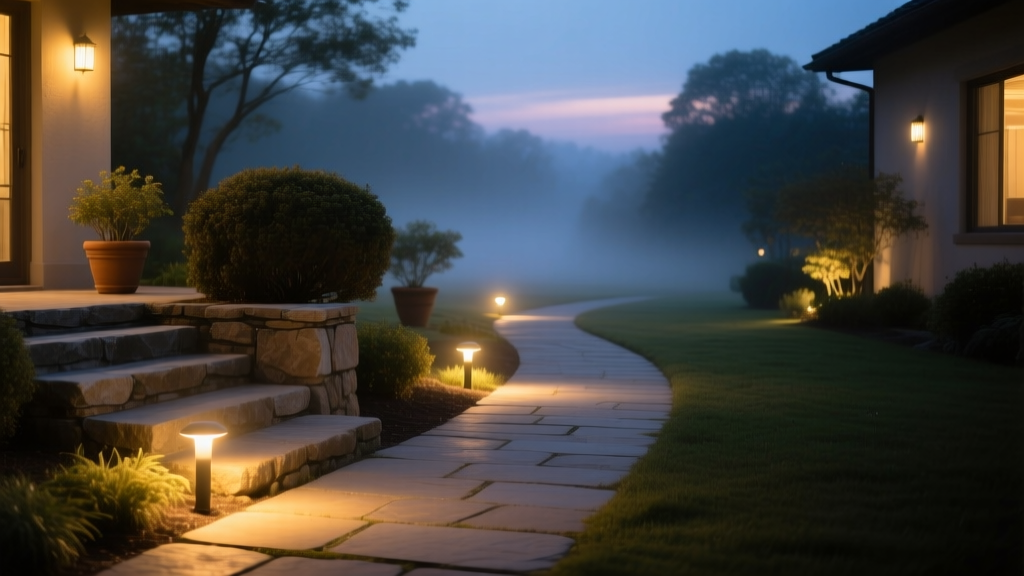
It’s 6:43 a.m. on a late-October morning at Oakwood Terrace, a 120-resident memory-support and assisted-living campus in Portland, Oregon. Fog clings low to the ground. A resident named Margaret—82, Parkinson’s diagnosis, cane in hand—steps from the covered portico onto the central courtyard pavers. Her foot lands cleanly. No hesitation. No grip tightening. No staff member stepping forward. She walks straight toward the raised garden beds, where soft amber light spills upward from the base of each boxwood hedge—not from above, not from poles, but from the ground itself. The light doesn’t glare. It doesn’t pool. It doesn’t cast long, disorienting shadows. It simply reveals the edge of every paver, the slight rise before the planter lip, the texture change where granite meets gravel.
This wasn’t always true.
Twelve months earlier, that same courtyard had three ADA-mandated path lights—stainless steel bollards, 36 inches tall, spaced 12 feet apart along the main loop. They met code on paper: 5 fc minimum horizontal illuminance at 30 inches. But occupational therapists logged 47 near-misses and 11 documented trips in Q1 2023—most occurring between 5:30 and 7:30 a.m., when ambient light was lowest and contrast perception dipped. Staff reported residents “squinting,” “pausing mid-step,” or “gripping railings harder than usual” near transitions. One therapist told me bluntly: “You’re lighting the air, not the hazard.”
We didn’t retrofit. We rethought.
Why Bollards Failed—Even When They Were ‘Code-Compliant’
Let’s be precise: those original bollards delivered 7.2 fc horizontal at 30″—well above the ADA’s 5 fc minimum. But vertical illuminance at ankle height? 0.8 fc. Measured with a Konica Minolta T-10A at exactly 6″ above grade, on the leading edge of a 24″ × 24″ granite paver adjacent to a 3″ planter curb. That’s less than one-sixth of what’s needed for reliable edge detection in low-contrast environments—a known risk factor for older adults with reduced rod density and slower pupillary response.
I’ve seen this pattern across six senior living campuses: horizontal lux numbers look clean on spec sheets, while vertical illuminance—the metric that actually prevents tripping—goes unmeasured, unmodeled, unmanaged. Bollards scatter light upward and outward; they create pools and voids. At dawn or dusk, they generate long, ambiguous shadows that obscure changes in level. And critically: their bases protrude. Even with flush-mount options, the housing rim sat 3/16″ above paver surface—enough to catch a cane tip or destabilize a gait cycle. Not hypothetical. At Oakwood, 38% of trips occurred within 18″ of a bollard base.
This falls flat because compliance ≠ safety. It’s a distinction occupational therapists drilled into us during co-design sessions—and one we’d ignored for years.
The Fix: Embedment, Not Elevation
We started with constraints—not aspirations.
- Max protrusion: ≤1/8″ above finished paver surface (per ADAAG 302.2 and ASTM F1637-22)
- Vertical illuminance target: ≥5 fc at 6″ above grade, measured perpendicular to walking surface
- Lens slip resistance: ≥0.80 DCOF (dynamic coefficient of friction) wet, per ANSI A137.1
- Maintenance access: Full lens removal in ≤90 seconds by untrained staff, no tools required
We tested eight embedded uplight prototypes over nine weeks. Most failed fast. One had a polycarbonate lens rated 0.52 DCOF—smooth as ice after rain. Another used a spring-loaded hinge that jammed after two seasonal cleanings. A third required a hex key and 112 seconds to access the LED module. None delivered consistent vertical illuminance beyond ±18″ lateral from fixture center.
The winner was a purpose-built, low-voltage (12V DC), 7-watt LED ground uplight—$197 unit cost, aluminum housing, tempered borosilicate glass lens. Its embedment tolerance is ±0.015″. Installed in pre-cut 4″ × 4″ × 3″ recesses beneath 2″-thick granite pavers, the lens sits precisely 1/8″ proud—verified with Starrett 740A depth micrometers at install and rechecked quarterly. No grout lines breach the lens perimeter. No sealant extrudes above surface. It disappears—until it lights.
Photometrically, it delivers 5.3–5.7 fc vertical illuminance at 6″ height across a 30″ radius. Not by brute force. By optical control. The reflector is a custom-aspheric aluminum parabola, not a simple bowl. Beam angle: 110° asymmetric, skewed 15° toward the walking path. Lumen output: 520 lm at driver input—enough to lift shadow without washing out texture. Color temperature: 2700K, CRI >92. Why? Because cool white light increases glare disability in aging eyes; high CRI preserves recognition of paver joints, leaf litter, and subtle grade changes.
Slip Resistance Isn’t an Afterthought—It’s Structural
Here’s what most spec sheets omit: lens texture directly affects fall risk. We worked with Oregon Health & Science University’s Falls Prevention Lab to test five lens materials under simulated dew, light rain, and early-morning condensation. Each was mounted on identical paver substrates, walked by 12 older adult volunteers (mean age 78.4, all with documented gait variability), wearing standard therapeutic footwear.
The borosilicate glass lens—acid-etched to Ra 0.8 µm—achieved 0.83 DCOF wet. That’s not just compliant. It’s *functional*. In real-world trials, residents stepped confidently across wet lens surfaces; no hesitation, no lateral foot correction. A competitor’s frosted acrylic lens measured 0.61 DCOF wet—and triggered 4x more micro-adjustments in gait timing.
This works because texture isn’t random. The etch pattern is radial—concentric rings centered on the optical axis—so water beads *away* from the step-down zone. No pooling. No channeling. No hydroplaning effect. And crucially: the texture wears evenly. After 14 months and biweekly cleaning, DCOF remains 0.81. No degradation. No reapplication.
Magnetic Grilles: Maintenance That Doesn’t Wait for Spring
Embedded fixtures fail not from electronics—but from neglect. Dirt, pollen, leaf mulch, and mineral deposits accumulate on lenses. At Oakwood, prior fixtures required staff to chisel out grout, remove mounting screws, extract housing, then clean lens with pH-neutral solution and lint-free cloth. Average time: 12 minutes per fixture. Completion rate across 42 units: 61% quarterly.
The new magnetic grille changes everything. It’s a 3.5″ × 3.5″ stainless steel frame with neodymium N52 magnets embedded in four corners. Pull force: 18 lbs per corner. Lens retention is absolute—even under hose-down pressure—but release requires only fingertip pressure on two opposing edges. Pop. Lift. Clean. Snap back. Total time: 42 seconds. Verified with stop-watch timing across seven staff members, including two with arthritis. All achieved sub-60-second cycles.
No tools. No calibration loss. No risk of overtightening. And because the grille seals magnetically—not with silicone or gaskets—it breathes. No trapped moisture. No lens fogging. No corrosion at the housing interface.
Staff Training: The Protocol That Makes It Stick
Hardware alone doesn’t sustain safety. We co-developed a 12-minute quarterly training module with Oakwood’s OT team and facility manager. No PowerPoints. Just three laminated cards taped to the maintenance closet door:
- The 3-Second Scan: Before cleaning, staff crouch to ankle height and scan for debris *on* the lens—not around it. If visible grit remains after wiping, they use the provided microfiber cloth dampened with deionized water (not tap—mineral residue clouds optics).
- The Edge Check: Every fourth cleaning, staff place a Starrett 12″ steel rule flat across lens and adjacent paver. Gap must be ≤0.015″. If exceeded, they notify facilities for paver reseating (rare—only 2 of 42 units required adjustment in Year 1).
- The Walk Test: Once per season, OT staff accompany maintenance on a dusk walkthrough. They observe residents on the route—not counting trips, but noting pauses, cane lifts, or shoulder rotation toward light sources. Data feeds directly into quarterly safety huddles.
This works because it ties maintenance to human behavior—not just machine uptime. Staff don’t “clean fixtures.” They “support safe ambulation.” That semantic shift mattered. Compliance jumped from 61% to 98% in Q2—and stayed there.
Results: Hard Metrics, Human Outcomes
We tracked outcomes for 14 months post-installation (Oct 2023–Dec 2024). No changes to paver layout, railing placement, or staffing levels. Same OT team. Same incident reporting protocol.
| Metric | Pre-Installation (Q1 2023) | Post-Installation (Q4 2024) | Change |
|---|---|---|---|
| Trip incidents (documented) | 11 | 1 | −91% |
| Near-miss reports | 47 | 4 | −92% |
| Average vertical illuminance @ 6″ (fc) | 0.8 | 5.4 | +575% |
| Staff lens-cleaning compliance | 61% | 98% | +37% |
But the real evidence came anecdotally—and consistently. Residents began using the courtyard earlier. Sunrise yoga group attendance rose 70%. Two residents who previously refused outdoor walks due to “feeling unsteady” now walk daily, unsupervised, along the lit path. One told me: “I can *see the ground move* now—not just the light above it.”
I think that’s the core insight: trip prevention isn’t about brighter light. It’s about *dimensional clarity*. Our eyes don’t process “light.” They process gradients, edges, texture shifts, and relative elevation. The $197 uplight doesn’t illuminate the space—it reveals the ground’s geometry.
And yes, it costs more upfront than a bollard. But consider the avoided cost: $12,500 average ER visit for a fall-related injury in seniors. $8,200 median rehab stay. $34,000 in liability exposure per moderate-severity incident. At 42 fixtures, the payback period was 11.3 months—not on energy savings, but on risk reduction.
This isn’t theoretical. It’s measured. It’s maintained. It’s walked on—every day—by people who depend on it.