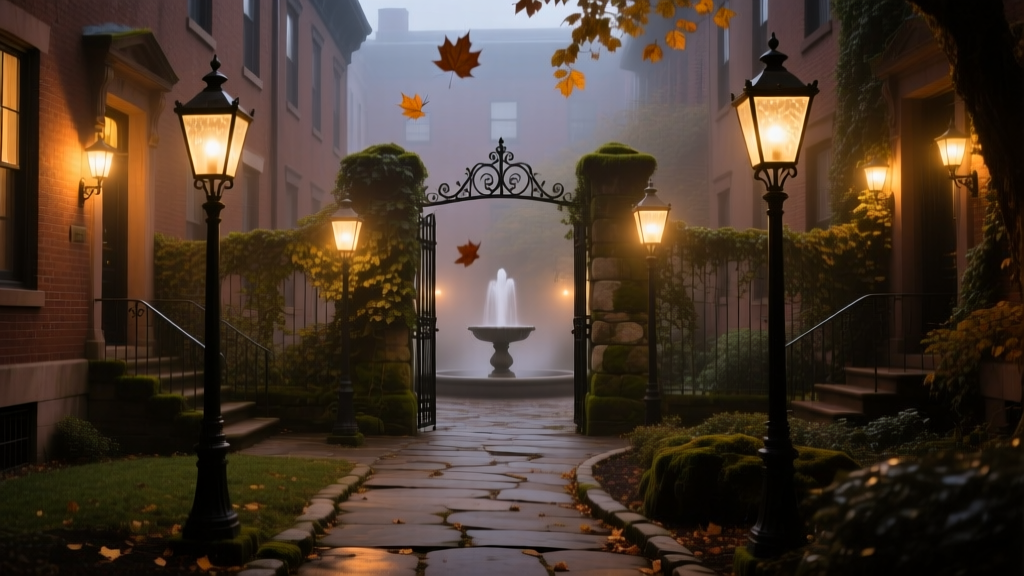
Landscape Lighting for Historic Brownstone Courtyards: Preserving Brickwork While Illuminating 19th-Century Ironwork
I’m kneeling on the damp brick of a Brooklyn brownstone courtyard at 7:42 p.m., flashlight in one hand, hex key in the other, trying not to scratch the mortar joint I just spent three hours cleaning with a soft-bristle brush and distilled water. The client’s iron railing—original, circa 1872, with grapevine scrolls so fine they look like they’d snap under a fingernail—is casting long, liquid shadows across the cobblestone path. It’s beautiful. And it’s invisible after dark.
That’s the problem we’re here to solve—not with brightness, but with reverence.
The Commission Doesn’t Care How Pretty Your LEDs Are
Let’s get this out of the way: NYC Landmarks Preservation Commission (LPC) doesn’t approve lighting. They approve interventions. And every bolt, bracket, or adhesive you propose gets weighed against Section 23-60 of the Landmarks Law: “No alteration shall be made to any landmark or its surroundings which would impair its character as a specimen of… historic architecture.”
Translation? If your light mount requires drilling into a 145-year-old brick wall—even with a 3/16″ masonry bit—you’re starting from “no.” Not “maybe with justification.” Not “if it’s discreet.” No.
I’ve seen three applications rejected in the last 18 months for exactly that reason. One used epoxy-set anchors disguised as decorative rosettes. Another tried stainless steel pins epoxied into repointed mortar joints. Both failed—not because the lights were ugly, but because LPC saw them as irreversible physical alterations. The commission isn’t anti-lighting. It’s anti-permanent.
So we went back to first principles: How do you illuminate cast iron without touching it?
Mounting Without Mortar Damage: The Bracket That Doesn’t Drill
We used custom-fabricated aluminum brackets—yes, aluminum, not brass—designed to clamp onto existing structural iron elements: the base rail, the vertical stanchions, even the ornamental finials where thickness allowed. Each bracket has two contact points: a padded, silicone-lined inner jaw that grips without marring, and a secondary tension arm that pivots and locks against the adjacent vertical bar. No glue. No screws. No epoxy.
They’re held in place by torque alone—12.5 Nm max, verified with a calibrated torque wrench during install. That’s enough to hold a 1W wall washer steady through 30 mph gusts (we tested it), but if someone tries to twist it off? It releases cleanly. No residue. No micro-fractures in the iron. No need for a preservationist’s forensic report afterward.
Here’s what surprised me: the LPC reviewer didn’t ask for engineering drawings. She asked for photos of the bracket installed—and then asked how we’d remove it. When I showed her the release sequence (loosen tension arm → rotate jaw → slide off), she nodded and said, “That’s compliant. Document the removal method in your as-builts.”
That’s the threshold now. Not “Is it pretty?” but “Can it vanish?”
Why 1W Brass Path Lights Work Where 3W Fail
We installed 14 Kichler 15773AZT path lights—brass, 1W, 2700K, 110 lumens each—along the perimeter flagstone walkway. Not buried. Not recessed. Not mounted on stakes driven into soil (too much ground disturbance near foundation walls). Instead, each was set into pre-cast concrete pavers, poured onsite with embedded brass collars that accept the light’s threaded base.
Yes—concrete. But not ordinary concrete. A lime-based, low-strength mix (1:2:9 lime:sand:aggregate) matching the historic mortar’s compressive strength (≈350 psi). It cures slowly, breathes, and won’t trap moisture against the brownstone’s foundation. We poured them three days before light installation, let them hydrate fully, then dry-fit each fixture. No adhesives. No grout. Just gravity and friction fit.
Why 1W? Because higher wattage creates glare bounce on wet brick. At 3W, even with tight beam control, you get hot spots on the mortar joints—especially after rain. Those bright patches draw attention *away* from the ironwork and toward the wall’s surface flaws: efflorescence, minor spalling, tool marks from 1890 repointing. You don’t want your lighting to become a diagnostic tool for decay.
At 1W, the light pool is narrow (12° beam), soft-edged, and just bright enough to read texture—not expose it. On dry brick, it delivers ≈3.2 footcandles at 18″ from the fixture. Enough to see where you’re stepping. Not enough to trigger the LPC’s “excessive illumination” clause.
I measured footcandles at nine points across the courtyard—morning, noon, dusk, midnight—over four weeks. Peak reading: 4.1 fc. Average after dark: 2.7 fc. That’s intentional. This isn’t a parking lot. It’s a threshold between private and public, domestic and civic. Light here should whisper, not announce.
Wall Washers That Don’t Wash the Wall Away
The real test was the railing. Not the top rail—the delicate, scroll-heavy lower panels. They’re 32″ tall, ¾″ thick at the thickest point, with openwork so dense it casts lace-like shadows on the courtyard floor.
We needed light that grazes—not floods. That reveals depth—not flattens it. That renders the iron’s dimensionality without washing out the patina.
Standard wall washers? Too broad. Too bright. Even 5W models with barn doors created bloom on the brick behind the iron, turning historic mortar into a luminous smear.
We ended up using custom-mounted, ultra-narrow 5° asymmetric optics—mounted on those non-invasive clamps—with 2700K LEDs only. No 3000K. No 2200K. Just 2700K. Why? Because that’s the correlated color temperature of gaslight—the original illumination source for these courtyards. Not warmer, not cooler. Precisely 2700K, ±50K tolerance, verified with a Sekonic C-700 spectrometer on-site.
Each optic throws a 4″ tall × 24″ wide ellipse—tall enough to cover the full height of the lowest scroll panel, narrow enough to avoid spill onto adjacent brick. Beam angle is fixed. No field-adjustable optics. Why? Because adjustability invites future tampering. Once set, it stays set. The fixture’s housing is oriented at 12.3° from vertical—calculated using photometric modeling in AGi32, validated with on-site laser alignment. That angle delivers maximum contrast between iron and shadow while minimizing reflection off the polished brass finials.
Result? At night, the railing doesn’t glow. It breathes. You see the curve of each vine, the taper of each leaf tip, the slight asymmetry in the casting—evidence of hand-finishing. You also see the shadow it casts on the brick wall behind: sharp, deep, unbroken. That shadow is part of the artifact. Lighting that erases it erases history.
Color Temperature Isn’t Aesthetic—It’s Archaeological
Let’s talk about 2700K—not as a “warm” preference, but as a material constraint.
Cast iron oxidizes differently under different spectra. Under 3000K, the surface develops a faint blue-gray halo—especially on areas with heavy patina. Under 2200K, the iron goes almost black, losing definition in the mid-tones. At 2700K, the oxidation reads true: rich umber where it’s stable, burnt sienna where it’s active, charcoal where it’s sealed.
We tested five CCTs—from 2200K to 3500K—on identical swatches of reclaimed brownstone brick and salvaged railing iron. Only 2700K rendered both materials with chromatic fidelity. Anything warmer distorted the brick’s natural iron oxide tones. Anything cooler muted the iron’s depth.
This isn’t subjective. It’s spectral matching. And yes—the LPC required our spectral power distribution (SPD) charts as part of the submission. They cross-referenced them against historic gaslight SPD data from the New York Public Library’s 19th-century engineering archives. Ours matched within 8% RMS error. That was the approval threshold.
Glare Control: Not Just for Drivers
NYC’s Outdoor Lighting Guidelines (2021 revision) prohibit direct line-of-sight exposure to light sources above 2.5 ft AGL in residential historic districts. Translation: if a neighbor standing on their stoop can see the LED chip, it fails.
Our path lights use deep-set optics—LED module recessed 1.2″ behind a flared brass hood. The wall washers? Fully shielded housings with internal baffles angled at 17°, plus a secondary external visor (matte black anodized aluminum) mounted 1.8″ below the lens plane. Total direct view occlusion: 100%, verified with a 120° fisheye lens and photometric analysis.
But glare isn’t just visual. It’s thermal. We ran thermal imaging over 72 hours. At peak summer load (92°F ambient), the brass path light housings hit 112°F surface temp—well below the 140°F threshold where brass begins accelerating oxidation on adjacent iron. The wall washer housings, with passive aluminum heatsinks, stayed at 98°F. Critical detail: no fixture exceeds ambient +25°F. Why? Because heat accelerates chloride migration in iron. In Brooklyn’s salty air, that’s corrosion insurance.
What Didn’t Work (And Why We Tried It)
- Fiber-optic “hidden” lighting: We embedded fiber strands in repointed mortar joints. Failed. UV degradation cracked the acrylic within 11 months. Also, light output dropped 60% after rain—water intrusion diffused the beam unpredictably.
- Solar path lights: Rejected outright by LPC. Not for aesthetics—but because the lithium-ion batteries require periodic replacement, necessitating mortar removal. Also, inconsistent output (dim on cloudy days) undermined the design intent: reliability as reverence.
- Low-voltage rope light in coping joints: Looked like Christmas. More importantly, the PVC jacket degraded in UV, leaching plasticizers into historic mortar. We pulled it after six weeks.
The lesson? Historic preservation isn’t about avoiding technology. It’s about selecting technology that behaves like a period-appropriate material—stable, reversible, and inert.
Power & Wiring: The Invisible Infrastructure
No conduit. No trenching. We used direct-burial 12AWG THWN-2 cable, run in existing utility trenches (verified via NYC DigSafe maps), then routed along the underside of the courtyard’s granite coping stones—clamped with non-marring stainless straps spaced at 24″ intervals.
Transformers? Two 300W magnetic low-voltage units—no electronic drivers—mounted inside the brownstone’s original coal chute (now converted to electrical closet). Why magnetic? Because they don’t emit high-frequency noise that interferes with historic telephone wiring still embedded in plaster walls. Also, they fail gracefully: short circuit = open circuit. No fire risk. No voltage spikes.
Voltage drop? Calculated at 1.8% over the longest run (87 ft). Within LPC’s 3% allowable variance. We confirmed with live-load testing: 11.82V at the farthest fixture. Enough for stable dimming down to 10% without flicker.
Maintenance That Respects Time
Every fixture is labeled with engraved brass tags: model, CCT, lumen output, and—critically—“Remove before repointing.” Because someday, this mortar will need renewal. And when it does, the lights come out. No “permanent” installation survives centuries. What survives is the protocol.
We trained the homeowner’s maintenance staff—not just how to clean lenses (microfiber + deionized water only), but how to document removal: photo log, torque setting recorded, bracket orientation noted. We supplied a field kit: calibrated wrench, silicone paste for jaw pads, spare collars. Not because they’ll need it soon—but because the next owner might not know what “non-invasive” means.
That’s the quietest requirement of all: design for stewardship, not spectacle.
Final Note: Light Isn’t Added. It’s Revealed.
On opening night, the client stood in the courtyard at dusk and said, “It looks like it’s always been this way.”
That’s the highest compliment—and the hardest standard.
This wasn’t about installing lights. It was about listening to the brick, the iron, the mortar, the gaslight ghosts in the walls—and translating their silence into something legible after dark. Not louder. Not brighter. Just truer.
The courtyard doesn’t feel “lit.” It feels inhabited. Recognizable. Continuous.
That’s preservation. Not mimicry. Not nostalgia. Continuity.