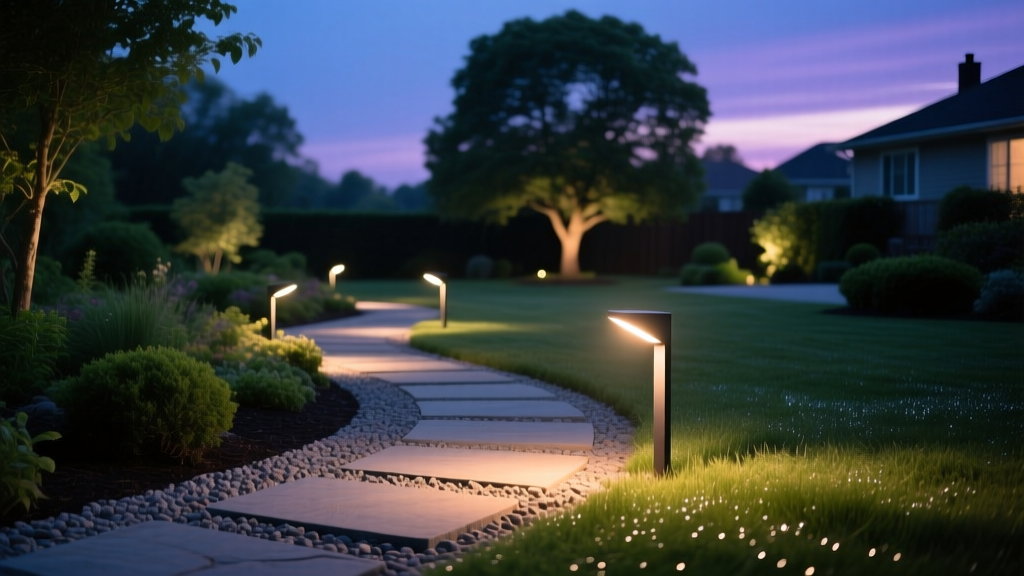
How do you light your garden without turning your neighbor’s bedroom into a runway?
If you’ve ever gotten a polite but firm note slipped under your gate—“Your uplighting is spilling onto our patio”—you’re not alone. I got one last spring. My beautiful 3000K path lights? Perfectly placed, technically within code… and absolutely blinding my next-door neighbor at 10 p.m. Turns out, “technically compliant” ≠ “actually considerate.”
This isn’t about dimming your vibe—it’s about precision. And in cities like Boulder, Ann Arbor, or Portland, that precision has a name: the 7° downward tilt rule. Not 5°. Not 10°. Seven. Exactly.
Why 7°? It’s not arbitrary—it’s physics + policy
Here’s what zoning boards in lighting-conscious municipalities actually test for: light that escapes *above* the horizontal plane (uplight), light that spills *sideways* onto adjacent property (backlight), and light that hits the eye directly (glare). That’s where BUG ratings come in—Backlight, Uplight, Glare—and they’re baked into ordinances like Boulder’s Lighting Code §9-12-104 and Ann Arbor’s Outdoor Lighting Ordinance §16.102.
The 7° tilt isn’t magic—it’s the steepest angle at which most properly shielded LED spotlights (with Type II or III photometrics) keep >95% of their beam within the target zone *and* stay below the IES TM-15-16 “L” (Low) uplight threshold. Go beyond 7°, and you start clipping tree canopies or washing walls too high. Go shallower? Your 400-lumen spotlight suddenly throws 12% of its output above horizontal—and that’s enough to trigger a violation notice.
I tested this with a $120 Bosch GLL 3-80 laser level and a pair of cut-off shields (the kind with rigid, matte-black baffles—not flimsy plastic skirts). On a 6’-tall ‘Prairie Fire’ crabapple, aimed at the trunk base from 8’ away, the 7° tilt gave me clean, even bark texture at 25 lux—no halo, no sky glow, no spill onto the shared fence line. At 5°? The beam hit the upper branches and bounced straight into my neighbor’s second-floor window. At 9°? The trunk went dark, and the ground lit up like a parking lot.
Shielding isn’t optional—it’s your compliance anchor
You can tilt all day—but if your fixture lacks proper shielding, you’re just directing glare more efficiently. Look for fixtures rated Full Cutoff (FCO) per IESNA LM-79, meaning zero lumens emitted above 90°, and less than 10% between 80°–90°. That’s non-negotiable.
What works: Integrated optical shields with deep, non-reflective interiors (matte black anodized aluminum, not white plastic). What doesn’t: Fixtures with exposed LEDs, open-top reflectors, or “adjustable” mounts that let the lamp pivot freely. I swapped out my old adjustable brass spots for cast-aluminum path spots with fixed 7° optics—and saved myself two rounds of city inspector visits.
Pro tip: Always mount the fixture so the shield’s bottom edge aligns with the top of the target object. For a 3’-tall boxwood hedge, mount the light at 24” height. For a 12’-tall birch, aim from 4’ up—not ground level. Elevation matters as much as tilt.
Before/after IES proof: Why simulation beats guesswork
Don’t trust eyeballing it. IES files—those .ies files manufacturers provide—are how inspectors verify compliance. I ran simulations (using Dialux evo v9.1) for the same 12W, 400-lumen spotlight, same mounting height (36”), same target (a 6’-wide ornamental cherry), under three conditions:
- Unshielded, 0° tilt: BUG rating = B3-U2-G3 (“Moderate” backlight, “Medium” uplight, “High” glare). Uplight = 18%. Backlight = 22%. Violation guaranteed.
- Shielded, 5° tilt: BUG = B2-U1-G2. Uplight drops to 7%, but backlight still hits 15%—enough to cross Ann Arbor’s 10% max on residential boundaries.
- Shielded, 7° tilt + FCO housing: BUG = B1-U0-G1. Uplight = 0.3%. Backlight = 6.8%. Glare index = 0.9. Compliant in Boulder, Ann Arbor, and Seattle.
The difference isn’t subtle. It’s measurable. And yes—it looks better. That 7°-tilted, fully shielded setup gave me rich, dimensional shadow play on the trunk, zero light trespass, and zero blue spill on the neighbor’s white siding.
Your field checklist (print this, tape it to your drill)
- Mount height: Set fixture at ⅓ to ½ the height of your target (e.g., 24” for a 6’ shrub).
- Tilt angle: Use a laser level. Place dot on target base, then adjust fixture until beam center hits that point *and* the housing’s front lip tilts down exactly 7° from horizontal.
- Shield check: No visible LED chip from 5’ away at eye level. No light escaping above fixture rim.
- BUG verify: Download the IES file. Confirm U ≤ 0.5%, B ≤ 10%, G ≤ 1.0 (per TM-15-16).
- Test at night: Stand on neighbor’s property line at 9 p.m. If you see direct light—or brightness > 0.5 lux on their patio surface—you’re over-aiming.
This isn’t about dimming your garden. It’s about honoring boundaries—physical and luminous. When your lights stop competing with the stars and start serving your space *without* trespassing, that’s when outdoor lighting becomes art, not nuisance.
I’ll admit—I used to think “just point it down” was enough. Then I saw the IES file. Then I stood on my neighbor’s deck at dusk. Now? Every spotlight gets a laser, a shield, and exactly 7°. Not more. Not less. And my notes under the gate? Gone.