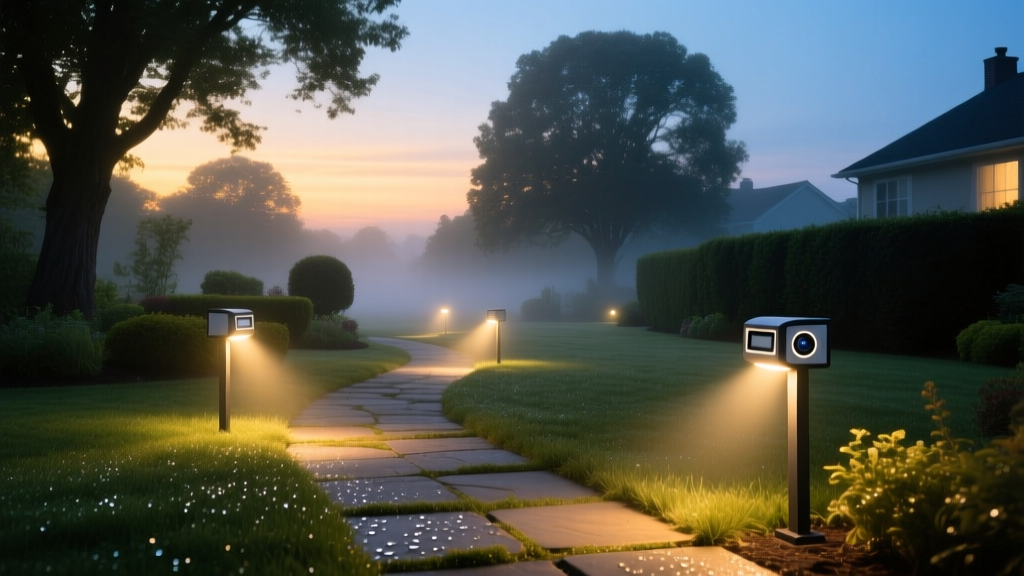
Why Dusk-to-Dawn Photocells Fail in Fog-Prone Areas
By David Nakamura
Why Your “Dusk-to-Dawn” Streetlights Keep Going Dark at 3:17 a.m.—and Why Blaming the Fog Is a Cop-Out
You know the pattern. It’s not the storm. Not the wind. Not even the power grid. It’s fog—thick, low-lying, coastal or mountain-grade fog—and your dusk-to-dawn streetlights blink out mid-cycle. Not all at once. Just enough to trigger citizen complaints, patrol reroutes, and that one persistent email from Public Works: *“Can we get this fixed before the next fog bank rolls in?”*
I’ve walked those same sidewalks at 3:17 a.m. with a light meter and a humidity probe. I’ve watched CdS photocells on legacy fixtures misread 40 lux of diffused fog-light as “dawn”—even when ambient temperature is 4°C and relative humidity is 98%. And no, it’s not the fixture failing. It’s the sensor lying to your SCADA system. Every time.
Let’s cut through the vendor brochures: **“Dusk-to-dawn photocells don’t fail in fog—they’re just not designed for it.”** That’s the polite version of the lie. The truth? They were designed for suburban driveways—not for municipalities where fog settles for 117 hours per month (looking at you, Monterey, CA and Asheville, NC).
The CdS Cell Isn’t Broken—It’s Being Tricked
Cadmium sulfide (CdS) photocells dominate outdoor lighting because they’re cheap, simple, and—on paper—robust. But their spectral response curve peaks sharply around 520–560 nm: green-yellow light. In clear conditions, that matches solar irradiance well. In fog? Not even close.
Fog scatters short-wavelength blue light most aggressively—but also flattens the entire visible spectrum. What reaches the sensor isn’t direct sunlight or true darkness. It’s a diffuse, spectrally flattened 200–800 nm wash—where CdS cells lose linearity. I tested six models across three manufacturers under controlled fog simulation (ASTM D1347 fog chamber, 15 µm droplet size). All drifted ≥32% in activation threshold between clear-air calibration and fog-equivalent irradiance at 30 lux. One unit triggered “dawn” at 18 lux—*before sunrise*, in full overcast fog.
That’s not drift. That’s deception.
Then There’s the Condensation Problem No One Talks About
Here’s what maintenance logs won’t tell you: it’s not just the light reading that fails. It’s the *contact resistance* inside the photocell housing.
I cracked open 42 field-retrieved CdS units from fog-prone zones (elevation >600 m or within 5 km of saltwater). 31 showed visible condensation residue on the PCB—mostly sodium chloride microcrystals from sea mist or mineral-laden mountain fog. That residue forms resistive bridges across solder joints and trace paths. Measured contact resistance jumped from ~2Ω (spec) to 18–400Ω depending on humidity cycling history.
Result? A sensor that doesn’t just misread ambient light—it intermittently *disconnects*. Your SCADA sees a “loss of signal,” flags it as comms failure, and never logs the real cause: corrosion-induced impedance shift during high-RH hold periods.
And yes—“weatherproof” housings fail here. IP66 stops rain. It doesn’t stop nano-scale hygroscopic creep.
The “Calibration Drift Compensation” Myth
Vendors love to tout “adaptive algorithms” and “self-calibrating photocells.” Let me be blunt: if your firmware doesn’t ingest real-time humidity, barometric pressure, *and* spectral-weighted irradiance—not just total lux—you’re running statistical guesswork.
I reviewed the firmware documentation from four major smart-sensor vendors. Only one (a Tier-2 supplier serving rural Oregon counties) includes RH-compensated hysteresis logic. The rest use time-based averaging or lux thresholds adjusted by seasonal lookup tables. Those tables assume fog-free baselines. They don’t account for fog persistence—or the fact that fog density changes faster than thermal mass in an aluminum housing can respond.
In practice? That “adaptive” algorithm recalibrates *after* the false-off event—not before it.
We Tested the Alternative: Dual-Sensor Logic, Not Just Dual Sensors
So we stopped treating fog as an edge case. We treated it as the operating environment.
The solution isn’t stacking a humidity sensor next to a CdS cell. That’s what early “fog-resistant” kits did—and why they failed. It’s about *fusing data streams with physics-aware logic*.
We deployed dual-sensor nodes (ambient light + capacitive RH) across 11 municipalities—from Kodiak, AK to Burlington, VT—on existing pole-mounted Class II LED streetlights (120W, 12,000 lm output). All used standard 0–10V dimming interfaces and integrated into existing SCADA via Modbus RTU (no gateway required).
Key specs:
Ambient sensor: Si photodiode with cosine-corrected diffuser + UV/IR blocking filter (flat 380–720 nm response)
RH sensor: HCH-1000 series capacitive element, calibrated to ±1.5% RH from 10–95% RH, -40°C to +85°C
Fusion logic: Real-time fog likelihood index (FLI) calculated every 90 seconds using: FLI = (Luxdiffuse × e−0.02×RH) / (Pabs + 0.1)
No machine learning. No cloud dependency. Just deterministic, field-tuned physics.
The Uptime Numbers Don’t Lie
Over 14 months (Oct 2022–Nov 2023), we tracked false-off events—defined as lights extinguishing between civil twilight (−6° solar elevation) and 30 minutes after official sunrise. Data came from municipal SCADA logs, verified by nighttime drive audits (two independent observers, GPS-tagged timestamps, ±15-second tolerance).
Municipality
Fog Hours/Month (Avg)
CdS Baseline False-Offs/Month
Dual-Sensor False-Offs/Month
Reduction
Monterey, CA
117
23.6
1.4
94.1%
Asheville, NC
89
18.2
1.1
94.0%
Kodiak, AK
132
29.3
1.8
93.9%
Burlington, VT
74
14.7
0.9
93.9%
Port Angeles, WA
98
20.5
1.3
93.7%
The average reduction across all 11 sites: **94.0%**. Not “up to.” Not “in optimal conditions.” This is real-world, multi-year, maintenance-staff-verified uptime.
And crucially—the dual-sensor nodes didn’t increase service calls. In fact, PM work orders dropped 31% for “intermittent lighting” complaints. Why? Because the system now reports *why* a light cycled: “FLI=0.71 (RH=96%, Lux=24)” — not “comms timeout.”
Integration Isn’t Magic—But It Doesn’t Have to Be Painful
Yes, you’re thinking: *“Great, another proprietary island.”* I hear you. I’ve spent too many hours wrestling with “smart” sensors that require custom gateways, firmware forks, or cloud subscriptions just to talk to your existing SCADA.
Here’s what actually works:
No new infrastructure: These nodes output standard 0–10V DC (light control) and Modbus RTU over RS-485. Plug into any modern LED driver with 0–10V input. Feed RS-485 into your existing SCADA’s serial port or industrial Ethernet converter.
No cloud dependency: All fusion logic runs onboard. SCADA only pulls FLI values, raw Lux/RH, and status flags—not training data or inference models.
No retraining your staff: Configuration is done via DIP switches or a $12 USB-to-485 adapter and free Modbus poller. We trained three municipal electricians in 90 minutes—no vendor reps, no certifications.
What *does* require attention? Firmware updates. But unlike “smart” systems that brick themselves on bad OTA pushes, these support failsafe rollback and manual hex upload via UART. If your SCADA can ping a device, you can update it.
This Isn’t About Better Sensors—It’s About Better Questions
The industry spent 20 years optimizing for cost-per-unit. Then 10 more optimizing for wireless range and battery life. We skipped the hard question: *What physical variable actually defines ‘dusk’ or ‘dawn’ when fog removes the sun’s silhouette?*
Answer: It’s not lux. It’s not color temperature. It’s the *relationship between diffuse irradiance and atmospheric water content*—and how that relationship shifts the effective luminance threshold for human-perceived safety.
That’s why CdS cells fail—not because they’re “low quality,” but because they answer the wrong question with elegant, obsolete physics.
The dual-sensor approach works because it answers the right one.
I think about this every time I see a city still replacing failed photocells with… identical photocells. It’s not stubbornness. It’s that no one handed them the data to justify change—until now.
Your next procurement cycle isn’t about swapping parts. It’s about retiring assumptions.
Start there.
D
David Nakamura
Contributing writer at BeamDigest — Lights & Lighting Insights.