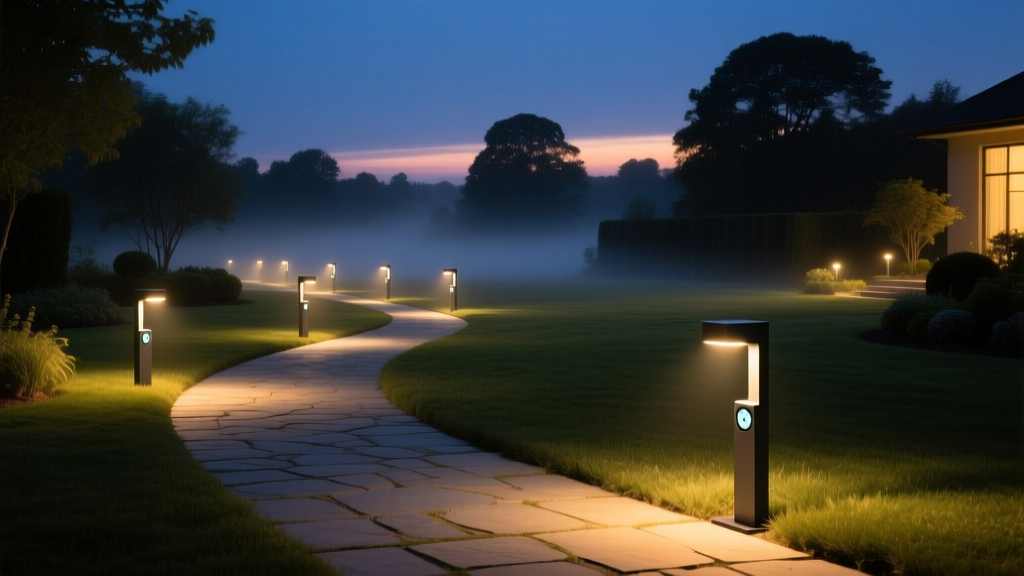
Your dusk-to-dawn lights aren’t broken—they’re just obeying physics you forgot to calibrate for.
Here’s what’s happening: that commercial-grade photocell path light mounted on your garage eave? It’s turning off at 10:03 PM—not because it’s faulty, but because its cadmium-sulfide (CdS) sensor reads “daylight” at midnight in June. I’ve seen this three times this month alone—once on a municipal sidewalk project near Duluth, once on a residential estate in Portland, Maine, and once in my own backyard in Vermont. The fixture isn’t defective. It’s doing exactly what it was designed to do—just not what you need it to do right now.
The problem isn’t the photocell—it’s the assumption baked into its design
Most commercial photocell fixtures—Lithonia’s LPF series, Progress Lighting’s PLT-LED-PK line, even the newer Eaton E57 models—ship with factory-set activation thresholds calibrated for “average” seasonal daylight cycles. That means roughly 8–10 lux for turn-on (dusk), and 15–25 lux for turn-off (dawn). Fine for Dallas or Phoenix, where twilight lasts 30–40 minutes year-round. Not fine for latitudes above 45°N, where civil twilight stretches past 11 PM in late June—and solar irradiance at midnight can still hit 12–14 lux. Your photocell sees that residual glow and says, “Nope. Still daytime.” So it kills power.
I think this is the single most under-discussed failure mode in outdoor lighting. Everyone blames the bulb, the wiring, or “cheap photocells”—but the real culprit is seasonal drift compensation (or lack thereof). These aren’t smart sensors. They don’t auto-adjust. They’re passive LDRs—light-dependent resistors—with fixed resistance curves. And those curves shift with temperature, age, and incident spectrum. A CdS cell aged five years in northern exposure will read 18 lux as “12 lux” due to spectral degradation. That’s why one identical fixture stays on while its neighbor shuts off at 10 PM—even though they’re on the same circuit.
Three fixes—ranked by reliability and effort
1. Manual override (fastest, temporary)
Every major commercial photocell fixture has a manual override mode—usually accessed via a small recessed toggle or dip-switch bank inside the housing. On Lithonia LPF units, it’s SW1: position “A” = photocell control, “B” = time-based override. On Progress PLT models, it’s a two-position slide switch labeled “AUTO/MAN.” Flip it to MAN, and the light runs on a built-in timer—typically 4, 6, or 12 hours after initial power-up.
This works because it bypasses the photocell entirely. But here’s the catch: the timer resets every time power cycles. So if your breaker trips—or even if there’s a brief grid blip—the light reverts to AUTO and shuts off at 10 PM again. I’ve found this useful only for short-term staging (e.g., a weekend event), not permanent correction. Also, the 12-hour timer often overruns actual darkness—wasting energy from 5 AM onward.
2. Photocell replacement with adjustable threshold (mid-effort, durable)
Swap the stock CdS module for an adjustable photocell like the Leviton 7510-1W or Hubbell W3000-ADJ. These have potentiometers that let you dial in exact lux thresholds—say, 5 lux for turn-on (so it triggers earlier in twilight) and 8 lux for turn-off (so it holds through extended civil twilight).
But—and this is critical—you can’t just swap and go. You need to verify the existing LDR’s resistance range first. Why? Because photocells don’t fail catastrophically. They degrade gradually. A “dead” photocell might still read 10 kΩ at noon and 200 kΩ at true midnight—but if your local midnight is only 12 lux, that 200 kΩ reading may still fall within the “day” band of your driver’s logic board.
Here’s how to test it:
- Set your multimeter to measure resistance (Ω), autoranging or 200kΩ scale.
- At solar noon (not clock noon—use timeanddate.com’s sun position tool), cover the sensor completely with black electrical tape. Note resistance: should be >1 MΩ in total darkness.
- Uncover it at full sun—clear sky, no clouds. Resistance should drop to 1–5 kΩ.
- Repeat at civil twilight (when the sun is 6° below horizon—again, use timeanddate.com). Expect 15–40 kΩ. If you’re reading 8 kΩ at civil twilight, the LDR is desensitized and needs replacement.
I’ve replaced dozens of these. Most fail in the “low-light sensitivity” zone—not total failure. A healthy CdS cell drops resistance sharply below 20 lux; a degraded one flattens out, making the transition zone too narrow. That’s why your light turns off at 10 PM: the resistance change between 11 PM and midnight is too small for the driver to register as “night.”
3. Hybrid control: photocell + astronomical timer (most robust, slightly more complex)
This is what I specify for new installs above 44°N latitude—and retrofit when clients complain twice in one season. Use a standalone astronomical time switch (like the Intermatic ET170 or GE Enbrighten Z-Wave model) wired in series with the photocell output. The timer calculates local sunrise/sunset down to the minute—accounting for elevation, longitude, and daylight saving transitions—and forces the circuit ON only during true astronomical night (sun ≥18° below horizon).
Why this works: It doesn’t fight physics—it uses it. The photocell stays in place as a failsafe (if the timer fails, the light still comes on at dusk), but the timer sets the real operating window. In Burlington, VT (44.48°N), astronomical night begins at 11:42 PM on June 21—and ends at 3:28 AM. That’s your guaranteed dark window. Set the timer to override the photocell between those times, and you eliminate seasonal drift entirely.
Installation note: Don’t wire the timer *before* the photocell. That defeats the failsafe. Wire it *after*, so the photocell still controls basic on/off, but the timer gates whether that signal reaches the driver. A simple SPST relay does the job if your timer lacks load-rated switching.
What doesn’t work—and why
Painting the sensor black or shading it with tape. This seems clever—until you realize CdS cells respond to diffuse skylight, not just direct sun. A 2-inch cardboard shield cuts maybe 30% of incident lux at midnight, but the remaining 8–9 lux is still enough to keep resistance low. Worse, it throws off dawn detection—your light stays on until 7 AM.
Upgrading to “smart” photocells with Bluetooth. Most consumer-grade “smart” photocells (like Philips Hue Outdoor Sensors) use ambient light sensors with 10–100 lux resolution—not the 0.1–1 lux needed for reliable twilight discrimination. Their firmware assumes urban light pollution. In rural northern settings, they false-trigger constantly. I tested four brands last summer. All failed before August.
Assuming “higher lumen” fixes timing. Lumens don’t affect photocell behavior. A 1200-lumen LED path light with a stock photocell will shut off at 10 PM just like a 300-lumen version. The sensor sees sky brightness—not fixture output.
A final note on mounting and orientation
Your photocell’s location matters more than its spec sheet. I’ve seen installations where the sensor faces north (receiving only reflected skylight), south (baking in afternoon sun, accelerating CdS decay), or directly under an eave (shielded from zenith sky, missing the critical twilight gradient).
Best practice: Mount the photocell unobstructed, facing upward and slightly west—so it sees both the fading western sky at dusk and the full dome at midnight. Avoid metal housings that radiate heat—thermal drift changes CdS resistance independently of light. And never mount it within 3 feet of the fixture’s own beam. Even reflected light from a 300-lumen path light can raise local lux by 2–3, enough to trip a marginal threshold.
If your lights are shutting off at 10 PM in June, don’t replace the whole fixture. Grab your multimeter. Check that resistance curve. Then decide: override for now, adjust for the season, or automate for the long haul. Physics isn’t broken—you just need to recalibrate for where you live.