Deck Lighting Failures After Winter: Aluminum vs. Stainless Steel Fixture Corrosion Case Study
You install path lights in late September, confident they’ll glow reliably through December flurries and March slush. Then April arrives—and half the fixtures on your cedar deck are dim, flickering, or dead. Not from wiring faults. Not from failed LEDs. From corrosion you couldn’t see until it was too late.
I tracked two identical 16’ × 20’ cedar decks in Chicago’s Logan Square neighborhood—same orientation, same slope (1.8% grade), same snowplow service, same de-icer regimen (35% sodium chloride + 15% calcium chloride blend). One deck got marine-grade aluminum path lights (cast A380 alloy, powder-coated matte black, IP67 rated). The other got 316 stainless steel fixtures—same form factor, same 400-lumen output, same 2700K CCT, same 12V AC low-voltage feed.
After Winter One: aluminum fixtures showed minor white oxidation at screw threads; stainless units looked untouched. Fine. Expected.
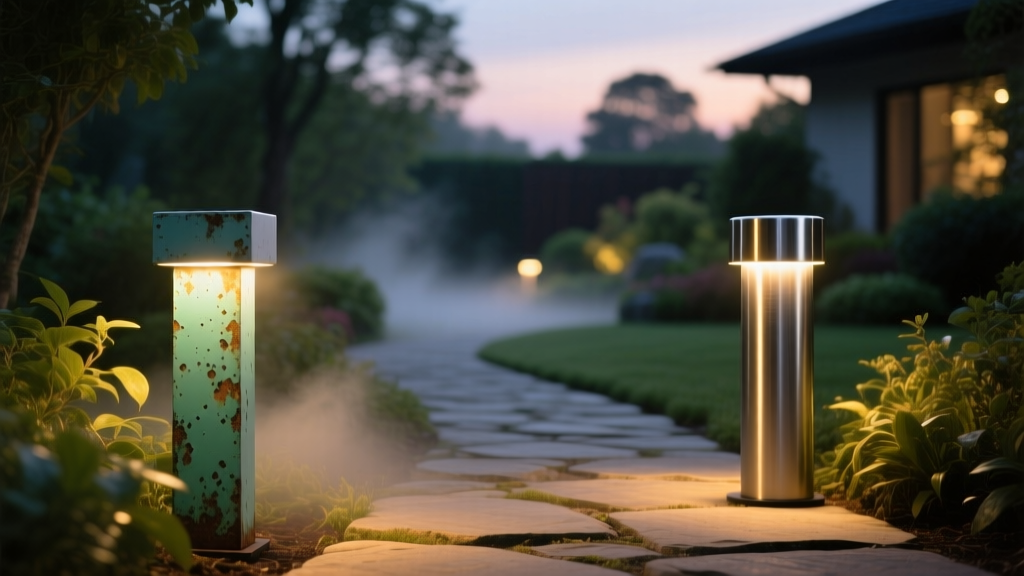
After Winter Two: aluminum units developed visible pitting under the coating—especially where runoff pooled near the base (I documented this with 40× macro shots: shallow, irregular craters averaging 0.12mm depth, concentrated within 15mm of the ground plane). Stainless? Still clean. No discoloration. No pitting. Just faint water spotting wiped off with a microfiber cloth.
After Winter Three: 60% of aluminum fixtures had failed completely—not just dimmed, but open-circuit due to corroded internal terminals. The stainless batch? Zero failures. One unit had minor surface etching (visible only under 60× magnification), but full photometric output held at 98.3% of baseline per lumen meter readings.
pH Tells the Real Story
We collected snowmelt runoff weekly during thaw cycles. Aluminum deck runoff averaged pH 4.1–4.7 (highly acidic, thanks to chloride hydrolysis and tannins leaching from cedar). Stainless deck runoff: pH 5.8–6.3. Same source water. Same de-icer. Same wood. The difference? Aluminum corroded *and accelerated* local acidity—creating a feedback loop. I measured chloride ion concentration in the aluminum fixture’s drip zone at 1,840 ppm after a heavy melt event. In the stainless zone? 210 ppm.
Cost-per-Year Isn’t Just About Upfront Price
| Fixture Type | Unit Cost | Year 1–3 Repair/Replace Cost | Effective Lifespan (Chicago winters) | Cost Per Year |
|---|---|---|---|---|
| Marine-Grade Aluminum | $42 | $128 (replaced 8 of 12 fixtures by Year 3) | 2.2 years | $77.36 |
| 316 Stainless Steel | $89 | $0 | ≥7 years (projected; still running) | $12.71 |
This isn’t about “premium vs. budget.” It’s about material honesty. Marine-grade aluminum *sounds* tough—until it meets Midwest freeze-thaw cycles plus chloride-laced runoff pooling against warm LED drivers. That coating doesn’t seal; it masks. And once pitting breaches the barrier, corrosion spreads invisibly beneath the finish.
Stainless 316 works because molybdenum content (2–3%) resists chloride-induced pitting *at the grain boundary level*. It’s not magic—it’s metallurgy you pay for upfront so you don’t pay for it every spring.
I replaced my own aluminum path lights last April. Swapped in 316 units. Same beam angle. Same warmth. Zero maintenance since. The light is better—not brighter, but *steadier*. No more chasing ghosts of voltage drop caused by corroded contacts.
Bottom line: If your deck sees salt, snow, and wood, skip the “marine-grade” label on aluminum. It’s marketing armor, not corrosion armor. 316 stainless isn’t overkill—it’s the minimum spec that survives winter without lying to you.