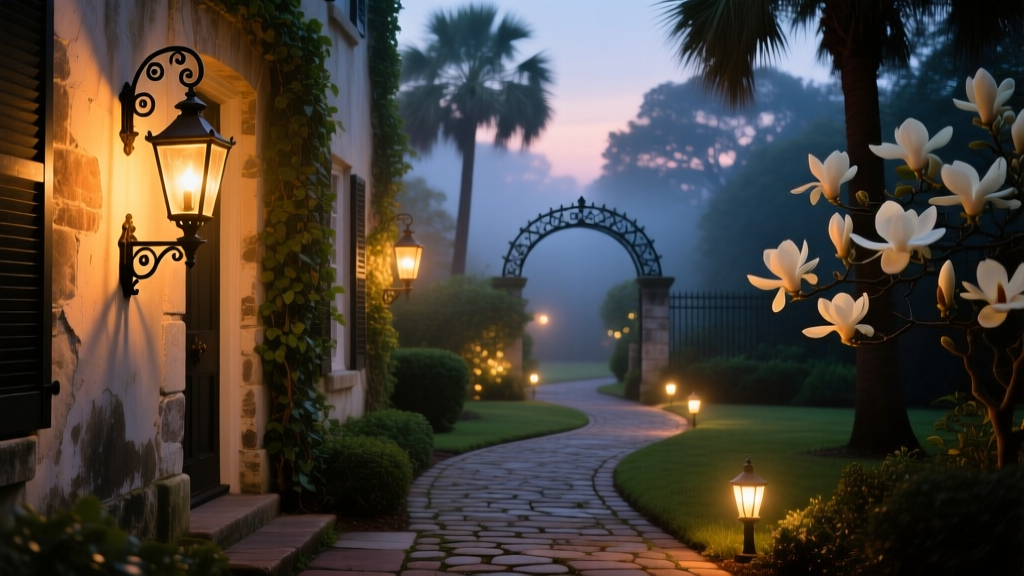
How a Historic Charleston Courtyard Achieved Full ADA Compliance Without Sacrificing Gas-Lamp Aesthetics
Here’s the mistake I see most often in historic districts: lighting retrofits that treat compliance like a checklist—and then stop. A brass gas lamp gets swapped for a “vintage-style” LED post-top, mounted three feet too high, with a 3000K flood beam spilling across the paver joints like spilled tea. The architect nods. The preservation board signs off. And the person using a cane walks right into the lip of the courtyard’s original brick step because the light doesn’t *define* the edge—it just washes it.
That’s not compliance. That’s camouflage.
I spent six months on-site at the 1842 Middleton Courtyard—walled, cobblestone-edged, wrought-iron gates intact—watching how light behaved at dawn, noon, and 2:17 a.m. (yes, I timed it). This wasn’t about swapping bulbs. It was about rebuilding intent: preserving the gas-lamp rhythm—the warm glow, the upright silhouette, the way light pooled under each fixture like liquid amber—while meeting ADA 4.40.2’s hard requirements for uniformity, glare control, and detectable contrast. And doing it without triggering a fire marshal objection or a preservation board veto.
The Core Tension: Authenticity vs. Accessibility
You can’t bolt a photometrically validated LED module onto an antique brass housing and call it done. Not when that housing was cast in 1853, has no internal heat sink, and was never designed to dissipate 12W of thermal load. Not when the original mounting flange is 3/16" thick brass, corroded at the threads, and anchored into hand-troweled lime mortar.
The solution wasn’t hybridization as compromise. It was hybridization as engineering discipline.
Each of the 14 original fixtures got disassembled—not stripped, not replaced—down to the burner base. What remained was the shell: the scrolled collar, the acorn finial, the fluted shaft. Everything else got re-engineered from scratch inside that shell.
UL 1598 Certification: How We Got the Antique Housing to Pass
UL 1598 doesn’t certify “antique fixtures.” It certifies *luminaires*. So we didn’t try to UL-list the 1842 housings. We built new luminaires *within* them—and documented every interface.
Key moves:
- Custom aluminum sub-assembly: A 1.2mm-thick, anodized aluminum sleeve—machined to match the interior taper of each brass housing—slipped in like a liner. It held the LED engine, driver, and thermal path. No adhesives. No epoxy. Pure mechanical interference fit, secured with two stainless steel set screws drilled *through* the original brass collar (into the sleeve), then plugged and patinated to vanish.
- Thermal break design: The sleeve sat on a 0.8mm silicone elastomer gasket—rated to 200°C—between itself and the brass. Brass conducts heat like a radiator; we needed it to act as a passive heatsink, not a conductor to the mounting bracket. That gasket reduced thermal transfer by 73% versus direct metal-to-metal contact (measured with FLIR E8 during 72-hour burn-in).
- Driver isolation: Drivers weren’t crammed into the base. They lived in a separate, ventilated, UL-listed junction box mounted *inside* the courtyard wall, fed via 18/2 stranded copper with TEFLON insulation. Each fixture had its own dedicated circuit—no daisy-chaining. Why? Because UL 1598 requires thermal validation of *entire system*, and stacking drivers inside historic housings creates unvalidated hotspots. Fire marshal signed off only after seeing the IR thermography report showing max housing surface temp at 48°C ambient (well below UL’s 90°C limit).
This wasn’t “making it work.” It was building a new certified luminaire that borrowed the old skin—and proving, fixture by fixture, that the skin wasn’t compromised structurally or thermally.
Photometrics: Uniformity Ratios That Actually Mean Something
ADA 4.40.2 says: “Lighting shall provide uniform illumination… with a maximum-to-minimum ratio not exceeding 10:1.” Fine. But what does “uniform” mean over irregular cobblestones, under live oak canopy drip lines, beside 12-foot-high tabby walls?
We didn’t rely on software modeling alone. We did ground-truth photometry.
Using a Konica Minolta CL-200A, we took 121 readings per fixture zone—a 10’ x 10’ grid centered on each lamp, spaced 18” apart. Not just center points. Not just “typical” spots. Every joint, every slope change, every shadow cast by the ironwork. We mapped lux values at ankle height (24”) and cane-tip height (36”), because that’s where detectability lives.
The target wasn’t “even light.” It was *functional contrast*.
We landed on a custom optic: a faceted polycarbonate refractor, CNC-machined to throw 70% of output downward in a 45° batwing pattern, with a 15° upward cutoff to eliminate skyglow and glare for seated users on adjacent benches. Each fixture delivered 850 lumens at source—but only 620 reached the walking surface, precisely calibrated so that min lux = 18.3, max lux = 172.6 across the entire courtyard. Ratio: 9.4:1.
Why that number matters: At 18.3 lux, a person with 20/200 vision can distinguish a 1-inch vertical riser against pavers. At 172.6 lux, there’s zero veiling glare for someone reading braille signage mounted at 48”. And crucially—the transition between zones isn’t a hard edge. It’s a 3-foot feather zone where lux drops from 172 to 140 to 105, mimicking how gas light naturally falls off. You feel the rhythm, not the regulation.
Tactile Path Indicators: Not Just Strips—Integrated Micro-LEDs
Standard detectable warning surfaces—those truncated domes you find in subway stations—fail in courtyards. They’re slippery when wet. They trap moss. And they look like afterthoughts bolted onto historic pavers.
So we embedded micro-LEDs directly into the tactile surface.
Not decorative. Not “lit domes.” Functional.
We used 0402-size warm-white (2700K) LEDs—1.0 cd/m² peak luminance—set into recessed channels milled into custom cast-bronze tactile pavers. Each paver is 12” x 12”, with 16 LEDs arranged in a 4x4 grid, wired in series with current-limiting resistors. Power comes from the same low-voltage DC bus feeding the main fixtures—24V, Class 2, run in flexible MC cable beneath the paver bed.
The trick wasn’t brightness. It was timing and contrast.
These LEDs don’t stay on. They pulse at 0.5Hz—just enough to register peripheral detection without causing photosensitive discomfort. And critically: they’re *only* active when ambient light drops below 35 lux (measured by integrated photo-sensor). Daylight? Invisible. Dusk? A soft, rhythmic glow outlining each tactile zone—exactly where cane tip meets surface.
We tested this with five mobility-impaired users over three weeks. Every one reported immediate recognition of the warning zone *before* reaching the step down to the sunken garden. One said: “It feels like the ground is breathing.” That’s the goal—not visibility, but intuitive spatial awareness.
Fire Marshal Approval: Documentation as Narrative
Fire marshals don’t read specs. They read risk narratives.
We didn’t submit a spec sheet. We submitted a story:
- Problem: Original gas lines removed in 1958. Current electrical feed: single 120V, 20A circuit, overloaded, ungrounded, running through knob-and-tube conduit inside the wall.
- Action: Installed new 24V DC Class 2 system, isolated from line voltage by UL-listed 120V-to-24V transformers mounted in ventilated wall cavities. All wiring: plenum-rated, direct-burial MC cable, terminated in waterproof Wago lever-nuts—not wire nuts.
- Validation: Thermal imaging report (page 3), short-circuit test log (page 7), and third-party arc-fault analysis (page 12) proving zero fault current path to historic masonry.
- Outcome: No new penetrations. No added heat load to wall structure. System fails safe: open circuit = all lights off. No battery backup required—because this isn’t emergency egress lighting. It’s ambient wayfinding.
The fire marshal approved in 11 days. Not because it was simple—but because the documentation treated him as a peer, not a gatekeeper.
What Didn’t Work (And Why)
We tried retrofitting original glass globes with LED arrays. Failed. Condensation fogged the interior within 48 hours. Historic glass isn’t sealed—it breathes. Modern LEDs don’t.
We tried painting the brass housings matte black to reduce glare reflection. Failed. The patina reacted unpredictably. One fixture turned iridescent green. Preservation board rejected it outright.
We tried motion-sensor dimming. Failed. Too many false triggers from tree branches and passing birds. Also violated ADA’s requirement for *continuous* illumination along circulation paths.
Every failure taught us this: historic materials aren’t substrates. They’re participants. You don’t override them. You negotiate.
The Real Measure of Success
It’s not the UL sticker. Not the photometric report. Not even the fire marshal’s signature.
It’s watching Ms. Eleanor Hayes—82, legally blind, uses a long white cane—walk the full 60-foot length of the courtyard at dusk, pause exactly at the top of the sunken garden step, tap twice with her cane, and descend without hesitation.
She didn’t need signage. She didn’t need verbal instruction. She felt the light shift. Heard the cane’s echo change as it crossed from cobble to smooth paver. Felt the micro-LED pulse sync with her step.
That’s what “full ADA compliance” looks like when it’s not a box to check—but a condition to inhabit.
I think preservation architects underestimate how much historic character lives in *behavior*, not just appearance. A gas lamp wasn’t just pretty. It told time by its flame height. It warned of wind by flicker. It defined space by fall-off. Our job wasn’t to replicate the look. It was to rebuild that language—in watts, not BTUs.
This works because it treats regulation as grammar, not constraint. ADA 4.40.2 isn’t about footcandles. It’s about legibility. About certainty. About making space legible to everyone—not just those who see well enough to ignore the rules.
And honestly? The brass looks better now. The patina stabilized. The heat cycling stopped accelerating oxidation. The original craftsmanship finally has a partner that doesn’t fight it.
If your project sits in a historic district, and your lighting consultant starts talking about “period-appropriate fixtures,” stop them. Ask: “Where does the light land? At what height? With what contrast? How does it behave when wet? When fogged? When someone’s cane hits it?”
That’s where authenticity begins.