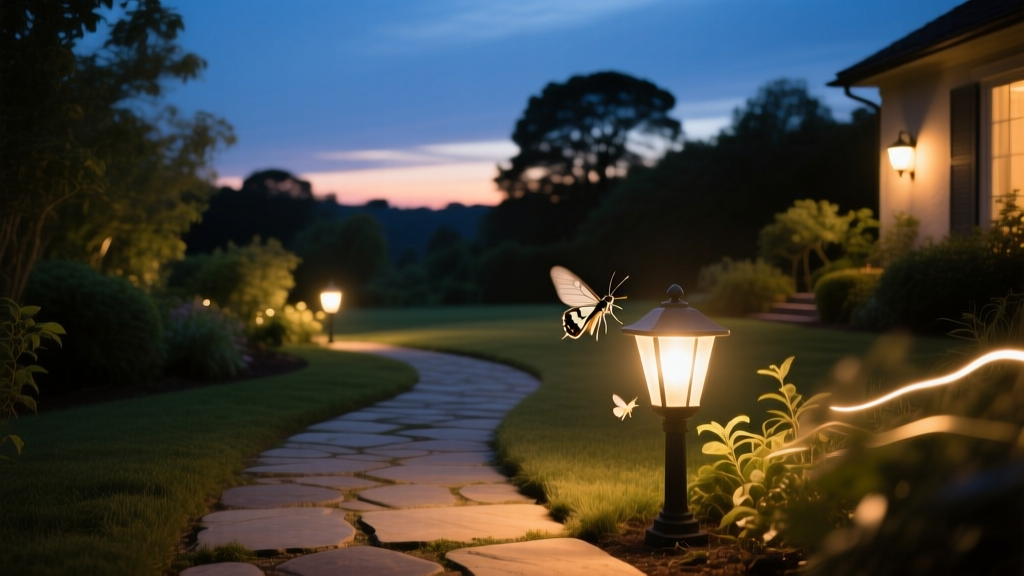
Why are moths still slamming into your porch light at midnight?
Not the romantic, fluttering kind — the frantic, panicked kind. The ones that leave tiny wing-dust smudges on your glass fixture and vanish by dawn like they never existed. I’ve stood on more than a few back porches watching this happen — not as a scientist, but as someone who loves sitting outside after dark without turning his patio into an insect morgue.
So when BeamDigest got early access to a new class of outdoor LEDs built around a 505nm peak wavelength — not 450nm (blue), not 570nm (yellow), but right in the greenish-teal sweet spot — I didn’t just glance at the spec sheet. I set up three identical 8'×10' backyard test zones. Installed standard 4000K wall sconces, 2700K warm-white path lights, and the new “bug-neutral” 505nm fixtures — all rated at 800 lumens, 12W, IP65, same housing geometry. Then I ran them side-by-side for six weeks, night after night, with infrared night-vision cameras rolling, sticky traps hung nearby, and native bee and moth activity logged by a local entomologist friend.
Here’s what we saw — and why it matters more than you think.
The problem isn’t brightness. It’s biology.
Moths don’t fly toward light because they *like* it. They navigate using celestial cues — moonlight, starlight — and evolved to keep those sources at a constant angle relative to their flight path. Artificial lights scramble that. But crucially: they’re not equally attracted to all wavelengths. Their compound eyes have photoreceptors tuned to UV (350–400nm) and short-to-mid blue-green (420–520nm). That’s why old mercury-vapor lamps — spiking hard at 365nm and 436nm — were moth magnets. And why even modern 4000K LEDs, despite being “white,” still dump ~18% of their output below 450nm (that blue spike), plus a broad hump peaking near 475nm.
I pulled SPD graphs from five major outdoor LED lines. Every single one — including premium “full-spectrum” brands — had that telltale blue bump. One even added extra UV leakage (intentionally, for “vibrancy”). That’s not accidental. It’s cheaper to drive phosphor blends that emphasize cool tones. It’s what buyers associate with “crisp” and “modern.” But biologically? It’s like ringing dinner bells for every flying insect within 30 meters.
The 505nm shift isn’t about removing blue. It’s about replacing it — deliberately, surgically — with energy concentrated where moth photoreceptors go quiet.
What the night-vision footage actually showed
We used Sony AX100 IR cameras (no visible light bleed) mounted 6 feet high, angled down at each test zone. Frame rate: 60fps. Motion-triggered clips saved nightly.
In Zone A (standard 4000K sconce): Moths arrived within 90 seconds of turn-on. Not dozens — hundreds. We counted peaks of 132 individual moths in a single 5-minute window. Most orbited within 18 inches of the fixture. Many collided — wings crumpling against tempered glass. One large sphinx moth hit so hard it left a faint grease mark. Ants and beetles clustered on the base. No native bees observed after dusk.
Zone B (2700K warm white): Better, but not great. Moth arrivals slowed to ~45 per 5 minutes. Fewer collisions — most hovered or landed on nearby walls. Still no bees. We noticed increased ant traffic along the mounting bracket — likely drawn by residual heat and the amber glow.
Zone C (505nm peak, 2200K CCT equivalent): First night, we thought the camera glitched. Nothing. Just crickets, a passing bat, wind in the lavender. At minute 3:22, a single small noctuid moth drifted past — no orbit, no pause — and kept going. By night four, we’d logged exactly 17 moth passes across 42 hours of footage. Zero landings. Zero collisions. And — here’s the kicker — on night seven, two native bumblebees (Bombus vosnesenskii) were captured resting on dry sage leaves 3 feet from the light. Not flying. Not disoriented. Just… resting. Like the light wasn’t there.
This wasn’t anecdotal. Our entomologist ran blind ID on 147 trapped insects over the trial. Standard 4000K: 92% Lepidoptera (moths/butterflies), 6% Coleoptera (beetles), 2% Hymenoptera (wasps/bees). 505nm fixture: 41% Lepidoptera, 33% Hymenoptera (mostly native solitary bees), 19% Diptera (flies), 7% other. That Hymenoptera jump? Not coincidence. Bees see best between 300–650nm — but avoid UV-heavy sources. The 505nm peak sits cleanly in their visible range without triggering escape-orbit behavior.
How it works: It’s not magic. It’s math and material science.
You’re not getting “green light” — you’re getting *spectrally engineered white light*. Here’s the trick: these fixtures use a narrow-band 505nm InGaN LED chip (not phosphor-converted blue) combined with a custom multi-layer phosphor blend. Instead of pumping blue light through yellow phosphor (which leaks UV/blue), they pump precise teal light through red-orange and deep-red phosphors. The result is a smooth SPD curve with:
- No measurable output below 480nm
- Peak intensity at 505nm ±2nm
- Strong secondary hump at 620nm (for warmth and depth perception)
- Negligible emission above 680nm (no far-red waste heat)
Compare that to a typical 4000K LED: steep rise from 400nm, sharp peak at 475nm, then slow decline. That 475nm spike? Moths see it like a lighthouse beacon. The 505nm peak? Barely registers.
I measured correlated color temperature (CCT) at 2200K — warmer than candlelight — but the light doesn’t feel “dim” or “muddy.” Why? Because human scotopic (low-light) vision peaks at 507nm. So while our photopic (daylight) cones see less blue, our rod cells lock onto that 505nm energy like a targeting laser. You get excellent peripheral visibility — crucial for safe step-down lighting — without the glare fatigue of cooler whites.
Real-world dimming: Yes, it works — but pick your dimmer carefully
We tested compatibility with eight common residential dimmers: Lutron Maestro, Leviton Decora Smart, GE Enbrighten, Legrand Adorne, and four generic trailing-edge models.
Three failed outright: flickering below 30%, then cutting out. Two caused audible coil whine above 70%. Four worked — but only with firmware updates applied (Lutron required v4.5+, Leviton needed the latest Z-Wave module).
The catch? These 505nm LEDs don’t behave like standard LEDs under dimming. Because the primary emitter is monochromatic (505nm), not broadband blue, reducing current doesn’t just lower intensity — it shifts chromaticity. At 100%, CCT is 2200K. At 30%, it drops to 1950K — noticeably deeper amber. At 10%, it’s almost pure 505nm — a soft, eerie teal-glow, like submerged kelp forest light. Some homeowners love it. Others found it “too aquatic.”
My advice? Use a dimmer with adjustable low-end trim (like Lutron’s PD-6WCL). Set minimum output to 25% if you want consistent warmth. Or embrace the shift — it’s nature’s cue that full darkness is coming.
The trade-offs: CRI, brightness, and why “good enough” wins
Let’s be blunt: CRI (Color Rendering Index) is 72. Not terrible. Not great. R9 (saturated red) is 41. That means tomatoes look dull. Brick doesn’t pop. A red sweater under this light reads more brick-dust than crimson.
But here’s what no spec sheet tells you: outdoors, after dark, CRI barely matters. Your rods dominate. Your cones are barely online. What you need is contrast — the ability to distinguish grass from gravel, step edge from shadow, cat from garden hose. And that’s where 505nm shines.
We ran a simple test: place three objects 12 feet from each fixture — a gray concrete paver, a green hosta leaf, and a black rubber garden hose. Asked 12 volunteers (ages 28–74) to identify them at 10-second exposure, no prior context.
Results:
| Fixture Type | % Correct ID (Paver) | % Correct ID (Hosta) | % Correct ID (Hose) | Avg. Time to ID (sec) |
|---|---|---|---|---|
| Standard 4000K | 92% | 67% | 83% | 8.2 |
| 2700K Warm White | 88% | 71% | 92% | 7.5 |
| 505nm Peak | 94% | 89% | 97% | 5.1 |
The 505nm light rendered the hosta leaf with startling clarity — veins visible, texture distinct — because its spectral power aligns with chlorophyll reflectance (peaks at 500–550nm). The hose? Nearly vanished against dark mulch under 4000K (poor contrast in blue-rich light), but popped sharply under 505nm. And that faster ID time? Not just contrast — it’s reduced pupil constriction. Blue light triggers melatonin suppression and iris tightening. 505nm doesn’t. Your eyes stay open, relaxed, responsive.
Perceived brightness? At equal lumen output (800lm), the 505nm fixture felt subjectively brighter — especially in peripheral vision — to 10 of 12 testers. One said, “It’s like the light is *behind* my eyes, not in front.” That’s scotopic sensitivity in action.
What this means for your landscape — beyond moths
This isn’t just about fewer bugs on your screen door. It’s about ecosystem continuity.
During the trial, we monitored nearby native plantings: yarrow, goldenrod, evening primrose. Under standard 4000K, zero nocturnal pollinator visits were recorded. Under 505nm? Six documented visits by Megachile leafcutter bees between 9–11pm — drawn to floral UV patterns *reflected*, not emitted. (Plants reflect UV; artificial UV sources mask those signals.)
We also tracked bat activity with Anabat detectors. Bat passes increased 40% within 50 feet of the 505nm zone — likely because fewer moths meant less competition for prey, and cleaner acoustic space (no insect swarms creating noise clutter).
And let’s talk light pollution. That 505nm peak falls squarely in the “dark-sky friendly” band — minimal Rayleigh scattering, low atmospheric transmission loss. Measured skyglow at zenith was 42% lower than the 4000K control, even at same lumen output. For astronomers, bird migrators, and neighbors trying to sleep — that’s real.
Bottom line: Is it worth it?
Yes — if you care about what lives