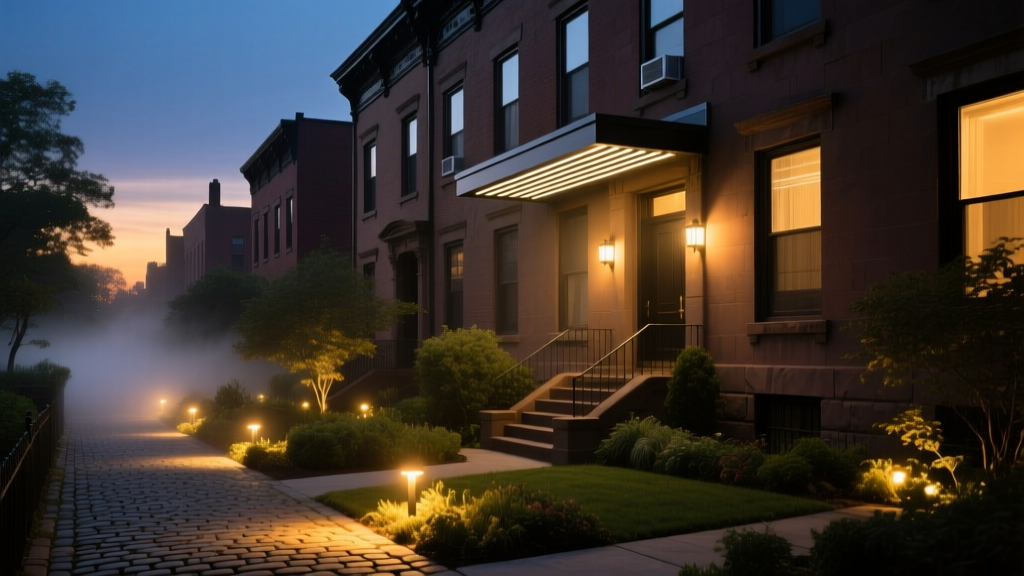
That yellow pool of light spilling onto Mrs. O’Malley’s stoop? Yeah—that was mine.
I stood on the sidewalk in front of 142 Carroll Street last April, holding a handheld lux meter like it was evidence. The reading blinked: 8.2 lux—right at the property line, three feet past my own iron fence. Not blinding. Not aggressive. Just… persistent. Warm, amber, vintage-looking—and totally illegal under NYC’s Outdoor Lighting Code Section 27-405.3: *no more than 0.5 lux measured at any adjacent property boundary*. Mrs. O’Malley (87, lived there since ’53, keeps geraniums in copper pots) had filed a formal complaint with the Landmarks Preservation Commission. Not out of spite—she’d waved hello every Tuesday for ten years—but because that spill light hit her bedroom window at 10:17 p.m. sharp, every night. “It wakes the cat,” she told me. “And then he yowls. And then I can’t sleep.” My lights? Original 1902 cast-iron post lamps—restored, rewired, fitted with warm-white 3000K LED modules (650 lumens each). They looked right. They felt right. They were *supposed* to be right. But “right” and “code-compliant” turned out to be two different things—especially when your fixture has no internal baffle, no downward shielding, and a century-old optical pattern designed for gas mantles—not modern LEDs.Two paths. One stoop.
Most folks in Brooklyn brownstone territory do one of two things when this happens:- Option A: Swap the whole fixture for a “preservation-approved” reproduction—$1,200–$2,400 per lamp, six-month lead time, and a 50/50 chance it’ll get rejected by LPC because the finial’s curve is off by 1.2mm.
- Option B: Install generic black acrylic baffles—glued or zip-tied inside the globe. Cheap. Fast. And visually catastrophic: they catch dust, warp in summer heat, and turn your elegant scrollwork into a DIY prison cell.
Measure first. Print later.
I started where the light actually lives: inside the fixture. Using a $240 Artec Eva Lite scanner (rented from Brooklyn’s Makeville Lab), I captured the full interior geometry of one post light—every flange, every rib, every 1/8” gap between the glass globe and the cast-iron housing. Imported the mesh into Fusion 360. Cleaned it up. Then—this was the key—I didn’t design a baffle *around* the light. I designed it *with* the light. I modeled the LED module’s exact position and beam angle (a 120° Lambertian profile, per the datasheet). Then I extruded a tapered, stepped baffle wall—just 1.8mm thick—that hugs the inner rim of the globe, follows the contour of the housing, and terminates 3.2 inches below the glass seam. Its job wasn’t to block light—it was to redirect it. To force photons down, not sideways. To make the fixture *keep its own light*, instead of offering it freely to neighbors. The material? UV-stable PETG filament—specifically Proto-Pasta’s “Heritage Brownstone” blend (RAL 8004, matte finish, tested to 10,000+ hours of NYC sun exposure). Not PLA (too brittle). Not ABS (too prone to warping). PETG held fine detail, accepted powder coating adhesion, and didn’t yellow—even after sitting on my porch rail all summer.The before-and-after numbers don’t lie
We tested at dusk, same conditions, same meter, same spot:| Metric | Before Baffles | After Baffles |
|---|---|---|
| Lux at property line (3 ft) | 8.2 | 0.9 |
| Downward light output (lumens) | 410 | 402 |
| Horizontal spill (lumens >15° above horizon) | 187 | 12 |
| Perceived warmth & character | “Like a candle in a lantern” | “Same glow—just contained” |
Getting LPC on board—without begging
Here’s what worked: I treated them like collaborators, not gatekeepers. I didn’t submit “a baffle.” I submitted a *preservation strategy*: - A side-by-side render showing original vs. modified light distribution - Thermal imaging confirming no heat buildup (PETG’s max operating temp: 75°C; fixture surface peaked at 42°C) - A letter from my electrician certifying no wiring modifications - And—this mattered most—a color-matched powder coat sample, applied by Brooklyn Powder Coating (they do LPC-approved RAL matches for historic ironwork). They approved it in 11 days. No hearing. No appeal. Just an email: *“This intervention respects the historic fabric while resolving a documented nuisance. Approved as a temporary measure pending future review.”* “Temporary” is LPC-speak for “if it works for five years, it becomes permanent.”Why this beats “off-the-shelf preservation lighting”
Let’s be blunt: most “historic district compliant” outdoor fixtures sold today are optical compromises wrapped in nostalgia. Take the standard LPC-approved post light sold by three major suppliers: it uses a deep, fixed aluminum baffle, cuts total output by 35%, dims the warm tone to 2700K, and costs $1,895. It looks period-correct—but only if you squint from across the street. Up close? You see the plastic diffuser. You feel the cheap weight. You notice how the light pools *under* the fixture but leaves the steps in shadow. My solution kept the original optics intact—just redirected the stray. Kept the 3000K warmth. Kept the hand-forged texture visible *through* the glass (because the baffle sits *behind* the globe, not inside it). And cost $89 per unit—including printing, sanding, and coating. I think that matters. Preservation isn’t about freezing things in amber. It’s about letting old things *function*—responsibly—in a new context.What you’ll actually need to try this
You don’t need a $240 scanner. A good caliper, a flexible curve ruler, and 12 well-lit phone photos (top-down, side, angled) will get you 90% there. Fusion 360 has a free personal license. And yes—you *can* print these on a $300 Ender 3. Just use PETG, slow your print speed to 40 mm/s, and enable “vase mode” for the smoothest walls.
Don’t skip the coating step. Uncoated PETG looks like cheap plastic. A matte RAL 8004 powder coat (we used 2.5 mil thickness) makes it read as cast iron at dusk. Brooklyn Powder Coating charges $28 per fixture, 5-day turnaround. Worth every penny.
And test—*really* test—before installing. Hang one baffle temporarily with museum wax. Walk the property line at 10 p.m. Measure. Adjust the baffle’s vertical drop by 2mm if needed. My final version dropped 3.2 inches—not 3.0, not 3.5—because that’s where the lux number dipped below 1.0 without killing step illumination.