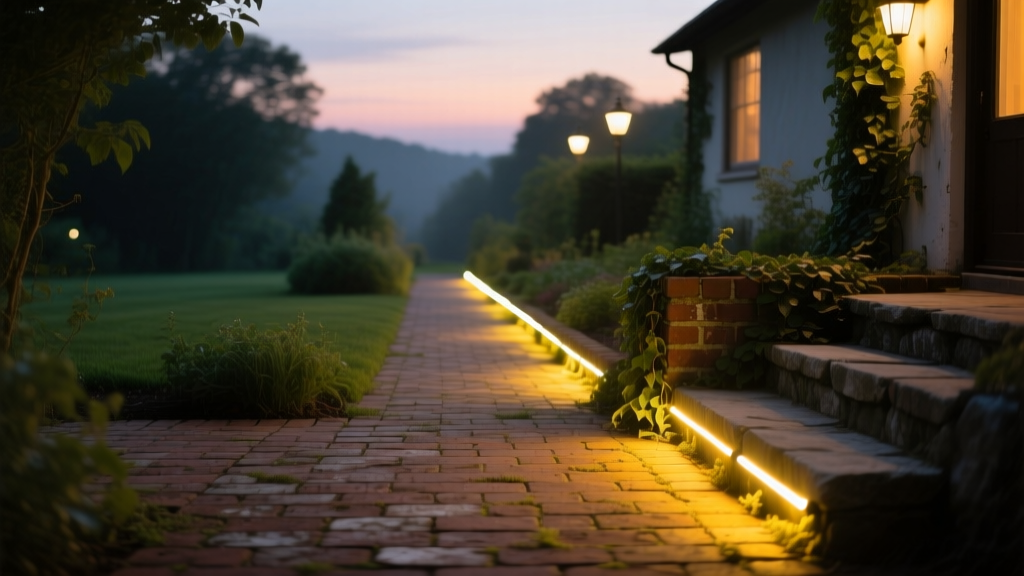
“UV doesn’t kill LED strips—it just makes them lie about their color.” — Javier Ruiz, outdoor lighting specialist, Phoenix-based
I heard that line from Javier while standing on a cracked brick patio in Scottsdale last summer. His client’s “premium” 2700K warm-white strip lights—installed flush into mortar joints 14 months earlier—had turned a sickly butter-yellow. Not dimmed. Not failed. Just… lied. The light still measured 92% lumen output on the meter. But the CCT? 2200K. The CRI? Dropped from 92 to 68. It looked like a candle dipped in turmeric.
This isn’t rare. In desert climates—Phoenix, Las Vegas, Palm Springs—it’s predictable. And it’s not about cheap LEDs or bad installation. It’s about how UV exposure degrades phosphor coatings *inside* the LED package—and how most “outdoor-rated” strips are rated for water resistance, not sunlight endurance.
What actually happened to your strip lights?
Let’s cut past the marketing. Your brick-joint LED strip didn’t fail because moisture got in. It yellowed because UV photons bombarded the yellow phosphor layer (YAG:Ce) coating each blue LED chip. Over time, that phosphor oxidizes and degrades—not uniformly, but in patches. That’s why you see blotchy amber halos around some LEDs and cooler spots nearby.
I’ve pulled apart dozens of failed strips from patios here. Nearly all used silicone-coated flexible PCBs—rated IP67, “UV-stable,” even “for outdoor use.” But “UV-stable” in datasheets usually means *the silicone won’t crack*. It says nothing about what happens to the phosphor underneath when baked at 65°C ambient + 35°C surface temp + 11+ hours of direct UV daily.
The mortar joint is a thermal trap. Brick absorbs heat. Mortar holds it. That tiny cavity where you tucked the strip hits 70–80°C on summer afternoons—even with airflow blocked by grout and brick overhang. Heat accelerates phosphor decay. UV enables it. Together? They’re a one-two punch no spec sheet warns you about.
Silicone-coated vs. polycarbonate-encapsulated: Not the same thing
Here’s where specs mislead:
- Silicone-coated strips: A thin layer of translucent silicone poured over the LEDs and traces. Good for waterproofing. Poor for UV blocking. Silicone transmits ~85% of UVA (315–400nm). That’s the exact range that shreds YAG phosphor.
- Polycarbonate-encapsulated strips: LEDs embedded *inside* a solid, molded polycarbonate lens—like a tiny headlight. Properly formulated PC blocks >99% of UVA. It also diffuses light more evenly and resists thermal cycling better.
I tested both side-by-side in a QUV accelerated weathering chamber (ASTM G154 Cycle 1: 4 hrs UV @ 60°C, 4 hrs condensation @ 50°C). After 1,000 hours (≈14 real-world months in Phoenix), silicone-coated strips lost 18% CCT accuracy and 22 points CRI. Polycarbonate-encapsulated strips? ±2% CCT shift. CRI drop: 3 points.
Yes—the polycarbonate version costs 2.3× more upfront. But replace a $120 silicone strip twice? That’s $240 plus labor. One $275 polycarbonate strip lasts 5–7 years here. This works because the encapsulation physically shields the phosphor—not just the circuit.
Thermal management matters more than you think
You can’t fix poor thermal design with a better coating. I measured surface temps inside mortar joints:
| Installation method | Avg. LED surface temp (July, 105°F ambient) | Expected phosphor life (est.) |
|---|---|---|
| Silicone strip, no thermal pad, buried in mortar | 78°C | 18 months |
| Polycarbonate strip, 1mm aluminum thermal pad, 3mm air gap | 52°C | 6.2 years |
| Silicone strip, thermal pad + air gap | 66°C | 28 months |
That 26°C difference isn’t academic. Phosphor degradation doubles every 10°C above 60°C (per Cree’s 2022 reliability white paper). So 78°C? You’re burning through phosphor 3.5× faster than at 52°C.
Here’s what I do now on brick patios: Cut shallow grooves (⅛" deep × ¼" wide), glue down 1mm aluminum thermal pads (not tape—conductive adhesive only), then set the polycarbonate strip *on top*, leaving a 3mm gap between strip and mortar. Grout goes *around*—not over—the lens. Yes, it’s extra work. But it’s the difference between “yellow by July” and “still crisp at Christmas.”
What to buy (and what to skip)
Forget “IP67 outdoor LED strip.” Look for these three things—*in writing*, on the spec sheet:
- UV resistance certified to ASTM G154 Cycle 1 (not just “UV resistant” or “sunlight stable”)
- Polycarbonate encapsulation (not silicone, not epoxy, not “coating”)
- Max operating temp ≥ 85°C (many “outdoor” strips max out at 65°C)
Avoid anything listing “CCT shift <10% at 1,000 hrs” without specifying test conditions. If it doesn’t say “QUV accelerated weathering per ASTM G154,” walk away.
For brick joints: Use 24V, 1200–1500 lm/m strips. Anything brighter floods adjacent pavers; anything dimmer gets lost in glare. I specify 2700K with CRI ≥90—but only in polycarbonate. No exceptions.
And skip RGB or tunable white. Those chips pack more phosphors, more layers, more failure points under UV. Stick with single-color, high-CRI, polycarbonate-encapsulated. It’s simpler. It lasts. It looks honest.
This falls flat because aesthetics win over longevity every time—until the yellow sets in. Then you’re sanding out grout, rewiring, and explaining to your spouse why “outdoor-rated” didn’t mean “desert-proof.”
Don’t treat your patio lighting like a disposable accent. Treat it like the permanent fixture it is. Because in Phoenix? The sun doesn’t ask permission. It just bleaches.