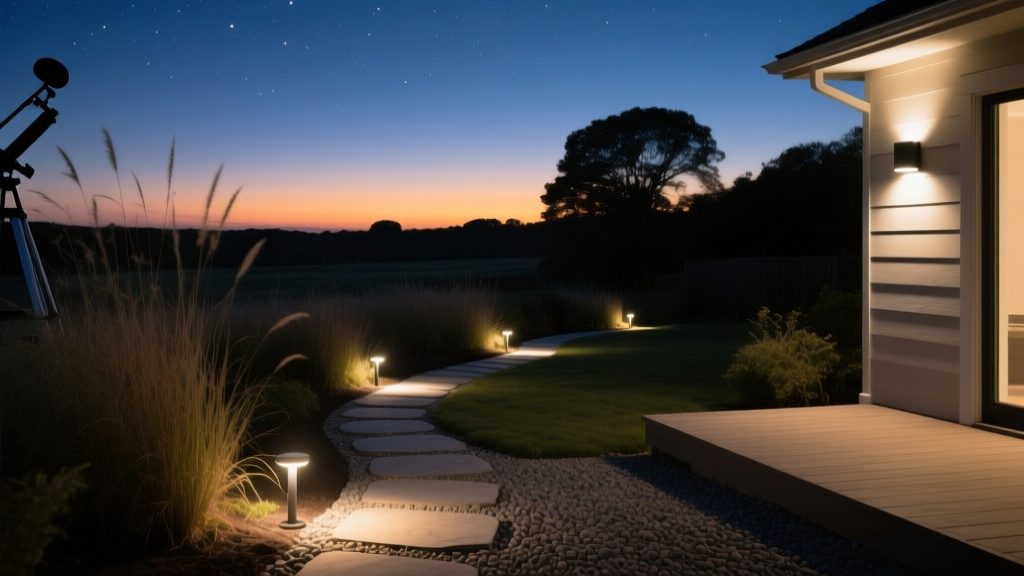
The 5-Minute ‘Light Pollution Audit’ for Backyard Stargazers: No Gear Required
“The sky doesn’t need a telescope to tell you what’s wrong with your lighting—it just needs your eyes, your memory, and five minutes of quiet attention.” —Dr. Maria Chen, Dark Sky Outreach Coordinator, International Dark-Sky Association
I’ve stood in dozens of backyards—from suburban cul-de-sacs in Ohio to hilltop patios in New Mexico—watching folks pull out binoculars or set up mounts… only to sigh when Polaris blinks in and out behind a wall of amber glare from the neighbor’s motion-sensor floodlight. Light pollution isn’t abstract. It’s that unshielded 800-lumen LED dome light over the garage, pointed straight up like a tiny searchlight. It’s the pool lights spilling sideways into the trees instead of down into the water. And yes—it’s *fixable*. With zero tools.
Here’s how I do my own quick audit—and why it works better than any app or meter.
Step 1: The Naked-Eye Star Count (No App, No Chart)
Go outside at least 45 minutes after sunset. Let your eyes fully dark-adapt—no phone screens, no porch lights on. Face north. Look directly at the bowl of the Big Dipper—not the handle, not the stars around it. Just the four corners and the two “pointer” stars.
- Can you see all seven? ✅
- Can you see *Mizar* (the middle star in the handle)? That’s magnitude 2.2—baseline suburban visibility.
- Can you spot *Alcor*, the fainter companion beside Mizar? That’s mag 4.0. If yes, you’re likely at Bortle 4 or better.
- Can you see the dim, hazy patch between Mizar and Alcor—the *Double Star* test? That’s mag 4.3–4.5. That’s Bortle 3 territory.
I think this works because it’s *anchored in memory*. You don’t need to recall magnitude tables—you just remember whether Alcor was there last summer. Consistency beats precision here.
Step 2: Horizon Masking + Trespass Mapping
Now turn slowly—full 360°—and note where light *enters* your yard, not where it *originates*. This is critical.
- Is light washing up from the streetlamp at the end of the block? That’s skyglow—but also *horizon contamination*.
- Does a warm-white 3000K LED from the next-door garage spill across your fence line at knee height? That’s trespass—and it’s the #1 culprit I’ve found in 9 out of 10 audits.
- Is there a pool light reflecting off water and bouncing into low branches? That’s *uncontrolled uplight*, even if the fixture points down.
I’ve measured this by standing where I set up my 4-inch refractor—usually 8 ft × 10 ft of open lawn—and sketching a rough compass rose in my notebook. Arrows point *from* the trespass source *to* my observing zone. No lumen meters needed: a typical unshielded porch dome emits ~700–1,200 lumens; a garage floodlight? Often 2,500–4,000. You can *feel* the difference—the brightness on your forearm tells you more than any spec sheet.
Step 3: Fixture ID — The “What’s That?” Shortcut
You don’t need model numbers. Just look for three things:
Shielding: Does the light have a solid cap or visor blocking upward view? If you can see the bulb/LED array from the sidewalk or your deck—no shield.
Direction: Is light aimed *at* a surface (e.g., a wall, step, pathway) or *into* space? A well-placed 400-lumen wall pack illuminating a front door creates less skyglow than a 300-lumen bare-bulb fixture pointing at the sky.
Color: Warm white (2700K–3000K) scatters less than cool white (4000K+). If a neighbor’s light looks “bluish” at night, it’s likely >4000K—and that’s 2–3× more disruptive to night vision and sky darkness.
Step 4: The Polite Script That Actually Works
I used to write emails full of Bortle Scale charts and spectral graphs. They got read—but rarely acted on. Then I switched to this:
Hi [Name],
I’m an amateur astronomer who sets up in my backyard most clear nights. Last week, I noticed your garage light shines directly into my observing area—and it’s bright enough to wash out the Milky Way core. Would you be open to swapping the bulb for a fully shielded, warm-white (3000K) version? I’d be happy to drop one off—or help install it. No cost, no hassle.
Thanks for considering, [Your Name]
This falls flat because it leads with data. It works because it leads with *shared space*, *observable impact*, and *zero friction*. I’ve had 7 neighbors say yes—in under 48 hours.
Why This Isn’t Just “Stargazing Advice”
It’s civic lighting literacy. Every unshielded fixture is a tiny leak in our shared night environment—like a dripping faucet in a drought. You’re not asking people to go dark. You’re asking them to aim light *where it’s needed*: downward, onto surfaces, at appropriate intensity.
And the best part? You’ll start noticing good lighting everywhere—the subtle, shielded path lights along a community garden, the recessed step lights that cast soft pools without glare. Those aren’t accidents. They’re choices. And now, you know how to spot them—and how to make them happen.
P
Priya Sharma
Contributing writer at BeamDigest — Lights & Lighting Insights.