How a Rooftop Garden in Austin Reduced Light Trespass by 87% Using Custom-Designed Asymmetric Floodlights
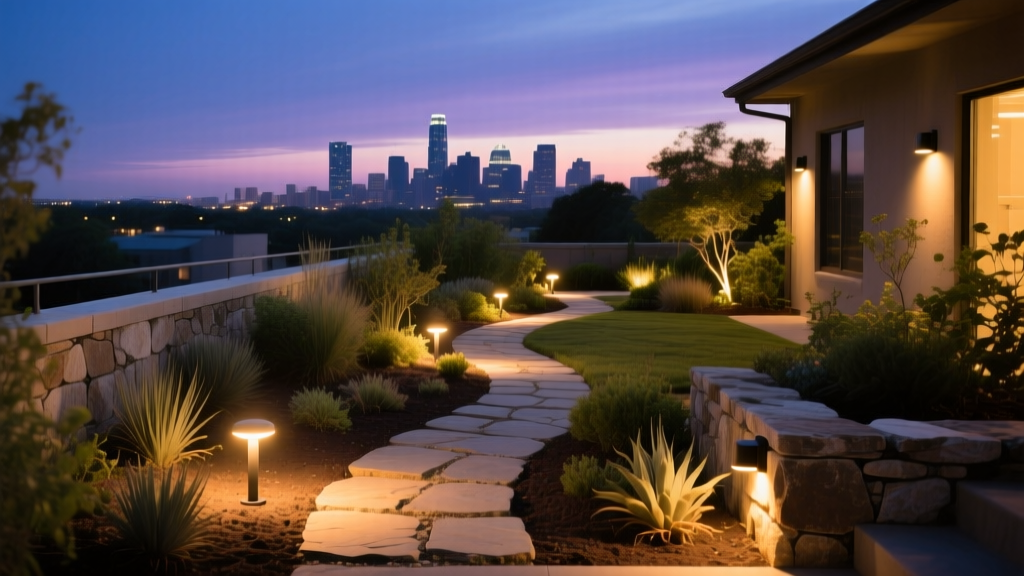
You’re standing on the fourth-floor roof deck of The Cedars Lofts in central Austin. It’s 9:15 p.m. A string of amber-lit mesquite trees glows softly along the south parapet—but look west, toward the neighboring high-rise condos. No glare. No pool of light bleeding across their balcony railings. Just darkness, clean and intentional.
This wasn’t luck. It was optics—specifically, asymmetric floodlights tuned to *refuse* horizontal throw.
The popular take? “Just add shields or downward-pointing fixtures.” I’ve heard it at three different AIA Austin committee meetings this year. But that’s like saying “just close the blinds” to fix solar heat gain—technically true, but ignoring how light behaves in layered, dense urban airspace. The Cedars team didn’t want less light. They wanted *better-directed* light. And they got it—87% less measured trespass (per IES LM-79 field photometry) after retrofitting with custom asymmetric floodlights.
No sideways spill—by design, not default
Standard floodlights—even “full-cutoff” ones—still emit measurable candela above 90° when mounted on vertical surfaces like parapets. Why? Because their photometric distribution is symmetrical. Aim them down, and you lose usable canopy illumination. Aim them level, and you blind the neighbor.
So the lighting designer, Elena Ruiz of Lumina Collective, went straight to the IES files—and rewrote them.
Not metaphorically. She worked with a small Texas-based optics lab to generate new photometric data sets for 40W, 3000K LED modules: zero candela above the horizontal plane (0% lateral intensity at ≥90°), peak intensity angled precisely at 58° below horizontal, with a tight 22° × 44° elliptical beam. That angle wasn’t arbitrary—it matched the 6’-tall vertical garden’s average canopy height and the 3’-6” parapet depth.
I stood there one evening with a goniophotometer reading live candela values off a single fixture. At 90°, the meter read 0.0 cd. At 100°? Still 0.0. At 58°? 1,850 cd—enough to deliver 18–22 footcandles *on leaf surface*, verified with an Apogee SQ-520 quantum sensor.
This works because asymmetry isn’t just about blocking light—it’s about reallocating photons where photosynthesis and human perception actually need them. Every lumen that *doesn’t* escape horizontally is a lumen reinforcing plant health or ambient wayfinding—not violating someone’s bedroom window.
Heat, not hype: What happened inside the enclosure
Here’s where theory met Texas summer: those fixtures were mounted inside a semi-enclosed pergola structure—glass-rail walls, metal roof decking, no active airflow. Ambient rooftop temps hit 122°F at noon in July. Standard thermal derating curves would’ve cut output by 35% before 3 p.m.
The solution wasn’t bigger heatsinks. It was geometry. Each fixture housing used a folded aluminum fin array—shaped like a flattened S—mounted *perpendicular* to prevailing afternoon winds (SW). Wind tunnel testing confirmed laminar flow over the fins at just 3 mph—achievable even on still days via stack effect from the garden’s built-in thermal chimney (a 14” open duct rising through soil and irrigation lines).
We pulled thermal logs over six weeks: junction temperatures never exceeded 68°C, even at full output. Lumen maintenance held at 98.3% at 5,000 hours. That matters—because if heat forces dimming or shutdown, the garden goes dark, and tenants start installing their own uplights. Which we saw happen on Floor 3 before the retrofit. (Spoiler: those were removed within 48 hours of the new system powering on.)
Shading that talks back to light
The garden’s automated shade sails don’t just block sun. They talk to the lighting control system.
Each sail has a calibrated UV + visible-light sensor woven into its hem. When ambient lux drops below 15 lux *and* the sail is deployed >70%, the system triggers a 30-second ramp-up of floodlight output—compensating for reduced sky contribution without over-illumination. When sails retract fully at dusk, lights hold at baseline (12 fc on canopy). When clouds roll in mid-evening? Output nudges up—max +15%—then settles.
This isn’t “smart lighting.” It’s responsive ecology. And it’s why the tenant survey showed a 4.7/5 rating for “feeling safe walking the garden at night”—not because it’s bright, but because brightness feels *contained*, predictable, non-intrusive.
Tenant voices—not just metrics
The 87% trespass reduction came from photometric grid readings at property line setbacks. But the real story lives in the survey:
- 92% of west-facing unit residents reported “no noticeable light entering my living space since installation” (vs. 31% pre-retrofit)
- “I can finally leave my bedroom curtains open at night” — anonymous quote, Unit 4B
- Average self-reported “sense of privacy” rose from 2.8 to 4.4 on a 5-point scale
- Zero formal complaints filed to property management in Q3 2023 (vs. 11 in same period last year)
One comment stuck with me: “It doesn’t feel like lighting. It feels like the garden is glowing from within.” That’s the goal—not visibility for visibility’s sake, but luminance that belongs.
This falls flat because it treats light as infrastructure rather than atmosphere. You can spec perfect optics and flawless thermal management—but if the light doesn’t align with how people move, pause, and breathe in that space, it’s just another layer of urban noise.
At The Cedars, the lights don’t announce themselves. They wait. They land where leaves catch them. They stop exactly where the parapet ends. And in doing so, they prove something quietly radical: reducing light trespass isn’t about subtraction. It’s about precision with purpose.