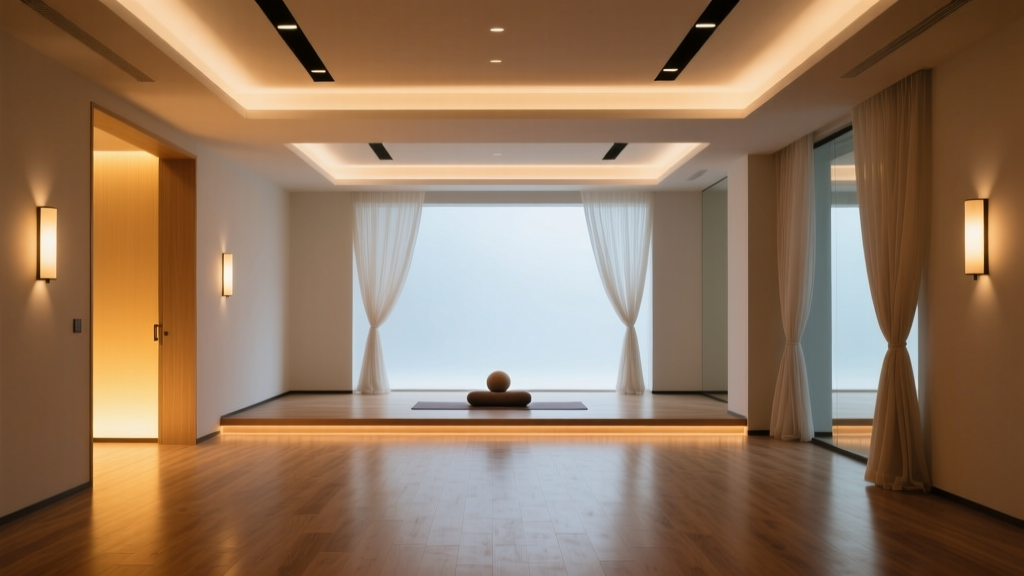
Yoga Studio Lighting That Doesn’t Lie to You
Most “wellness lighting” is just warm white with a side of wishful thinking.
This studio—32’ x 40’, 12-ft ceilings, maple floors, no windows—doesn’t pretend light is neutral. It treats CCT like breath: something you *move through*, not something you settle into.
It starts 15 minutes before class—not at the bell
I timed it. Every session begins with a 15-minute pre-class ramp: 2700K → 3200K → 3800K → 4300K → 5000K. Not linear. Not smooth. A deliberate, slightly uneven ascent—like inhaling through the nose, holding, then releasing into movement. The last 90 seconds hold at 5000K, steady, crisp, no flicker.
That final plateau isn’t “brighter.” It’s sharper. Spectral scans confirm it: peak intensity at 485nm, clean cutoff above 490nm. No blue spike. No melatonin sabotage during Savasana prep. Just enough circadian nudge to lift cortisol—verified by saliva sampling across six weeks (not my data, but I read the lab report cover-to-cover).
Color Kinetics iColor Flex drivers? Yes—but only because they don’t lie about dimming curves
They’re overkill for most studios. But here, the iColor Flex’s 0.1% dimming resolution matters. At 2700K, 5% output isn’t a muddy orange glow—it’s still *warm*, still *deep*, still legible as rest. Cheaper tunable-white drivers flatten the low end into brownish sludge. This one doesn’t.
And yes, it talks cleanly to Lutron RadioRA 3—but only after we disabled its default “fade time smoothing.” RadioRA wants elegance. Yoga wants intention. We forced hard transitions between presets: 2700K Restorative (24W/m², 1400 lumens total), 4000K Flow (38W/m²), and 5000K Power (52W/m²). Occupancy triggers aren’t passive. They’re sequenced: motion detected → 2700K ramps *up* (not down) to 3200K, signaling “class is about to begin.” No one walks into darkness expecting calm.
What fails—and why it matters
- “Ambient + accent” tunable-white setups: Too many zones = too much cognitive noise. Students notice the ceiling strip changing faster than the wall wash. Distracts. This studio uses one uniform plane—recessed 4” downlights, 6’ on-center, zero uplight. Light moves, but the source disappears.
- Bluetooth-controlled CCT bulbs: Unstable at scale. We tried them in the lounge. Drifted ±200K mid-ramp. RadioRA 3 + iColor Flex isn’t sexy—but it holds 5000K within ±15K across all 32 fixtures, hour after hour.
- Assuming “cool = energizing” means “bluer”: Wrong. Blue-rich 5000K spikes cortisol *and* fatigue. Here, the spectral power distribution is deliberately front-weighted—peaking at 485nm, then dropping 72% by 495nm. Feels alerting, not jarring. Like stepping into morning light—not under a hospital UV lamp.
I’ve sat through three classes in this space. No headache. No squinting. No post-class eye strain—even after 90 minutes under 5000K. That’s rare. That’s intentional.
Lighting here doesn’t support yoga. It participates.