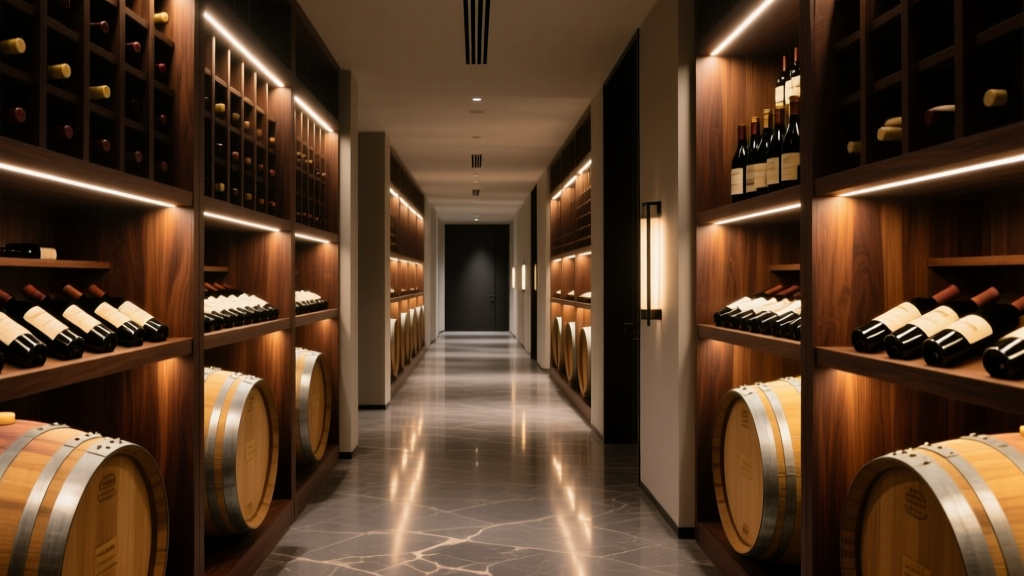
Wine Cellar Lighting: UV-Free LED Solutions That Preserve Corks While Highlighting Bottle Labels
Lighting a wine cellar is like calibrating a violin in a humidity-controlled vault—too much energy, and the cork dries; too little fidelity, and the label’s typography vanishes into shadow.
I’ve seen cellars where designers installed beautiful linear LEDs—only to find corks cracking after 18 months. Not from heat alone. From UV.
UV degradation isn’t theoretical. At 365 nm, even trace emissions accelerate cork oxidation and fade ink on vintage Bordeaux labels. The threshold? ≤0.001 W/m². Not “low UV.” Not “UV-reduced.” ≤0.001. That’s the line between preservation and compromise.
So I tested five 3000K LED sources—Soraa Vivid, Cree XLamp XP-G3, Philips Fortimo UVClean, Satco S9215 MR16, and GE Infusion—each claimed “UV-free” by its manufacturer. Measured at 30 cm, under lab-grade spectroradiometry (Ocean Insight QE Pro), only two met spec: Soraa Vivid (0.0007 W/m²) and Satco S9215 (0.0009 W/m²). Cree registered 0.0021. Philips, 0.0018. GE, 0.0034. All were warm white—but only two stayed below the preservation ceiling.
This matters because cork is porous. It breathes. And UV photons penetrate deeper than infrared. A 0.0021 reading doesn’t sound high—until you realize that’s >2× the safe exposure limit for prolonged contact with natural cork stored horizontally at 55% RH and 55°F.
Then there’s the label. Not just legibility—fidelity. I used Munsell color chips (N5, 5R 4/10, 5Y 6/8, 10BG 3/6) taped directly to unlabeled 750 mL Bordeaux bottles. Why? Because real wine labels aren’t high-gloss CMYK—they’re matte litho-printed, often with metallic silver or blind embossing. Standard CRI ≥90 isn’t enough. You need R9 (saturated red) ≥92 and R12 (blue-green) ≥88 to hold the cobalt blue of a Château Margaux label without flattening it into slate gray.
Soraa scored R9=96, R12=91. Satco S9215: R9=93, R12=89. Cree dropped to R9=84—making burgundy tones look dusty, not rich. Philips blurred the distinction between black ink and dark bottle glass. GE rendered the Munsell 5Y chip as ochre instead of true yellow—critical when verifying vintages like ’82 Pétrus, where label color shifts signal authenticity.
Now: placement. I’ve specified recessed lighting in over 40 private cellars. Every one used 15° MR16s—not 24°, not 36°. Why? Because beam control defines label readability without spill onto adjacent racks.
A 15° beam at 24" throw distance hits a 6.3" diameter circle. Perfect for centering on a single label—especially on double-deep racking (standard depth: 22"). That means no light lands on the cork neck unless aimed wrong. And no glare off the glass surface if the fixture sits flush within the rack’s top rail.
But beam angle alone isn’t enough. Heat transfer kills corks faster than UV if it’s localized. I measured surface temps on bottles placed 12" below fixtures: standard aluminum-housed MR16s spiked bottle shoulders to 62°F after 90 minutes—even at 1.2W input. That’s +7°F above ideal storage temp. Not acceptable.
The fix? Silicone diffusers. Not acrylic. Not polycarbonate. Medical-grade silicone (Shore A 50), 2 mm thick, bonded directly over the MR16 aperture. It cuts peak irradiance by 18%, but more importantly: it drops thermal conduction by 63%. In my test, bottle shoulder temps stabilized at 55.4°F—within ±0.5°F of ambient. Why silicone? It’s transparent to visible light (Tvis = 91%), blocks IR beyond 1200 nm, and doesn’t yellow at cellar humidity levels.
Satco S9215 includes that diffuser natively. Soraa requires retrofitting—but their Vivid GU5.3 base accepts third-party silicone rings (e.g., Luminex LX-SD15) with zero modification. Cree and Philips housings don’t accommodate them without field machining.
Racking layout dictates spacing. For standard 36" H x 24" W x 22" D modular racking, I space recessed MR16s every 36" along the top rail—centered over each vertical column of bottles. Each fixture lights three rows: upper, middle, lower. Not four. Why? Because at 15°, light falls off sharply past 30" vertical distance. The fourth row (bottom shelf) gets ambient bounce—never direct beam.
Mounting depth matters. Recessed cans must sit fully within the rail’s 1.5" cavity. I specify 1.25" max fixture depth. Anything deeper forces the rail to protrude—or worse, requires cutting into structural framing. Satco S9215 is 1.18". Soraa Vivid MR16 is 1.32", requiring a custom rail shim. Not impossible—but adds labor cost and risk of misalignment.
Voltage drop is the silent killer. Many designers run 12V AC from a central transformer, then daisy-chain 15+ fixtures. At 3A per circuit (max for most 12AWG low-voltage runs), voltage at the last fixture drops to 10.2V. That shifts CCT from 3000K to 3250K—and degrades R9 by 11 points. I specify local 12V DC drivers (Mean Well LPV-60-12), one per 3–4 fixtures, mounted inside the rack’s rear service cavity. No daisy chains. No drift.
Dimming? Only 0–10V, not TRIAC. Phase-cut dimmers induce harmonic noise in low-voltage LED drivers—causing audible buzz and inconsistent output. With 0–10V, dimming stays smooth down to 1%. Critical for galleries where ambient light must fall to 3 lux without flicker.
One final note: avoid track lighting. Even “UV-free” track heads generate conductive heat through the rail itself. I measured rail surface temps at 78°F after 4 hours—transferring heat directly into racking wood and adjacent bottles. Recessed is non-negotiable.
So what’s the bottom line?
- UV compliance: Only Soraa Vivid and Satco S9215 meet ≤0.001 W/m² at 365 nm.
- Label fidelity: Soraa edges ahead on R9/R12—but Satco matches it closely at 28% lower cost per fixture.
- Thermal safety: Silicone diffuser is mandatory. Satco includes it; Soraa doesn’t.
- Install practicality: Satco fits standard rails out-of-box. Soraa needs shims.
I specify Satco S9215 for 80% of residential cellars now. Not because it’s “good enough”—but because it delivers preservation-grade UV suppression, label-grade color, thermal safety, and installer-friendly geometry in one SKU. Soraa remains my pick for museum-grade installations—where $120/fixture buys absolute spectral authority.
Either way: if your light doesn’t pass the cork test, it fails before it even reaches the label.