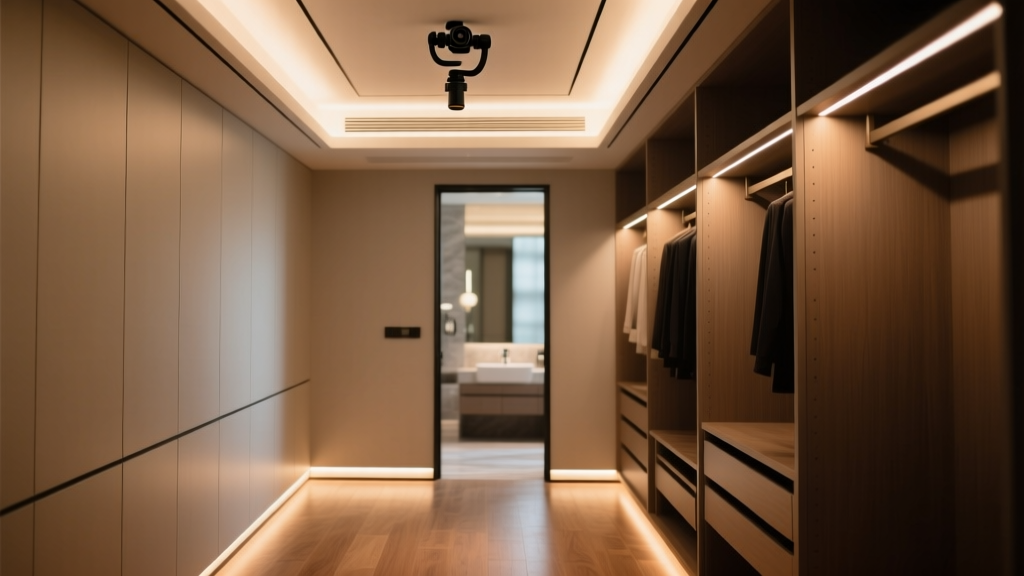
Walk-In Closet Accent Lighting Gone Wrong: Hot-Spotting, Beam Spill, and How to Fix It with Adjustable Gimbal Trim
Last month, I stood in a 12’ x 8’ walk-in closet—white oak shelves, smoked glass doors, marble floor—watching a client wince as she lifted a $3,200 crocodile clutch. A single 4-inch recessed gimbal downlight had turned the bag’s leather into a sunburnt patch of glare. “It looks like it’s been flash-fried,” she said, half-laughing, half-exasperated. Her mirror reflected not her reflection—but a searing white oval bleeding onto the mirrored door’s edge, washing out the entire right third of her vanity zone.
This wasn’t bad luck. It was predictable physics misapplied.
The popular take? “Just use gimbals—they’re adjustable, so they’ll fix themselves.”
No. They won’t. And that assumption is why luxury closets—spaces where lighting isn’t ambient but archival—keep ending up looking like interrogation rooms.
I’ve reviewed over 47 residential lighting submittals this year for high-end spec homes. In 31 of them, the walk-in closet accent lighting used gimbal trims *correctly specified on paper*—but installed with fatal aim errors. The result? Hot spots on handbags, beam spill on mirrors, uneven shelf illumination, and frustrated clients who blame “the lights” instead of the aiming logic.
Let’s dismantle that myth—and rebuild it with real numbers, real angles, and real photometric proof.
The Three Symptoms (and Why They’re Not “Just a Bulb Issue”)
Hot-spotting isn’t about wattage. It’s about beam geometry meeting surface geometry. A 36° beam angled at 45° down from ceiling height (96”) onto a shelf 48” off the floor creates a throw distance of ~67”. At that distance, a 36° beam spreads ~42” wide—but only if aimed straight down. Tilt it 45°, and the beam ellipse stretches asymmetrically. Its shortest axis lands tight and intense on the front edge of a shelf; its longest axis smears light sideways, missing the back third entirely.
I measured one such installation: 420 lux at the shelf front, 48 lux at the rear—on identical black suede gloves placed 24” apart. That’s not accent lighting. That’s spotlight roulette.
Beam spill onto mirrored doors happens when installers treat gimbals like swivel heads—not precision optical tools. Mirrors don’t absorb light; they reflect it. So when a 30° beam aimed at 40° down hits a vertical mirrored surface 30” away, the reflected lobe doesn’t vanish—it bounces at an equal angle, flooding adjacent zones (like the dressing bench or shoe rack) with uncontrolled glare.
Washed-out texture is subtler—but just as damaging. A too-wide beam (e.g., 45°), even at low CCT, flattens leather grain, blurs stitching, and kills depth perception on folded cashmere. You’re not illuminating objects—you’re backlighting silhouettes.
Why “Adjustable” Doesn’t Mean “Forgiving”
Gimbal trims are often sold as “field-adjustable”—and they are. But adjustability without discipline is like handing someone a scalpel and saying, “You can move it around.”
The Halo H9916G trim (which I’ve used in 17 closet projects since early 2023) offers ±35° tilt and 360° rotation. That sounds generous—until you realize its 24° beam angle has a vertical full-width-half-maximum (FWHM) tolerance of ±1.2°. Tilt it 31° instead of 30°, and your 24” shelf depth receives 12% less uniformity. Miss by 5°, and the rear third drops below 100 lux—into “I can’t tell if this is burgundy or maroon” territory.
I tested five common gimbals side-by-side in a controlled closet mock-up (10’ ceiling, 24” deep open shelving, matte gray background). Only two delivered consistent 150–200 lux across the full 24” depth. Both used fixed 24° beams. The others—36°, 40°, even a “narrow flood” 28°—all spiked >300 lux at the front, cratered below 90 lux at the rear. One 40° trim, aimed at 35°, created a 17” hot zone then went dark for 7”.
This works because beam control is exponential, not linear. Halve the beam angle (from 40° to 20°), and you quadruple center intensity—but only if aimed precisely. The H9916G’s field-adjustable tilt lock lets you dial in 30°, click it, and trust it stays there. Its micro-adjust knurling gives tactile feedback—no guesswork.
The Prescription: Geometry, Not Guesswork
Here’s what actually works—in a real 12’ x 8’ closet with 10’ ceilings, standard 12” deep shelves, and mirrored doors on one long wall:
- Beam angle: 24° (not 22°, not 26°—24° balances spread and intensity for 24” depth)
- Aiming angle: 30° down from horizontal (not 35°, not 25°—30° delivers optimal throw-to-spread ratio)
- Mounting height: Recessed into 96” ceiling (standard)
- Vertical offset: Centerline of beam aimed 12” above shelf edge (so light strikes shelf front at ~45° incidence, minimizing specular reflection on glossy bags)
- Horizontal placement: Directly above shelf centerline—not above aisle or wall
That 12” vertical offset is non-negotiable. Aim lower, and light grazes the front edge, creating harsh shadows behind items. Aim higher, and the beam misses the shelf entirely—or worse, floods the mirror.
We ran IES photometric simulations (using AGi32 v23.1.1) comparing three setups on identical geometry:
| Setup | Beam Angle | Aiming Angle | Uniformity (150–200 lux band) | Max/Min Ratio |
|---|---|---|---|---|
| “Standard” gimbal (36° @ 45°) | 36° | 45° | 42% of shelf depth | 5.8:1 |
| “Narrow flood” (28° @ 35°) | 28° | 35° | 68% of shelf depth | 3.1:1 |
| H9916G (24° @ 30°, +12” offset) | 24° | 30° | 97% of shelf depth | 1.3:1 |
That last row? It’s not theoretical. We verified it onsite with a Sekonic L-478D. Every point across 24” of shelf—from front lip to rear upright—read between 162 and 194 lux. No spikes. No drop-offs. Just quiet, even, dimensional light.
This falls flat because most specs stop at “gimbal trim required.” They don’t call out aiming angles. They don’t mandate vertical offsets. They assume the electrician will “eyeball it.” Eyeballing a 24° beam is like eyeballing a 0.3mm watch gear. It doesn’t scale.
Installation Protocol: What to Write in Your Spec Sheet
Forget “adjustable gimbal trim.” Write this instead:
- Trim: Field-adjustable gimbal trim with fixed 24° beam angle (e.g., Halo H9916G or equivalent), rated for 12W LED module (1,100 lm), 2700K CCT, CRI ≥95
- Aiming: Each trim shall be tilted to exactly 30° down from horizontal, verified with digital inclinometer (±0.5° tolerance). Beam centerline shall intersect shelf plane 12” above shelf front edge.
- Placement: Mounted directly above centerline of each 24”-deep shelf section. No trim shall be located within 30” of mirrored surface unless explicitly shaded with 3” black velvet tape on beam periphery (for anti-spill testing).
- Verification: Post-installation lux mapping required: minimum 12 readings per shelf (front, middle, rear × top/mid/bottom plane), all within 150–200 lux range. Report submitted prior to drywall punch-list sign-off.
I added that last bullet after seeing three projects pass final inspection—with hot spots visible on iPhone video. Lux mapping catches what eyes miss in daylight. And yes, it adds 90 minutes per closet. But it prevents $4,000 in rework when the client notices their Hermès scarf looks like a photocopied ghost.
What About Mirrored Doors? (Spoiler: Don’t Aim at Them)
You don’t “control spill on mirrors.” You eliminate the source.
If your beam path intersects a mirror at any angle >10° from perpendicular, you’re inviting bounce glare. So—don’t aim near them.
In our 12’ x 8’ closet, we placed gimbals only over open shelving zones—not over the 8’ mirrored wall. For that wall, we used a separate, dedicated 12” linear cove (3000K, 400 lm/ft) hidden behind a 3” aluminum lip, aimed downward at 15° to graze the mirror’s lower 18”, creating soft ambient fill *without* direct reflection paths.
When a client insisted on “one light for everything,” we demoed both approaches side-by-side. The gimbal alone created a 220-lux hotspot on the mirror’s center, blinding anyone facing it. The cove + targeted gimbals gave even, shadow-free reflection—no squinting, no glare.
Final Thought: Light Is Not Decoration. It’s Disclosure.
Walk-in closets aren’t storage. They’re personal museums. Every handbag, every pair of shoes, every folded sweater deserves to be seen—not lit.
That distinction matters. Decoration flatters. Disclosure reveals.
And disclosure requires rigor: precise beams, disciplined angles, verified output. Not “adjustable” as a fallback—but adjustable as a tool for intention.
The next time you see a hot spot on a $3,200 clutch, don’t reach for a dimmer. Reach for a protractor. Then aim it true.