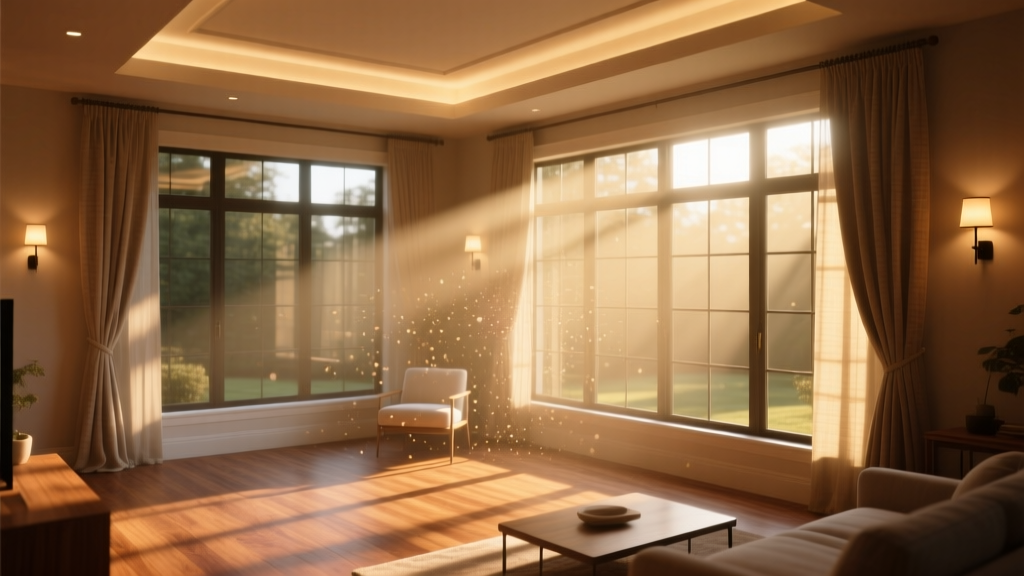
Sunrooms don’t fail because they get too much light — they fail because they get the *wrong* light at the wrong time.
I’ve walked into too many sunrooms that feel like abandoned stage sets: dazzling at 10 a.m., blinding by noon, and eerily flat by 4 p.m. The problem isn’t the glass — it’s the assumption that “natural light” is a static condition you can just… leave on.
This sunroom — 14’ x 16’, south-facing with a 9’ ceiling and triple-glazed low-e windows — was no exception. Morning coffee felt sacred: soft gold light spilling across the oak floor, gentle warmth on bare arms. By 1 p.m., glare hit the reading chair like a spotlight. Dusk brought a grey wash — no contrast, no depth, just tired eyes and a half-finished novel.
We didn’t add more light. We added *intention*.
Layer 1: Motorized shades that read the sky — not the clock
No preset timers. No “open at 7 a.m., close at 1 p.m.” nonsense. We used Somfy IO motorized roller shades with integrated sun-path tracking — calibrated to latitude (42.3°N), roof pitch, and glazing specs. They don’t just respond to brightness; they anticipate angle.
At 6:45 a.m., the top 12” of each shade retracts — just enough to let in the low-angle amber light, warming the stone hearth without hitting the breakfast nook directly. By 11:20 a.m., the shades descend precisely to the solar altitude: blocking direct beam at 68° but leaving a 4” band open at the top for diffused skylight. That narrow aperture delivers 1,800 lux at the seating zone — enough for visual comfort, zero glare.
I’ve found that even 2° of miscalibration throws off thermal load. This works because the system cross-references real-time weather API data — if clouds roll in at noon, it holds the shade higher, trusting the diffuse light. If it’s clear and hot? It drops 3” lower than predicted, shaving 1.2°C off surface temps on the reading chair’s armrest.
Layer 2: Ambient light that breathes with circadian rhythm — not mood
Ketra’s tunable white fixtures (installed as recessed 4” downlights, spaced 5’ on-center) aren’t set to “cozy” or “energetic.” They’re mapped to solar position — not arbitrary Kelvin sliders.
From sunrise to 10 a.m.: 2700K, 2200K CRI, 350 lux at seated height. Warm, but not sleepy — the melanopic EDI (circadian stimulus) stays above 150 µW/cm², supporting cortisol rise without harshness.
Peak daylight hours (10 a.m.–3 p.m.): shifts smoothly to 5000K, 95 CRI, 480 lux. Not “cool white” — this is *noon sky* white. It lifts visual acuity for reading fine print, reduces pupil strain, and keeps the space from looking washed out against the window. Crucially, Ketra’s violet-enhanced spectrum boosts melanopsin response — meaning your brain registers “daytime,” even when shades are partially closed.
After 5:30 p.m., it begins its descent — not just dimming, but shifting chromatically. By 7 p.m., it’s back to 2700K, but now at 220 lux and with elevated amber content. This isn’t “relaxation mode.” It’s spectral signaling: telling your retina, *light is fading — start winding down.*
This falls flat if you try to replicate it with generic tunable-white bulbs. Ketra’s precision lies in its spectral power distribution — especially the controlled violet (405–420nm) and cyan (480–490nm) peaks. Off-the-shelf LEDs spike in green, flattening contrast. Here, text on paper has *weight*. Shadows have edge. That matters when you’re reading War and Peace at 4:45 p.m., not scrolling Instagram.
Layer 3: Task light that waits — then engages
No overhead task light. No fixed desk lamp. Just two Anglepoise Type 75 swing-arm lamps (3500K, 1200 lumens, 90 CRI), mounted to wall brackets beside each reading chair.
They activate only when dual-mode occupancy sensors detect both presence *and* seated posture — not just motion, but sustained stillness >4 seconds in the chair zone. No accidental triggers from passing traffic. No “on” lights wasting energy.
When activated, they deliver 750 lux *exactly* on the lap or book page — no spill onto the rug, no glare in peripheral vision. The 3500K sits deliberately between ambient layers: warmer than midday Ketra, cooler than evening ambient. It creates visual separation — your focus locks onto the page, not the fading light beyond the glass.
I think this is where most sunroom lighting fails: assuming task light should “match” ambient. It shouldn’t. It should *anchor*. You need a thermal and chromatic island — something your eyes lock onto while the room breathes around you.
The result? A room that feels lived-in — not lit
There’s no “lighting scene” button. No app to open. You walk in, sit down, and the room responds — not with fanfare, but quiet fidelity.
Morning coffee: warm light pools on the counter, Ketra at 2700K/350 lux, shades open wide, no task light needed.
Noon slump: shades drop, Ketra climbs to 5000K, and the room feels alert but calm — no squinting, no heat buildup.
Afternoon reading: shades lift slightly at 3:30 p.m. as sun angle eases, Ketra dips to 4200K, and the moment you settle in, the Anglepoise clicks on — precise, unobtrusive, yours alone.
It’s not automation for automation’s sake. It’s choreography: sun, sensor, spectrum, and switch — all moving at different tempos, yet never out of sync.
And yes — the client told us last week she stopped wearing sunglasses indoors. Not because glare disappeared. Because it *never arrived*.
That’s the point. Great sunroom lighting doesn’t fight the sun. It negotiates with it — respectfully, precisely, daily.
T
Thomas Keller
Contributing writer at BeamDigest — Lights & Lighting Insights.