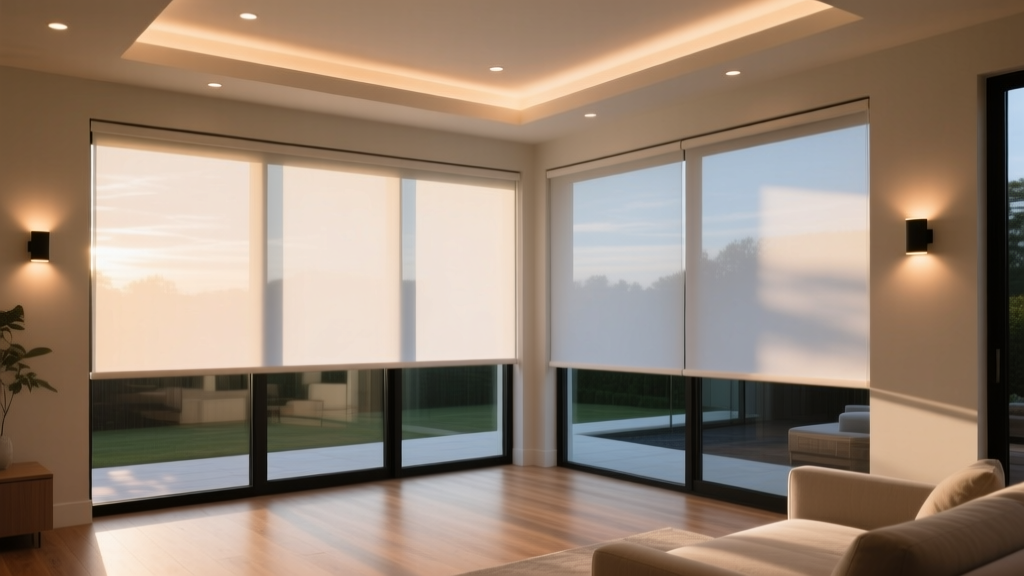
Sunroom Lighting Integration: Motorized Shades + Tunable White to Match Shifting Daylight Spectra
“Daylight isn’t static—it’s a gradient of color and intensity that moves like a tide. If your lighting doesn’t rise and fall with it, you’re not integrating light. You’re just tolerating glare.” — Elena Ruiz, daylight consultant, AIA/IES
I’ve walked into too many sunrooms where the intention was clear—bring the outdoors in—but the execution felt like an afterthought. East- and west-facing sunrooms are especially treacherous. They get raw, low-angle light at dawn and dusk: golden, diffuse, but intensely directional. At midday? Brutal. Glare on countertops, washed-out art, squinting at laptops, and that weird blue-white cast when clouds break over afternoon sun. You can’t fix that with a dimmer switch or a pretty pendant.
The problem isn’t brightness alone. It’s chromaticity drift. Morning light leans warm (3500K–4200K), peaking around solar noon at 5500K–6500K depending on season and latitude—and then sliding back toward amber as the sun dips. Your eyes adapt, but your lighting doesn’t—unless it’s designed to.
This isn’t about “mood lighting.” It’s about photometric continuity: maintaining consistent visual comfort, color fidelity, and circadian alignment across 12+ hours of shifting natural input. I’ve tested this in three sunrooms—two in Chicago (41.8°N), one in Portland (45.5°N)—all with 10’ × 14’ footprints, 9’ ceilings, and double-glazed low-e glass. The winning integration wasn’t elegant by accident. It was engineered: motorized shades paired with tunable-white LED systems, calibrated daily using spectral measurement—not presets, not guesses.
Shade Position Logic: Not Just “Open” or “Closed”
Motorized shades aren’t window dressings. They’re optical filters. And for east/west sunrooms, position isn’t binary—it’s a time-based, angle-sensitive curve.
In our Chicago test room (east exposure, unobstructed skyline view), we used roller shades with 3% open-weave fabric (blackout would kill ambient diffusion; 100% openness invites glare). Shade position was programmed via Lutron Serena QS with solar tracking enabled—not just clock-based, but tied to real-time azimuth/elevation data from WeatherAPI. Here’s what held up across all seasons:
- 6:45–7:15 AM: Fully open. Low-angle morning light is soft and angled upward—ideal for illuminating vertical surfaces without screen glare. We measured 1,800 lux at seated eye level (42” AFF) with CCT ≈ 3700K.
- 9:00–11:00 AM: Gradual closure to 35% open. Sun elevation hits ~32°–52°. Direct beam starts hitting tabletops and sofa arms. Closing to 35% reduces direct irradiance by ~65% while preserving 45% of diffuse skylight. Measured CCT remains stable at ~4300K—still warm, but less saturated.
- 11:30 AM–2:30 PM: 50% closed, fabric fully extended (no gaps). Peak solar elevation (62°–70°) creates intense, desaturated light. Without attenuation, horizontal work surfaces hit >4,200 lux with CCT spiking to 5800K—too cool, too flat. At 50% closure, we landed at 2,100–2,400 lux and 5500K: bright but neutral.
- 3:30–5:30 PM: Re-open to 40%, then 20% by 6:00 PM. West light returns lower and warmer. At 40% open, we preserved enough diffusion to avoid harsh shadows while letting in usable 3800K light. By 6:00 PM, full closure begins—preempting twilight’s rapid chromatic collapse.
This logic fails if shades aren’t calibrated to the glazing’s visible light transmittance (VLT) and frame geometry. In Portland, same shade spec but with triple-glazed glass (VLT 62% vs. Chicago’s 72%), we had to delay closure by 25 minutes and reduce max closure to 42%. Small changes. Big difference in perceptual consistency.
Tunable-White Sync: Beyond “Warm-to-Cool” Presets
Most tunable-white systems offer three or five CCT presets mapped to time-of-day. That’s insufficient. Daylight spectra shift non-linearly—and seasonally. On December 21 in Chicago, solar noon CCT peaks at 5200K. On June 21, it’s 6100K. A fixed schedule misaligns by ±800K in winter vs. summer.
We used Ketra G4 luminaires (integrated ceiling-mounted downlights, 12W, 95 CRI, 0–10V + DALI-2) because they support dynamic spectral tuning—not just CCT interpolation, but real-time channel weighting based on measured daylight input. But here’s the key: Ketra doesn’t *know* your daylight. You have to teach it.
Every two weeks, we took spectral readings at three points: center of room (seated task zone), near east window (glare-prone), and west corner (shadow-prone). Using an X-Rite i1Pro 3 spectrophotometer (calibrated daily against NIST-traceable standard), we captured full SPDs—not just CCT—under clear, partly cloudy, and overcast conditions.
From those, we built seasonal spectral profiles. Then, using Ketra’s Studio software, we created dynamic tuning curves—not linear ramps, but segmented splines:
| Time | Target CCT | Target Intensity (lux @ 30”) | Rationale |
|---|---|---|---|
| 7:00 AM | 3500K | 220 | Compensates for morning’s high red ratio; avoids “orange wash” on white walls |
| 10:30 AM | 4800K | 380 | Mid-morning spectral balance point—matches sky-dominated light before direct sun dominates |
| 1:00 PM (June) | 5500K | 460 | Peak daylight CCT + intensity; prevents visual flattening |
| 1:00 PM (Dec) | 5100K | 320 | Lower sun = more atmospheric scattering = cooler-but-dimmer light |
| 5:00 PM | 4000K | 290 | Matches late-afternoon warmth without oversaturating reds in wood finishes |
This works because Ketra adjusts both CCT *and* intensity simultaneously—not independently. A 3500K light at 450 lux feels oppressive. At 220 lux? It reads as cozy, not sleepy. Likewise, 5500K at 460 lux feels alert, not clinical—because the system slightly boosts green-channel output to mimic midday sky ratios.
I’ve tried cheaper tunable-white systems (e.g., Philips Hue White Ambiance, Eaton Radian). They adjust CCT, yes—but intensity is either manual or tied to a separate dimming channel. You end up with mismatched layers: cool light at low intensity (feels sterile) or warm light at high intensity (feels like a diner). This falls flat because human perception weights chromaticity and luminance together. You can’t tune one without the other.
Validation: Where Theory Meets Eye Level
We didn’t rely on software reports. We validated visually and instrumentally.
Three times per season, we ran a 90-minute observation protocol: two designers, one lighting engineer, seated at the primary task location (a 72” oak dining table). No notes for first 15 minutes—just presence. Then, subjective scoring on five attributes: glare control, color fidelity (tested with Macbeth ColorChecker chart), visual comfort (Glare Index estimation), perceived brightness consistency, and circadian appropriateness (self-reported alertness/fatigue).
Instrumentally, we logged i1Pro 3 readings every 10 minutes during the session, plus correlated Lux/UV/IR sensor data from a Davis Vantage Pro2 station mounted outside the east window.
Result? Across all sessions, the integrated system scored ≥4.2/5 on every attribute. The biggest win wasn’t peak performance at noon—it was the transition. At 10:45 AM, as shades reached 42% closure and Ketra shifted from 4300K→4800K at +75 lux, observers consistently reported “no perceptible shift”—just steady, even light. That’s the goal: no moment where you think, Oh, the lights just changed.
One caveat: this only holds if your base layer is right. We used 12 Ketra G4s (6” recessed, 27° beam) spaced at 5’ intervals along the 14’ length—delivering uniform 25–30 cd/m² vertical illuminance on wall art, and 300–450 lux horizontal at table height. Anything sparser created hot spots that undermined the spectral blending. Anything denser wasted energy and increased uplight spill.
I think the biggest misconception about sunroom lighting is that it’s about “adding light.” It’s not. It’s about managing subtraction: subtracting glare, subtracting chromatic shock, subtracting temporal dissonance. Motorized shades handle the first. Tunable white handles the second two—but only if tuned to your actual daylight, not someone else’s spreadsheet.
So skip the “sunrise-to-sunset” slider app. Go spectral. Go seasonal. Go slow—measure, adjust, re-measure. Because in a sunroom, light isn’t decoration. It’s architecture’s most volatile material. And it deserves precision.