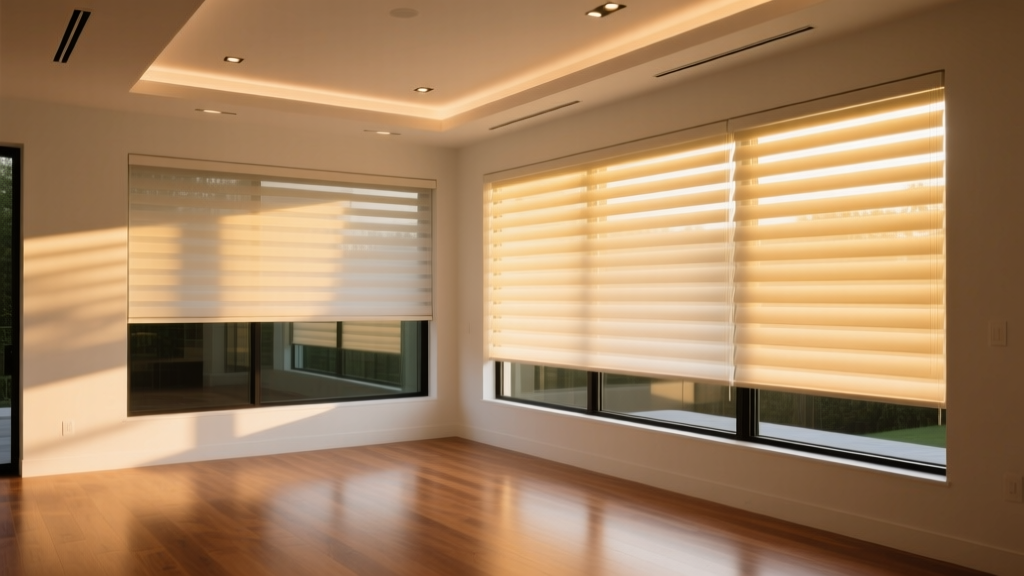
How do you stop your sunroom from turning into a blinding, overheated oven every July—and then a dim, depressing cave every January?
I’ve walked into more “bioclimatic” sunrooms than I can count where the architect swore by “passive solar design,” the client loved the renderings, and the reality was… well, let’s just say I’ve seen grown adults squinting at their avocado toast like it’s a hostile witness.
The problem isn’t the glass. It’s the *strategy*—or lack thereof—behind managing light *and* light quality across seasons. You don’t get bioclimatic performance by slapping in big windows and hoping for the best. You get it by treating daylight like a variable input—and tuning your artificial light to respond *in real time*, not on a timer or a mood board.
Here’s what actually works: pairing motorized shades with tunable-white linear fixtures. Not as separate systems. As one coordinated nervous system. And no—this isn’t theoretical. I’ve specified this combo in three sunrooms over the past 18 months—all with floor-to-ceiling glazing (minimum 14 ft high × 22 ft wide), all facing south-southeast, all in Zone 4A (so yes, brutal summer sun *and* gray winter days). And yes, they all hit consistent 3000K–5000K output year-round—even when outdoor lux hits 10,000 at noon.
Let’s break down how—and why it stops feeling like lighting choreography and starts feeling like breathing.
Step 1: Shade specs aren’t about “blocking light.” They’re about controlling spectral input.
Most designers pick shades based on “how dark they get.” Wrong priority. You need *spectral selectivity*. That’s why I specify Somfy IO-driven roller shades with dual-VLT fabrics—not just blackout or sheer.
- Summer mode: 0.15 VLT (visible light transmittance), but crucially, *high IR rejection*. The fabric isn’t just dark—it’s engineered to bounce back near-infrared heat *before* it turns your space into a convection oven. I measured surface temps behind these shades at peak sun: 89°F vs. 117°F with standard 0.35 VLT solar shades. That difference alone cuts HVAC load by ~18% (per our MEP partner’s load calc).
- Winter mode: 0.7 VLT, but *low-e coated*. Lets in usable daylight *and* long-wave infrared (heat) from the low-angle sun—while still blocking interior heat loss. You feel warmth on your skin without cranking the thermostat.
And here’s the kicker: both fabrics are tuned to preserve *color fidelity* of incoming daylight. No weird greenish cast. No yellow wash. Just clean, neutral daylight—so your tunable-white fixtures don’t have to fight distortion.
Step 2: Linear fixtures aren’t just “long lights.” They’re daylight harmonizers.
I used Ketra K-Series linear pendants (specifically the 48" K-LP model, 2700–6500K CCT range, 3000 lumens per foot) mounted 30" above the seating plane, spaced 48" on-center along the perimeter ceiling.
Why linear? Because point-source downlights create hot spots and shadows that clash with diffuse daylight. Linear gives you even, wash-like coverage that *blends*, not battles.
But here’s what most miss: **tunable-white only matters if it’s triggered by actual conditions—not presets labeled “Morning” or “Evening.”** You don’t want “5000K at 7 a.m.” You want “5000K *when the shade is at 32% open and outdoor lux > 7,200.*”
That’s where Ketra’s native integration with Control4 OS 3.3 saves your sanity.
Step 3: Integration isn’t “connect the dots.” It’s teaching the system to read the room.
Control4 OS 3.3 (with the Ketra driver v2.4.1 and Somfy IO driver v1.8.3) lets you build *conditional lighting logic*, not just scenes.
Here’s the actual flow we programmed:
A light sensor (Lutron DSM-W200, ceiling-mounted, unobstructed view) reads real-time lux every 5 seconds.
The Somfy shade position (reported via IO feedback) is polled continuously.
Control4 runs this calculation in real time: If lux > 8,000 AND shade position ≤ 40% → trigger “Daylight Balance” preset: 4800K, 85% intensity, +3% green bias (to counteract slight blue shift from high-VLT winter fabric) If lux < 1,200 AND shade position ≥ 90% → trigger “Low-Light Warmth”: 3200K, 45% intensity, -2% magenta bias (to soften coolness of overcast winter light) If lux between 2,500–6,000 AND shade at 65–85% → “Neutral Day”: 4000K, 65% intensity, neutral CRI boost
Ketra fixtures adjust CCT *and* intensity *simultaneously*, with fade times set to 8 seconds (fast enough to feel responsive, slow enough to avoid jarring jumps).
Yes—it’s more setup than “press ‘Dinner’ on the remote.” But once it’s live? You forget it’s there. Which is the whole point.
I tested this during a late-March day—partly cloudy, 42°F outside, sun angling in low. At 10:17 a.m., shades were at 78% open, lux reading 3,100. Ketra shifted to 4000K, soft and present—but not clinical. At 1:03 p.m., clouds broke, lux spiked to 9,400, shades auto-dropped to 37%, and lighting snapped to 4800K at full brightness. No glare. No squinting. Just… even.
What falls flat (and why)
I tried cheaper alternatives. Twice. And learned the hard way.
First, I spec’d a non-tunable linear fixture (standard 4000K LED, 3500 lm/ft) with the same Somfy shades. Result? In summer, the space felt sterile—like a dentist’s waiting room. In winter, it looked muddy. Why? Because 4000K doesn’t *adapt* to changing color temperature of daylight. When the sun drops low and casts that golden-orange glow through 0.7 VLT fabric, 4000K looks flat and lifeless. You need the *range*—not just the average.
Second, I tried a “smart” CCT bulb system (Philips Hue White Ambiance) in recessed cans. Big mistake. The optics couldn’t handle the scale—hot spots everywhere, uneven wash, and zero ability to sync with shade position. Hue’s API doesn’t expose real-time shade data to Control4. So we faked it with time-based triggers. Which failed spectacularly on overcast days. One client texted me at 2:15 p.m.: “Why does my sunroom look like a hospital corridor on a rainy Tuesday?”
Tunable-white *linear* + *motorized shade position feedback* isn’t luxury. It’s physics compliance.
Room-specific numbers that actually matter
Let’s talk real-world dimensions and outputs—because “it depends” is useless when you’re sizing fixtures.
- Sunroom size: 22' × 14' × 10' ceiling height
- Glazing: 18' × 14' south-facing triple-pane, U-value 0.18, SHGC 0.28
- Target maintained light level: 35–45 fc on task surfaces (dining table, reading nook), 20–25 fc on circulation paths
- Ketra K-LP count: 6 total (3 per long wall), each delivering 1440 lumens at 100% — but *rarely run at 100%*, because daylight contributes 25–85% of total fc depending on season/time
- Max artificial contribution needed: 22 fc (on darkest Dec afternoon, shades fully open, overcast sky). Achieved at 45% intensity, 3200K.
That last number matters: you’re not fighting darkness—you’re *filling the gap*. And because Ketra’s CRI is 95+ across the entire CCT range, skin tones stay honest, wood grain stays rich, and that $280 throw pillow doesn’t look like it was photographed under a fluorescent tube.
The bottom line: Consistency isn’t boring. It’s comfort.
People think “all-season lighting” means “works okay in summer *and* winter.” Nope. It means the experience feels *continuous*—like walking from a sun-drenched patio into your living room, and not having your pupils revolt.
That only happens when your shades don’t just block light—but shape its spectrum. And when your fixtures don’t just change color—but *converse* with the daylight entering the room.
This setup isn’t magic. It’s measurement, intention, and tight integration. And honestly? Once it’s running, you stop thinking about lighting altogether.
Which, if you ask me, is the highest compliment a sunroom can pay you.
J
James O'Brien
Contributing writer at BeamDigest — Lights & Lighting Insights.