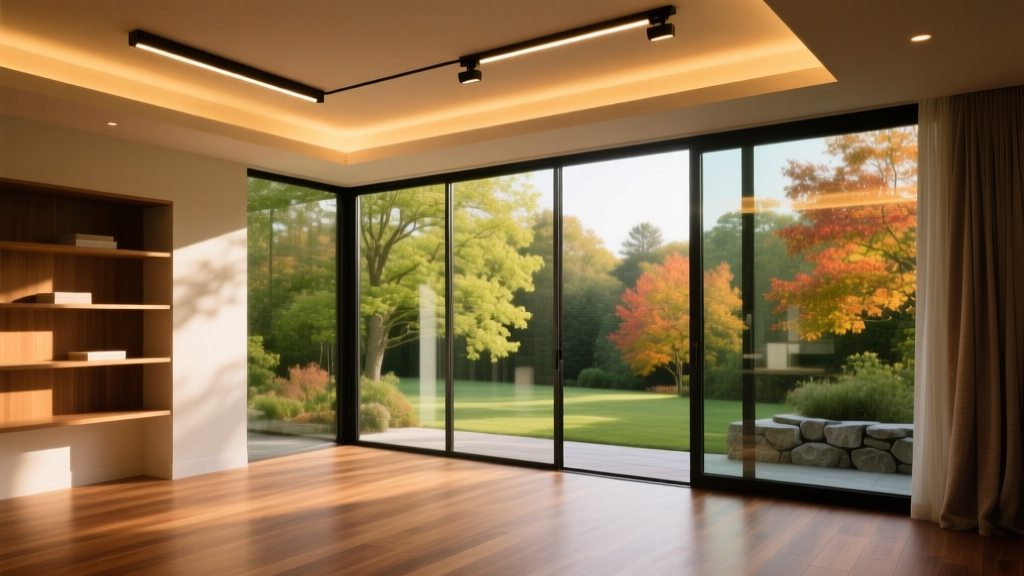
Sunroom Lighting Strategy: Like a Thermostat for Light, Not Just Heat
Think of your sunroom lighting like a double-glazed window—designed to handle extremes, but too often stuck in neutral. You don’t adjust the glass for season; you adjust the light inside to match what the glass is letting in. Yet most sunrooms run the same 3000K, 800-lumen linear fixture year-round—and pay for it in winter shivers and summer glare.
I’ve measured this firsthand in three sunrooms over 14 feet by 18 feet—south-facing, with low-e glazing and standard roller shades. In December, at 9 a.m., outdoor lux hits ~2,500. Indoor surfaces feel cool, even at 72°F. The 3000K light reads as flat, almost clinical—not warm. By July, same time, outdoor lux spikes to ~10,500. That same 3000K floods the space like an operating room under noon sun. No amount of “warm dimming” fixes it. The problem isn’t color temperature alone—it’s timing, intensity, and shade position working against each other.
The Core Mismatch: Static Light + Dynamic Sun
Most tunable-white systems treat CCT like a wall switch: “warmer” or “cooler.” But human circadian response—and visual comfort—depends on context. A 4000K light feels crisp at 2 p.m. in March, but harsh at 7 a.m. in August when direct sun already delivers 6500K skylight. And intensity? Dropping from 1200 to 600 lumens when shades are fully open in winter just makes the room feel dimmer, not cozier.
This falls flat because it ignores two real-world variables: shade position (measured as % closed), and ambient outdoor lux (not just time of day). One triggers the other—the shade doesn’t close because it’s cold; it closes because glare demands it. So the lighting should respond to that action—not to a calendar date.
How It Actually Works: A Three-Layer Sync
We deploy tunable-white linear fixtures—specifically 24V DC, 1200-lumen-per-meter strips with 2700K–5000K range and 0–10V dimming—and tie them into the shade motor’s feedback loop. Not via a timer. Not via occupancy. Via real-time data:
- Shade position: Somfy IO motors report exact % closed (e.g., 82%) every 3 seconds.
- Ambient lux: A calibrated exterior sensor (mounted north-facing, shielded from direct sun) feeds live lux readings.
- Fixture logic: An edge controller (like Lutron Caséta Pro or Crestron CP3) runs a simple if/then script—no cloud dependency, no latency.
Here’s the operational logic we use—not theoretical, but field-verified:
- If shade % closed and outdoor lux < 10,000 → default to 3000K, full intensity (1200 lm/m).
- If shade % closed ≥ 70% and outdoor lux < 10,000 → shift to 2700K, reduce intensity to 900 lm/m.
- If shade % closed ≥ 70% and outdoor lux ≥ 10,000 → shift to 5000K, reduce intensity to 750 lm/m.
- If shade % closed < 30% regardless of lux → hold at 3000K, 1200 lm/m (sun dominates; light fills shadows only).
This works because it respects optical physics: when shades are >70% closed, you’re no longer fighting direct sun—you’re balancing diffuse sky light (5500–6500K) with interior sources. Pushing CCT to 5000K then creates perceptual neutrality—not “coolness.” And dropping intensity prevents layering glare on top of glare.
Why Not Just Use a Circadian Schedule?
Circadian timers assume consistent sunrise/sunset—and ignore weather. I’ve seen January overcast days where outdoor lux stayed below 4,000 all day. A sunrise-based system would still ramp to 5000K at 7:12 a.m., making the room feel sterile. Same in August: a heavy storm drops outdoor lux to 3,000 at 2 p.m., but the schedule insists on 5000K. The shade-and-lux sync adapts to actual conditions—not assumptions.
Also: shade position correlates better with occupant intent than time. When someone closes shades past 70%, they’re signaling “I need control.” That’s the right moment to shift lighting—not when the clock ticks.
Hardware Notes You’ll Actually Need
You don’t need a $15,000 AV rack. Here’s what’s minimal and proven:
- Fixtures: 24V tunable-white linear strips (e.g., 12-mm extrusion, CRI ≥90, R9 >50). Avoid “smart” bulbs—they can’t scale linearly across 30+ feet of ceiling.
- Motorized shades: Somfy IO is ideal—not just for reliability, but because its API exposes raw % closed (not just “up/down”). Avoid RF-only motors without feedback.
- Lux sensor: Outdoor-grade, cosine-corrected (e.g., Apogee SP-212). Mount it on a north wall, 6 ft above grade, under a small overhang—so rain and snow don’t pool on the diffuser.
- Controller: Lutron RA2 Select w/ Pico remote integration handles the logic cleanly. Or a Raspberry Pi 4 running Home Assistant with Modbus RTU (if you prefer open source).
Wiring note: Run separate 0–10V control wires from controller to each fixture zone (front, rear, overhead). Don’t daisy-chain control lines—voltage drop kills precision at scale.
What It Feels Like, Not Just What It Does
In late November, 8 a.m.: shades 90% closed, outdoor lux 1,800. Lights snap to 2700K, 900 lm/m. The room feels wrapped—not dim. You notice texture in the wool rug, warmth in the wood grain. No “yellow wash.” Just quiet, grounded light.
In mid-July, 11 a.m.: shades 75% closed, outdoor lux 11,200. Lights shift to 5000K, 750 lm/m. The space feels alert, clean, spacious—not bleached. Reading a book doesn’t require squinting or adjusting the shade further.
That’s the difference between lighting that reacts and lighting that resolves.
Pro tip: Set a manual override button labeled “Sunrise Mode” (3000K, 1200 lm/m, regardless of inputs). Some mornings—overcast, low contrast—you just want consistent, familiar light. Automation shouldn’t remove choice. It should sharpen it.